
The Russell-Sartre Tribunal
Dec 20, 2024
story
Seeking
Collaboration


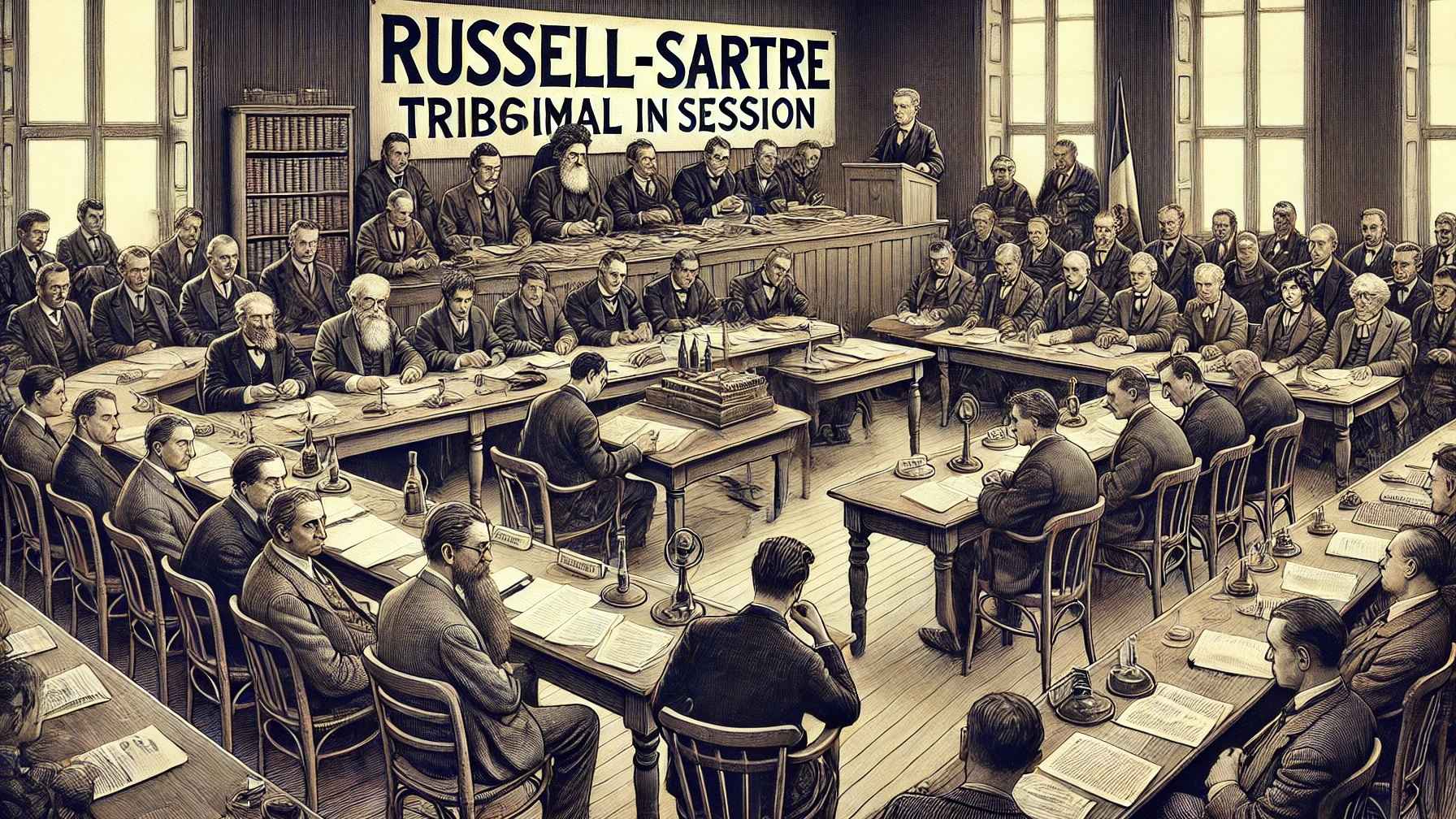
The Russell-Sartre Tribunal: A Tool for Examining Fundamentally Unjust Laws
The Russell-Sartre Tribunal, also known as the International War Crimes Tribunal, was created in 1966 by philosopher Bertrand Russell and writer Jean-Paul Sartre. Initially conceived to investigate American war crimes in Vietnam, the tribunal expanded its scope to become a moral and ethical forum capable of judging acts and structures deemed unjust by official judicial institutions.
Today, its model serves as inspiration for examining not only war crimes but also systemic laws that perpetuate structural oppression, such as those linked to patriarchy or other discriminatory systems.
1. The Russell-Sartre Tribunal: A Moral Justice Beyond States
A. Origins and Objectives
- Founded in Stockholm in 1966, the Russell-Sartre Tribunal was a citizen-led initiative aimed at exposing violations of international law and human rights.
- It had no legally binding power but operated as a "tribunal of conscience." Its primary goal was to bring hidden or ignored facts to public attention, mobilizing public opinion.
B. Functioning
- The tribunal relies on testimonies from victims, experts, and documented evidence to support its findings.
- Judgments are based on universal ethical principles, transcending national interests.
- While its judgments are not legally binding, their strength lies in the moral pressure they exert on governments and institutions.
C. Modern Applications
- The Russell Tribunal model has inspired similar initiatives, such as:
- The Russell Tribunal on Palestine, which evaluates human rights violations in this context.
- The Monsanto Tribunal, which examines the ethical and environmental impacts of this multinational corporation’s practices.
2. The Tribunal as a Tool for Evaluating Unjust Laws
The Russell-Sartre Tribunal could be applied to evaluate laws that perpetuate systemic injustices. Here’s how its functioning could be adapted:
A. Analysis of Laws
- Evaluation Criteria:
- Universality of Rights: Does the law respect the fundamental rights of individuals?
- Equity and Justice: Does the law promote genuine equality or maintain structural discrimination?
- Social Impact: What are the effects of the law on marginalized or vulnerable groups?
- Examples of Unjust Laws:
- French Civil Code (1804): Article 213, which subordinated women to their husbands, is a historical example of patriarchal legislation.
- Colonial Property Laws: Laws enabling the dispossession of indigenous lands in colonies are a blatant case of institutionalized injustice.
B. Tribunal Procedures
- Collection of Testimonies:
- Victims and experts testify about the effects of unjust laws.
- Historical and contemporary documents are presented as evidence.
- Deliberations:
- Judges, often ethical figures or legal experts, evaluate the facts based on universal ethical principles.
- Moral Judgment:
- The tribunal issues a verdict denouncing the laws in question and proposing recommendations for their reform or abolition.
3. Case Studies: Application to Specific Laws
A. Patriarchal Laws
- Laws on Wifely Obedience:
- Likely Judgment: "A direct violation of principles of equality and human dignity."
- Recommendation: Total repeal and acknowledgment of historical consequences.
- Reproductive Rights Laws:
- Likely Judgment: "A denial of women’s fundamental rights to bodily autonomy."
- Recommendation: Adoption of laws guaranteeing safe access to abortion.
B. Property and Dispossession Laws
- Code de l’Indigénat:
- Problem: Institutionalized land dispossession and systemic discrimination against colonized peoples.
- Likely Judgment: "A law contrary to principles of universality and social justice."
- Recommendation: Recognition of wrongs and restitution of stolen lands.
- International Laws Favoring Multinational Corporations:
- Example: ISDS (Investor-State Dispute Settlement), allowing corporations to sue states.
- Likely Judgment: "These laws reinforce inequality between citizens and large corporations."
- Recommendation: Revision of treaties to protect citizens’ rights.
4. Toward Ethical Citizen Mobilization
A. Creation of Citizen Tribunals
- Inspired by the Russell-Sartre Tribunal, these tribunals could be organized to evaluate:
- Discriminatory laws.
- Institutional practices contrary to universal ethical principles.
B. Global Awareness Campaigns
- Symbolic judgments can mobilize public opinion and exert pressure on governments.
C. Long-Term Objectives
- Establish precedents for unjust laws to be denounced and reformed.
- Promote a culture of ethics and accountability in lawmaking.
Conclusion
The Russell-Sartre Tribunal demonstrates that unjust laws can and must be examined in light of universal ethical principles. While it lacks binding power, its functioning relies on moral and intellectual mobilization, highlighting flaws in legal systems. By applying this model to systemically discriminatory laws, such as those linked to patriarchy or colonial dispossession, it is possible to inspire significant change and promote a more equitable society.
- Our Impact
- Moments of Hope
- Revolutionary Solidarity
- Europe