
🧠 Mental Health in 2025: Where Empathy Leads, and Innovation Learns to Follow
Aug 9, 2025
story
Seeking
Encouragement
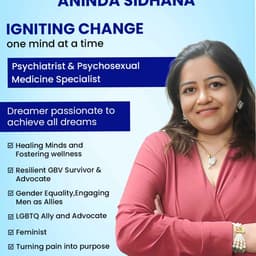

🧠 Mental Health in 2025: Where Empathy Leads, and Innovation Learns to Follow
By Dr. Aninda Sidhana
Psychiatrist | Psychosexual Medicine Specialist | Trauma-Informed Advocate | Global Goodwill Ambassador
Mental health in 2025 is no longer a private ache—it is a public reckoning.
It is no longer confined to therapy rooms—it pulses through headlines, hashtags, and homes.
And as Avik Chakraborty writes in “Mental Health in 2025: Where Innovation Meets Human Connection,” we are standing at a threshold:
Between urgency and ethics.
Between innovation and intimacy.
Between access and attunement.
But beneath the policy shifts and tech debates lies a quieter truth:
Healing begins not with systems, but with stories.
Not with algorithms, but with empathy.
Not with scale, but with survivor-led care.
> “We do not heal by being fixed. We heal by being witnessed.”
> —Dr. Aninda Sidhana
---
🔥 Three Forces Colliding: What Avik Got Right
Avik identifies three powerful forces shaping mental health today:
1. Tragic Stories
Families losing loved ones when help came too late.
These stories are not anomalies—they are emotional fault lines.
They remind us that timeliness without tenderness is not care—it’s crisis management.
Response:
We must move beyond reactive care.
Prevention must be proactive, relational, and rooted in community.
Mental health cannot be treated as an emergency room—it must be cultivated like a garden.
And survivors must be at the center—not as case studies, but as co-creators.
> “Urgency without empathy is a system in panic.
Presence is the antidote.”
—Dr. Aninda Sidhana
2. Tech’s Growing Role
AI chatbots now offer instant support. But they often lack nuance, context, and emotional intelligence.
They may respond to grief with generic affirmations.
They may misinterpret trauma as a scheduling issue.
They may offer advice that feels robotic, even harmful.
Response:
AI must be designed with trauma-informed principles.
It must know when to escalate, when to pause, and when to defer to human care.
It must never pretend to understand what it cannot feel.
And it must never replace the sacred space of human connection.
> “Technology can hold space. But only humans can hold sorrow.”
—Dr. Aninda Sidhana
3. Policy Shifts: The WOPR Act
Illinois’ WOPR Act bans AI from diagnosing or acting as a therapist.
It allows AI only in assistive roles—with informed consent.
This is not a rejection of innovation—it’s a reclamation of dignity.
Response:
The WOPR Act is a model of ethical restraint.
It reminds us that innovation must never outpace integrity.
It affirms that healing is not a transaction—it is a relationship.
And it invites other nations to follow suit—not with fear, but with fierce compassion.
> “Boundaries are not barriers.
They are the architecture of safety.”
—Dr. Aninda Sidhana
---
🌍 Global Echoes: India’s CBSE Hub & Spoke Model
India’s CBSE Hub & Spoke model pairs resource-rich schools with those in need of counseling support.
It’s a promising framework for equity—but it must be implemented with care.
Response:
We must ensure that:
- Teachers and peers are trained in mental health first aid.
- Programs are culturally attuned and trauma-informed.
- AI tools are used for journaling, reminders, and exercises—but never as substitutes for therapy.
- Survivors and students are invited to co-design these programs—not just participate in them.
> “Equity is not redistribution.
It is recognition.”
—Dr. Aninda Sidhana
---
💬 Avik’s Questions: A Deeper Dive
> “Can AI ever truly match the empathy and nuance of a human being?”
Response:
No—and it shouldn’t try.
Empathy is not a feature. It is a felt experience.
It is the ability to sit with discomfort, to witness pain, to honor silence.
AI can support care, but it cannot embody it.
Let technology be the bridge.
Let human connection be the destination.
> “How do we expand access to care without sacrificing safety?”
Response:
We expand access by expanding presence.
By decentralizing care—into schools, communities, and homes.
By training hearts, not just systems.
By embedding emotional literacy into every curriculum, every policy, every app.
And by ensuring that survivors lead the way—not as recipients, but as architects of change.
> “Safety is not a checkbox.
It is a culture.
And culture must be shaped by those who have lived within its gaps.”
—Dr. Aninda Sidhana
---
✨ What Survivor-Centered Care Demands
As someone who curates care through clarity and calm, I believe we must build systems that reflect the following truths:
1. Emotional Literacy
We must teach people to name, navigate, and normalize their emotional experiences.
This is not just for therapists—it’s for everyone.
Emotional literacy is the foundation of resilience.
It is how we prevent harm before it happens.
2. Narrative Medicine
Stories are not soft data—they are sacred truths.
We must center lived experience—not just clinical metrics—in every decision.
Healing begins with being heard.
And survivors must be the ones holding the mic.
> “Data may inform care.
But stories transform it.”
—Dr. Aninda Sidhana
3. Trauma-Informed Design
Every digital mental health tool must be built with safety, consent, and dignity.
No chatbot should ever respond to trauma with a script.
No app should ever override a cry for help with a pop-up notification.
Design must be led by those who know what it feels like to be misunderstood.
4. Community-Based Care
Healing must be local, relational, and culturally attuned.
We must empower communities to care for their own—through training, trust, and shared wisdom.
And we must fund these efforts—not just applaud them.
5. Ethical AI
AI must be transparent, accountable, and always subordinate to human judgment.
It must know when to step back.
It must never pretend to understand what it cannot feel.
And it must be shaped by survivor-led ethics—not just tech ambition.
---
🧭 Where We Begin
Let’s start here:
- Use tech to hold space, not take it.
- Train hearts, not just systems.
- Share stories, not just statistics—because healing begins with being heard.
- Build policy that protects presence, not just productivity.
- Make mental health programs mandatory in schools—not as a checkbox, but as a commitment to care.
- Ensure survivors are at the table—not just as testimonials, but as decision-makers.
Mental health care must be survivor-centered, ethically grounded, and emotionally intelligent.
Let’s build a world where innovation honors intimacy.
Where every voice—especially the quiet ones—is heard.
Where healing is not rushed, but received.
Where empathy is not engineered—but embodied.
> “The future of care is not faster.
It is deeper.”
—Dr. Aninda Sidhana
---
Dr. Aninda Sidhana
Curating care with clarity, calm, and survivor-centered truth.
MentalHealth2025 #SurvivorCenteredCare #AIandEmpathy #WOPRAct #HubAndSpokeModel #NarrativeMedicine #TraumaInformedCare #HealthyMindByAvik #WorldPulseVoices #EthicalTech #EmotionalLiteracy #MentalHealthFirstAid #PolicyWithPresence #LivedExperienceLeadership
- Health
- Behind the Headlines
- Becoming Me
- Global