
A Simple Conversation
Aug 31, 2021
first-story

The community of Kisii, Kenya is a proud one. It’s a community of integrity and a community of traditions. It’s also a community where in 2010, 92% of young girls had undergone female genital mutilation.
Female genital mutilation is not an easy topic to speak about. It is as uncomfortable for communities practicing FGM to speak to outsiders about this issue as it is for the outsiders trying to communicate. Millions of dollars have been spent to battle FGM using shame. Days for Girls International is no stranger to topics that make people uncomfortable. DfG focuses principally on one such topic, one that goes unnoticed, but that literally affects every human being on the face of the earth: periods.
We don’t like to talk about menstrual hygiene. It can be embarrassing. There is blood involved. And yet, this is a simple biological process that over half the human population experiences, and without which no human being is able to been born. Without periods, there would be no people!
Days for Girls provides sustainable feminine hygiene kits and health education to girls and women who would otherwise go without. DfG works to break the barriers of silence and social stigmas surrounding this issue, to empower women and girls with the knowledge that they are beautiful, important, and worthy of care and protection. DfG works in 57 nations on 6 continents, in communities where women and girls have a limited ability to care for and speak about their bodies – communities like Kisii.
When DfG went to Kisii to distribute kits and conduct health education, we were invited to speak with the cutters in the community. DfG asked them to share about the right-of-passage ceremony that included, often unbeknownst to the girls participating, the cutting procedure. During this dialog, we learned about all the rich and wonderful aspects of a girl’s right-of-passage ceremony, and shared that we did not have an equivalent ceremony in the US. We said that we wished we had one. The cutters felt elevated, and seem pleased to know that we felt something about their culture was missing in our own culture. Then we told them that we were not there to make them wrong, nor to tell them to stop. We were there to acknowledge that Kenyan women, any woman, is beautiful and powerful naturally. We acknowledged their leadership and authority in their communities and asked them to consider making a new decision. Our approach was just to offer a possibility: what if it would be possible to honor a girl with the ceremony alone? Is it possible to cut out the cut? We asked them to join us in wearing a purple ribbon to indicate that women are beautiful and powerful naturally. They were the only leaders who could cut out the cut.
There was silence. After a minute that seemed like an eternity, one ululation broke through the room, and other voices joined it in affirmation. The cutters said they would consider the option.
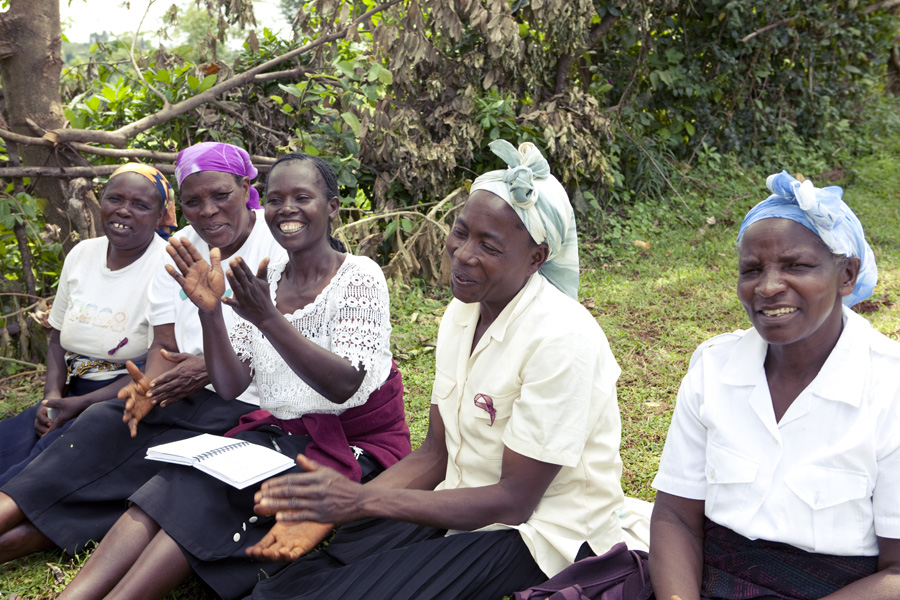
Shortly after that time, the six head cutters (photo attached) said that they had decided to lay down their knives. This was a tremendously brave decision, because the position of cutter is well-respected , well-paid, and one of the few available to women. All of these are challenges to overcome. Nevertheless, the cutters made a choice. They shared that this practice had ruined their daughters, because their husbands had gone out in search of ‘women who could act as real wives’, and had brought back AIDS. They already knew the impacts of this practice, but receiving support and positive affirmation of their own authority as changemakers proved to be the shifting point. DfG received reports a few months afterward from the Water District that FGM levels had already dropped 30%.
Change sometimes happens slowly, and sometimes dramatically. But it doesn’t happen unless we have the courage to address the difficult topics, simply by opening the forum to have a conversation. That’s what DfG is committed to.
We’d love to know what you think. What other difficult conversations could be facilitated through an approach that empowers cultural leaders to leverage their existing strengths and become their own agents of change?
- Leadership
- First Story
- Northern America