
An Uneasy Calm: Why Peace Is Only as Strong as Its Justice
Oct 11, 2025
story
Seeking
Visibility


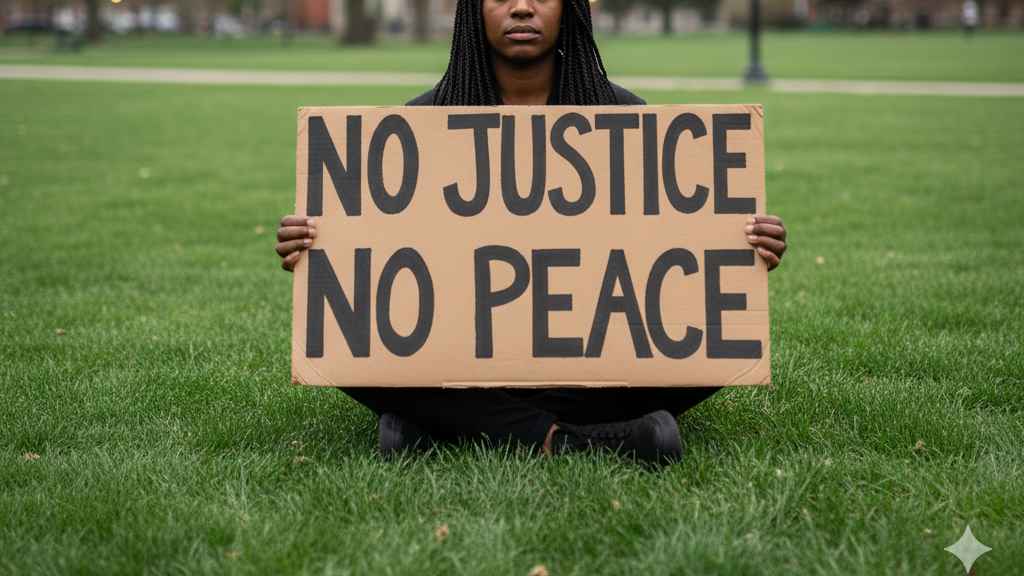
Photo Credit: AI Generated
I have never liked the word, peace. Never. As a matter of fact, when I saw this campaign was centred around peace, I recoiled. So I had to interrogate that reaction. I wanted to understand why the word peace makes me feel so resentful, and what peace really means to me.
Growing up, every time someone mentioned peace it seemed like they should have used the word "quiet" or "silence" instead.
My relatives would tell my mother to go and appease her troublesome, meddling mother-in-law "in the interest of peace". My friend with an abusive husband would be told repeatedly to ignore his behaviour and avoid aggravating him so there could be 'peace'. Little girls who were sexually abused by prominent relatives were warned not to disturb the "peace" of the family by identifying them. The police told me to pray for my brother who beat me almost out of an eye, so that "peace" would be restored to the family. A Nigerian lawmaker sued for "peace" between a female senator and her male counterpart who persecuted her because she accused him of sexual harassment. The lawmaker's path to peace was for the female senator to apologise to her tormentor.
Just a few days ago, my landlord served E-eviction notices to my neighbour and I . This followed a complaint I had lodged about noise and some structural damage that was causing leaks into my side of the building. He felt it would be "in the interest of lasting peace" if we both sought alternative accommodation when our rent expires. When two people are involved in a public altercation in my country, "peacemakers" are quick to run to the aggrieved and beg them to remain calm or be silent while the offender remonstrates.
It seems that, everywhere I look, the oppressed are being silenced, the instigators are assuaged, and the issues are swept under the carpet, in the name of "peace". So, to me, peace has always meant quiet seething, unaddressed tension, suppressed anger, injustice, unfairness, and everything pandering to a pretentious, biased audience.
So I loathe the word.
The definition of peace in the dictionary is " freedom from disturbance ; tranquillity." This may be what all the unappointed judges in the previous scenarios were trying to achieve: a freedom from disturbance - but this at the expense of the victim?
Freedom from disturbance, to me, would mean victims not being forced to repress their pain. It would mean the perpetrators of that disturbance are made to show remorse, recompense and/or restitution. Tranquility would mean the body, mind and psyche of everyone is in a state of rest. That no one would be silently harbouring pain because of another. Because can true, sustainable peace exist without fairness? And is it really peace when one party is gagged and bound to silence?
Many years ago, during a casual pre-employment interview for a TV Production job, the Executive Producer offered me a place in the News department. I declined vehemently saying I disliked news (production). Unknown to me, the head of that department was hovering around and she took that as a slight against her, holding and wielding a grudge that would affect the delivery of both our jobs.
One day in exasperation, I complained to our boss about her behaviour. It was then he explained why she was upset. He then advised that I make peace by complimenting a show she presented or something she was wearing. I really did not want to because I had done nothing to require her being appeased.
However, my opportunity came a few days later, when, because of a minor mix-up with a news item in the Master Control Room, I was summoned to the GM's office. The Head of the News department also sat there, as I gently explained how the mistake was from someone else. Afterwards, I told her how much I loved the show she hosted the night before. She smiled, said "thank you" , reached into her bag, pulled out a pretty box of chocolates, and handed it to me.
Apparently, when my boss advised me to make peace with a compliment, he also scolded her for picking silly fights with her subordinate, and asked her to fix it. To his credit, she remained my closest friend in that office till I resigned.
And I think that is what peace really means to me. Peace, to me, means fairness and equity. It means providing a balanced solution for problems; equitable procedures for conflict resolution. It means -in one word- justice. Because, in the words of Martin Luther King “in the final analysis, there can be no peace without justice, and there can be no justice without peace".
- Peace & Security
- Leadership
- Peace Is
- Global