
Antimicrobial Resistance In Women And Adolescent Girls
Mar 18, 2026
story
Seeking
Action


Antimicrobial Resistance (AMR) in Women and Adolescent Girls
Someone might ask:
How does antimicrobial resistance (AMR) affect women and adolescent girls?
One important factor to consider is menstrual hygiene.
Menstrual hygiene refers to the practice of using clean materials to manage menstruation while maintaining cleanliness, privacy, and comfort.
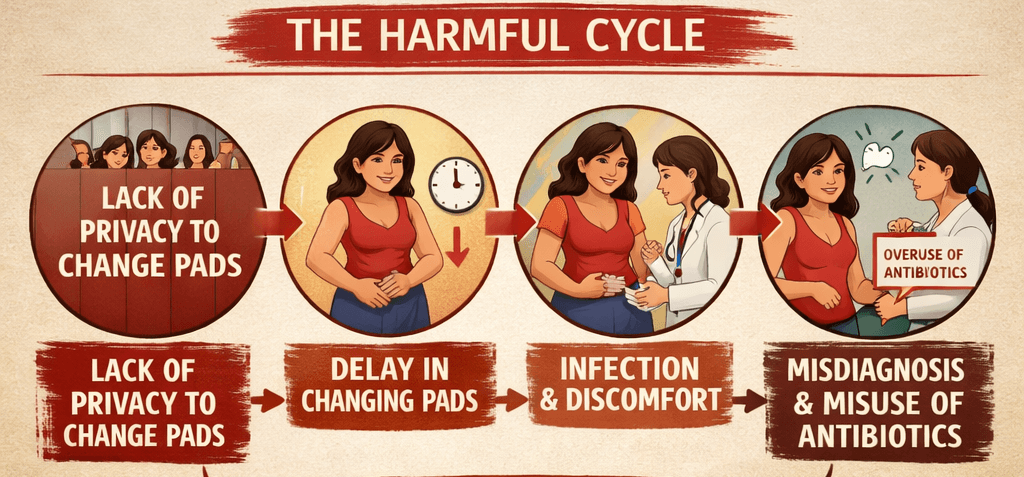
below is the illustration I came up on both the harmful cycle and the solution cycle.
Harmful Cycle
Women and adolescent girls face several challenges during menstruation.
One major issue is the lack of privacy when changing sanitary products. This is common in places such as schools (universities, colleges, boarding houses) where multiple people share limited space.
Ideally, a woman or girl should change her sanitary pad every 4 to 6 hours, this can vary depending on flow. However, due to overcrowded living conditions and discomfort, especially for more private individuals—this may be delayed to longer hours.
This delay can:
Increase the risk of infections such as Reproductive Tract Infections (RTIs)
Lead to misdiagnosis
Result in the misuse or overuse of antibiotics, contributing to AMR.
Solution Cycle
To address these challenges, it is important to:
Provide adequate private spaces for women and adolescent girls
Improve access to clean water, sanitation, and hygiene (WASH) facilities
Promote proper menstrual hygiene practices
These solutions will:
Encourage regular changing of sanitary products
Help prevent infections
Reduce the irrational use of antimicrobial agents
Ultimately contribute to reducing AMR.
- Health
- Peace & Security
- Environment
- Girl Power
- Human Rights
- Climate Change
- Global