
BLISS: Business and Life Skills School
Jan 21, 2015
first-story


Overview
BLISS—Business and Life Skills School—aims to reduce exploitative labor and increase literacy in communities where young girls must pick work over school to make ends meet. BLISS is the brainchild of two MIT students—Saba Gul and Eleni Orphanides, and is currently funded by the MIT Legatum Center for Entrepreneurship and by the MIT IDEAS Competition. We are currently running a successful pilot project in Attock, Pakistan with 38 Afghan refugee girls who previously provided labor at carpet looms for up to 14 hours a day. They are now coming to school to learn English, Math and Urdu (Pakistan’s national language), as well as embroidery and needlework.
BLISS is a self-sustaining program that provides the girls with monetary incentives to eliminate the need for them to work. The incentives are funded by an afterschool vocational class where unique indigenous crafts are created, to be sold in fair-trade markets globally. Coupled with a business curriculum, BLISS encourages financial independence and entrepreneurship, giving its enrolled girls a chance to attend school, stay in school, and to get mentorship to set up their own ventures.
Objectives
BLISS aims to:
• Allow girls an equal opportunity to attend school, thus increasing female literacy rates and improving health practices in the community
• Reduce the incidence of exploitative labor among young girls
• Empower girls with practical real-life skills that increase their earning potential
• Promote unique indigenous art in the form of socially conscious products
Target Community and Social Need
The remote city of Attock, Pakistan is home to about 38,000 Afghan refugees. The girls and women in the community labor at carpet looms, hand weaving carpets for up to 14 hours a day, and earning a meager $1—$2 for this back-breaking work. In the last decade, the carpet industry has done poorly, but with little education and no other skills, this population cannot find alternative employment. To top things off, Pakistan has no labor laws to protect refugees from exploitation. This problem of exploitative labor is global—with an estimated 3.3 million working youth in Pakistan, and about 166 million in the rest of the world. These young laborers cannot afford to attend school, even if it is free, because of the high opportunity cost of attendance. In other words, every hour they spend in school, they lose out on wages that could be earned by providing labor instead—making it impossible to spare time for an education. Educational NGOs in Pakistan concentrate on improving the quality and affordability of education, but almost none address the opportunity cost of attending school. In Attock, dropout rates are soaring despite three free schools for the Afghans. There is also a need for educational schemes to equip underprivileged youth with practical and vocational skills that improve their job prospects without the necessity of attending institutes of higher education—a luxury almost none of them can afford.
The BLISS Model
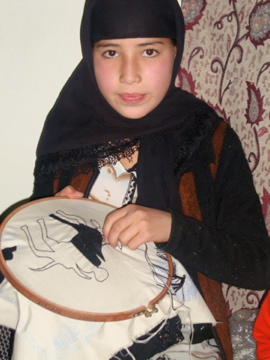
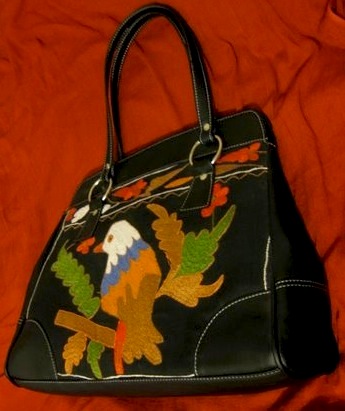
BLISS vocational classes supplement the regular curriculum, and take place at two free schools run by our partner NGO, Barakat Inc. Girls learn to embroider motifs on fabric supplied to them, which is then stitched into fashionable handbags by local bag makers at workshops across the country, and cleverly marketed by our team in local and global markets. For attending 1 hour of the vocational class and 3 hours of evening school where Math, English, and Urdu are taught, BLISS pays each girl $12/month. This is about $2 more than the amount she would make by skipping school and weaving carpets instead.
BLISS supplements the existing curriculum with its ‘Business and Life Skills’ module. It increases the relevance of formal education by offering business and livelihood training, with the aim of financially empowering the girls even if they cannot afford higher education. Our curriculum teaches basic business acumen, the ABCs of starting and running a business, access to economic opportunities outside the community, and access to mentorship by small entrepreneurs and MBA students from nearby cities, giving students the confidence and skills to set up their own ventures. As part of its Life Skills module, BLISS creates awareness about how education can empower communities, with lessons on hygiene, nutrition, gender rights, reproductive health, child trafficking, teamwork, negotiation and social skills, and economic opportunities. BLISS imparts skills that students can use for life, and gives them a higher value for the time they spend in school.
BLISS has already established partnerships with fair-trade craft stores and online retailers to market its line of handbags, both in Pakistan and the US.
Community Response
BLISS has received an overwhelmingly positive response from the Afghan community, with requests for new enrollments by never-been-schooled girls every week. Abdul Jabbar, the village elder, told the BLISS team: “This will be very good for our children. The carpet business is not doing well, and we are sick of it. It is very hard work and we don’t earn much. This is a way for our children to learn a new skill and also get educated.” 15-year old Fatima, an enthusiastic BLISS participant, says: “I want to be a doctor when I grow up. I love to read and write, but it is very hard for my father to afford to send me to school. BLISS has reduced the burden of my education on my father. I will spend the money I get from coming to school on books. I hope someone will buy my work so I can continue to stay in school.”
BLISS website: http://www.bagsforbliss.org
BLISS blog: bagsforbliss.wordpress.com
BLISS featured on What Gives (Betty Londergan's 365-day Philanthropy blog): http://whatgives365.wordpress.com/2010/03/31/teaching-afghan-refugee-gir...
- First Story
- South and Central Asia