
Borderless, But Bound: When Paper Walls Keep African Women Apart
Jul 31, 2025
story
Seeking
Visibility

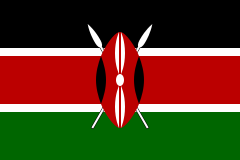
As a woman living in Africa, I support the borderless Africa movement, not just as a political idea, but as a lived necessity. For African women, freedom of movement isn’t about convenience—it’s about connection, opportunity, and care. It’s about showing up for one another, across borders, without bureaucracy standing in the way. In a world where sisterhood is our strongest currency, paper walls are costing us too much.
How can women help one another when I need permission to enter my sister’s country?
We speak often of a borderless Africa—a beautiful vision of freedom, unity, and shared strength. But in reality, African women are still being kept apart—not by distance, but by paperwork. Visa regimes, hidden behind the language of “electronic authorization” or “security checks,” are slowly choking our ability to connect, collaborate, and care across borders.
Let’s be honest: this hurts us all.
A borderless Africa matter to women, because we are the ones running community kitchens, not just conferences. We are the ones healing one another’s trauma in quiet rooms, not only on policy panels. But how can a Kenyan woman train a group of young Tanzanian girls in self-defense when she needs weeks of visa processing and unpredictable approvals?
Women’s empowerment thrives on presence, not just presence on Zoom, but presence in rooms, in workshops, in villages. Being there, hand in hand. Without that, we reduce sisterhood to hashtags.
Look at freedom in America. Look at Europe. People move freely. They can work, live, or marry across borders. They can fall in love in France and build a home in Germany. But here in Africa? You marry someone from a neighboring country and suddenly travel becomes a burden. Visiting your own in-laws, seeing your parents, attending funerals or celebrations—it all becomes a process of permissions. How can we talk of Pan-African love when even visiting family becomes a border negotiation?
Why does it matter to grassroots organizations? Because collaboration should not be a luxury—it should be the foundation. Small, women-led nonprofits across Africa are solving real problems—poverty, violence, child education, maternal health—but they often duplicate work, because they can’t meet, visit, or learn from each other easily. Visa restrictions keep partnerships theoretical instead of practical.
Imagine a Ugandan organization with surplus sanitary pads that could support a rural girls’ home in Malawi, but the cost of travel documents swallows the funds meant for transport. Paper walls are stealing our impact.
Why does it matter to people doing good? I’ve seen it firsthand—women who simply want to visit orphanages across the border. Not for profit. Not for publicity. But out of pure care. Yet they are delayed, denied, or deterred because of passport power. Is compassion a crime? Is kindness now something that must be pre-approved?
What kind of continent are we building if those who want to give are treated with suspicion?
A borderless Africa is not naïve—it is necessary. It means healing is faster. It means trust is stronger. It means our daughters will grow up knowing no invisible lines between the people who could love, guide, or help them.
It is not just about movement. It is about meaning.
World Pulse taught me that women’s voices can break borders. But I dream of a day when our feet follow our words—when we don’t need a stamped document to show up for one another.
Until then, we remain borderless in spirit, but
bound in law. And that must change.
- Girl Power
- Leadership
- Caring for Ourselves
- Africa