
Bridging the Gaps: Understanding and Addressing Regional Differences in the Philippines
Nov 5, 2025
story
Seeking
Encouragement


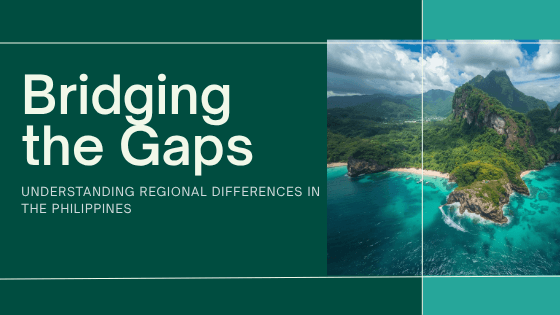
From inequality to inclusivity — exploring the roots of regional disparities and pathways toward balanced national development
The Philippines is an archipelago of over 7,000 islands, rich in culture, language, and natural resources. Yet, this diversity also brings profound regional disparities that continue to shape the country’s economic and social landscape. While Metro Manila and other urban centers surge ahead in growth and modernization, many provinces remain mired in poverty, underdevelopment, and limited access to basic services. Understanding these regional differences is key to building a more inclusive and equitable nation.
One of the most glaring issues lies in economic inequality. The National Capital Region (NCR) contributes more than 30% of the country’s GDP, while agricultural regions such as Eastern Visayas or the Bangsamoro Autonomous Region in Muslim Mindanao (BARMM) lag far behind. The concentration of industries, jobs, and investments in Luzon has left other regions dependent on remittances or agriculture, sectors often vulnerable to climate shocks and price volatility. This uneven growth reinforces a cycle of migration to urban areas, straining city resources while rural areas suffer from brain drain and depopulation.
Infrastructure disparity is another significant factor. Roads, bridges, and digital connectivity remain inadequate in many parts of the Visayas and Mindanao, limiting mobility, trade, and access to education or healthcare. Meanwhile, typhoons and flooding frequently destroy public works in vulnerable provinces, making development efforts harder to sustain. These challenges are compounded by political centralization, where decision-making and budget allocation are still largely controlled from Manila, leaving local governments with limited autonomy and resources to address their specific needs.
Cultural and linguistic diversity, while a source of pride, can also deepen social divides. Some ethnic groups and indigenous peoples experience exclusion in political participation, education, and access to social services. Historical neglect of Mindanao, for example, has fueled decades of conflict rooted in identity, land, and resource inequity. Similarly, rural and upland communities often feel left behind in national policies designed with urban populations in mind.
Addressing these disparities requires a multi-dimensional approach. Decentralization must go beyond token devolution; it should empower local governments to design programs that reflect their community’s realities. The full and fair implementation of the Mandanas-Garcia ruling—which increases LGUs’ share of national taxes—offers a promising start if coupled with strong governance and capacity-building.
Investments in infrastructure and digital inclusion can connect marginalized regions to broader economic opportunities. Expanding internet access in rural areas, for instance, can open doors for education, e-commerce, and telemedicine. Strengthening education and local industries—from sustainable agriculture to eco-tourism—can promote self-reliance and job creation at the community level.
Lastly, promoting inter-regional collaboration instead of competition can help balance growth. By encouraging resource sharing, trade partnerships, and regional innovation hubs, the Philippines can leverage its diversity as a national strength rather than a dividing line.
Bridging the country’s regional gaps is not merely an economic challenge—it’s a moral imperative. A truly progressive Philippines will emerge only when every region, from the bustling cities of Luzon to the highlands of Mindanao, shares equally in the promise of development and nationhood.
- Peace & Security
- Human Rights
- South and Central Asia