
Building Trust, Bot by Bot: How a 'Girl in ICT’ built an Enterprise for Workplace Safety
Apr 21, 2025
first-story
Seeking
Visibility
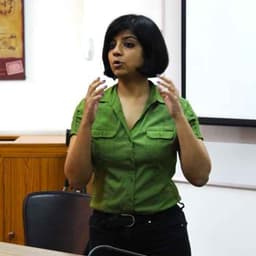

Photo Credit: Graphic source: People illustrations by Storyset
Building Trust, Bot by Bot: How a 'Girl in ICT’ built an Enterprise for Safe Workplaces
Gender-based violence, which is a driving force keeping structures of inequity in place, requires agile, adaptable, scalable and customisable strategies for prevention and redressal. In the case of sexual harassment at the workplace, even more so. Sexual harassment in the workplace remains to be one of the most underreported and unaddressed issues worldwide. Several studies have shed light on the fact that fear of loss of income, backlash, stigma and career-related consequences force survivors to remain silent, and not escalate instances of such violence.
In the Indian context, there is a legal provision to specifically address sexual harassment at workplace, called the Sexual Harassment of Women at Workplace (Prevention, Prohibition and Redressal) Act, 2013, or the POSH Act, hereon. Although it was enforced in December 2013, its implementation remained inadequate. The Indian #MeToo movement of 2018, specifically highlighted glaring gaps in women’s ability to escalate and seek support in such instances. It made very obvious the fact that structures of power and hierarchy, institutional backing and privilege continued to shield perpetrators and institutions were either unaware or unwilling to take actions when complaints were raised.
It was at this time that Meghana Srinivas, a Bangalore-based working professional who had trained as a molecular biologist at UC Berkeley, herself a survivor of workplace misconduct, sought to find a solution to the issue. When I had a conversation with Meghana around the genesis of TrustIn, she shared, “I was furious at the fact that as a survivor, I was isolated and could not access any avenues for support or escalation. I wanted to ensure that no other survivor felt this way, and so I just began to code, to build a chatbot.”
From a chatbot to a company: the TrustIn Story
Meghana coded India’s first ever legal chatbot for survivors of sexual harassment, POSHPal. At its most nascent stages, TrustIn (which existed as POSHPal) was still a side-project which she juggled along with a full time role. However, seeing her experience reflected in the stories that hundreds of women across the country were sharing on social media during the #MeToo movement, Meghana moved full time into the TrustIn project, to refine, develop and further this initiative.
Taking inspiration from Project Callisto and other case reporting platforms, Meghana sought to build a product that enabled escalation of complaints and their adjudication in one integrated platform. The idea was bold, fresh, and most importantly, sought to strengthen implementation of the existing legal framework in India, rather than re-inventing the wheel.
TrustIn began with the TrustIn Enterprise Platform, a secure reporting-redressal system that ensures a confidential, unbiased, and compliant process for cases of sexual harassment in the workplace. TrustIn’s vision was to leverage technology to scale impact and create cultures of safety. Unlike other systems, it combines complaint reporting and case redressal mechanisms, where the AI-adaptive TrustIn Enterprise system does the thinking and advises ethics committees on what to do.
Today, TrustIn has expanded to an all womxn team and roster of training consultants, and supports 120 Indian organisations in proactively addressing sexual harassment, misconduct, micro aggressions and in intentionally building safe workplace cultures, through an innovative 3Ps model:
- Program: Training for individuals, management, and committees to recognise and prevent gender-based violence, discrimination, and harassment, and to foster a culture of allyship.
- Policy: Establishing structures to prevent and prohibit violence and discrimination based on sex, gender, caste, accessibility, and other factors.
- Platform: The TrustIn Enterprise Platform is a secure, scalable reporting and redressal system that ensures a confidential, unbiased, and compliant process. It supports survivors with information and access to redressal, while enabling Committees to adjudicate cases through fair and transparent processes. POSHPal, embedded in the platform, has evolved into an AI legal chatbot providing safety resources and information to both survivors as well as redressal committees.
The vision to enable safety at scale is supported by TrustBot, a free, trauma-informed chatbot on Telegram that provides survivors of domestic violence and sexual harassment with 24/7 confidential support. Developed with Saahas, a non-profit tackling domestic violence, TrustBot was developed by Meghana during COVID-19 to ensure survivors could access resources regardless of financial constraints. It has since resolved nearly 200,000 anonymous queries, offering SOS legal and psychosocial support.
To resolve the issue in all its intersections, TrustIn’s 3P model has since evolved with a commitment to include individuals who have been historically excluded from traditional systems—due to gender, class, caste, or other barriers. The web app is available in 12 vernacular languages, and each of the training spaces hosted by TrustIn focus on mindset shifts that promote safety and inclusivity highlighting intersectional challenges.
Employee centricity is at the core of TrustIn’s operations, empowering individuals through trauma-informed and objective support, allowing them to access their rights and relevant information related to their complaints, if/when escalated. Further, unlike single training interventions, the TrustIn solution offers an adaptive, AI-supported learning and decision making continuum, through our legal chatbot POSHpal, simplified legal content and reporting templates, and a data-driven case recommendation engine.
Big Takeaways
TrustIn, powered by technology, is leading change, one institution at a time. Its impact in just five years, and potential for scalability are proof that when women build tech, they bring in not just innovation, but they can potentially also ensure greater inclusion. Technology on its own can have immense benefits, but with the right intent behind it, can become transformative.
In the case of TrustIn, a solo female entrepreneur’s work in the digital/technology space is forging meaningful pathways to strengthening implementation of a law that is the need of the hour, in a country where sexual harassment and violence against women and girls has been a critical concern, making it one of the most dangerous places for women to live. TrustIn stands as proof of the powerful outcomes that emerge when access to technology and communication is diversified, and equitable opportunities are created.
TrustIn will continue to support organisations and institutions with POSH and DEI-B (diversity, equity, inclusion and belonging) services, all the while supporting and cheering girls who enter tech and forge new paths and solutions that challenge and change the status quo. With this in mind, this Girls in ICT Day, we celebrate with joy and hope—wishing for many more women in tech and looking forward to the powerful solutions their access and inclusion will bring.
------------------------------------------------------------------
Written by Nitya Sriram, who leads programmes and partnerships at TrustIn. Need support? Reach out today: mailto:nitya@trustin.co.in.
With inputs and support from Nachiketa Mishra, who leads technology at TrustIn. Need support? Reach out today: mailto:nachiketa@trustin.co.in.
- Human Rights
- Gender-based Violence
- Girl Power
- Technology
- First Story
- #ShiftThePower
- Girls in ICT Day!
- Global