
CAMEROON: Sex Education Could Have Prevented My Unsafe Abortion
Apr 30, 2019
story


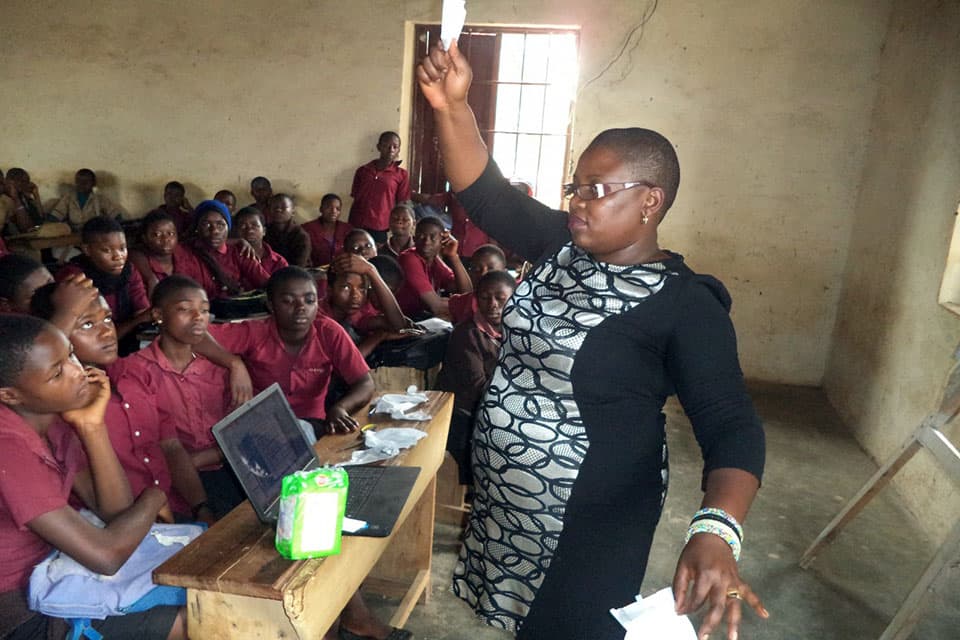
Photo courtesy of Sally Mafor
Sally Mafor teaches girls what she wishes she had known when she was a teenager.
I am working so that young mothers with unwanted pregnancy won’t have to follow in my footsteps.
When I was 14, being a virgin was unfashionable amongst my school peers. I started having sex out of a desire to belong. But it was also an abomination to my family and society to have a baby at that age.
Because sex was a taboo subject within our communities, most of us had no information about our sexual health or reproductive health rights. We used homemade contraceptives like hot drinks, highly concentrated salt or limestone solutions, vinegar, and herbs.
After gambling with these for five years, what I dreaded most happened: I missed my menses for six weeks.
My friends and I then embarked on a mission to bring my missing menses back. Oh! How I Regret the nasty and risky things we did.
First I took a black tablet that did not do the job. Then I was given some injections—i never found out what they were. Nothing worked. My size was increasing by the day and so was my fear that my mother would discover my pregnancy.
I decided to settle on a crude, unsafe abortion. A young man who worked at a local drugstore was popular among our age group because he solved our problems. He made us look innocent in the eyes of our parents and wise in front of our friends. This drugstore was located across from a clinic, which is probably why we thought it was a safe place.
Once I decided to have an abortion (which we called a D&C), I couldn’t wait to be done with my problem. When I got to the drugstore at 8 in the morning, there were so many young girls buying one after-sex pill or the other.
The man waited until all the buyers had left and then put a stick across the door to indicate he was not available. He then prepared his “theater” by placing a piece of plywood on the same table where he had been serving people just moments before. He leaned another piece of plywood on the drug shelf to serve as a screen. He asked me to lie on the prepared table while he pulled forceps out of a big bucket.
Before he started the process, he convinced me that he had to have sex with me before the procedure to ease my pain and make the process go faster. I accepted because my only goal was to get that unwanted pregnancy out of my system.
After more than an hour, the fetus was out. The man put it in the bucket that had held the forceps. I paid him 10, 000 Francs ($20 US). I couldn’t afford that amount on my own and neither could the guy responsible for the pregnancy. I raised the money by sleeping with other guys.
I left the drugstore with wrapped toilet tissue in my underwear. The blood continued pouring for two days and I became pale. When the blood luckily stopped flowing, I erroneously thought things had returned to normal.
A week later I started having some funny discharge, which degenerated into acute infection. The odor from this discharge was so pungent that I could not sit among people. I skipped classes, became an object of ridicule among my peers, and worst of all I failed the GCE Advanced level that year. Throughout all this, I never had the support of my parents because they never realized I had an unsafe abortion.
Seventeen years after this happened to me, the situation is still the same in my community. We still have many cases of unwanted pregnancy and unsafe abortions. Young people have no access to sexual health education or services for their reproductive health needs.
Talking to adolescents about sexual and reproductive health matters is still a taboo, and when it does happen, it happens in parables. For example, you hear phrases like: “If you play with a man you are dead. ” “Don’t go near a man. ” “Don’t allow your bananas to be touched. ”
The girls hear these phrases when they have their first period and the boys get nothing at all. Mothers who do not have any sound information on these issues are left with the responsibility to educate their children. Even curriculum designers fail to give it serious consideration. Most of the information adolescents can access comes from their peers and is confused with myths.
This misinformation has led to a catastrophe within my community. Parents are crying while adolescent girls are either dropping out of school or dying because of unsafe abortions.
The young boys are not left out. Together with the girls they suffer from sexually transmitted infections, including HIV. My community in the North West Region of Cameroon has some of the highest rates of HIV cases in the country. In the current academic year, at least three girls have dropped out of each secondary school because of unwanted pregnancies and another girl died from an unsafe abortion.
If these are the recorded cases, we can begin to imagine the number of girls who attempt ineffective folk remedies to prevent pregnancy. What is most disturbing about this situation is the silence from parents and guardians.
Living with the guilt and the fear of barrenness in the years that followed my abortion was not easy on me. I secretly wished I could turn back the hands of time. I told myself, “No other girl should go through this experience”.
I eventually got married and had children. I became a teacher, which gives me an opportunity to fight against these ills. I exploit every opportunity to talk about sexual health with my students. This is not easy because many communities in my country are plagued with religious doctrines, cultural taboos, ignorance, and neglect from policymakers.
The myth that discussing sexuality with a child makes him or her sexually active has blinded most parents to the truth. This makes it really difficult for them to help their children. Policymakers take an unclear stance and school authorities, community heads, and family heads resist efforts at sexual health education.
There is little or no control on how contraceptives are sold or prescribed, which has led to abusive use of contraceptives. This has caused tremendous damage among young girls and women and made correct use of contraceptives a dreaded issue.
When I first started teaching and working with youth organizations, most of the discussions were on preventing HIV/AIDS through abstinence. This was supported by the religious doctrines around me. For the 10 years that I was actively involved in the abstinence crusade, the number of unwanted pregnancies kept increasing by the day.
I also realized that using only a few minutes of lesson time was just as bad as not talking at all. Acknowledging that the gospel of abstinence has failed, I started an organization to protect adolescent girls by respecting their reproductive health rights.
It is time to address the silent destroyer of unsafe abortions in our communities. All stakeholders concerned should reconsider their stance on abstinence. It is obvious this crusade is a wild goose chase. A clear policy to ensure adolescents’ rights to sexual and reproductive education should be enacted. We need to encourage and improve discussion amongst children and parents. Clinics should be created to make reproductive health education more accessible.
As a first step towards these objectives, my organization launched the Every Girl for Any Girl Initiative, which discusses these issues in school clubs. I am working so that young mothers with unwanted pregnancy won’t have to follow in my footsteps. Rather than holding on to beliefs and cultural norms that have failed, let us engage on realistic solutions that work.
- Girl Power
- Health
- Education
- Sexual and Reproductive Rights
- Africa