
Crawling back into the darkness: a journey of reliving domestic violence as a pro bono lawyer
Apr 28, 2022
first-story
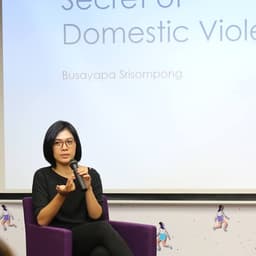

Domestic Violence has been normalized in Thai Culture, it has been justified until most victims of domestic violence are pushed back into abusive relationships. Stuck in the circle of violence, the victims often face societal challenges as soon as they speak up.
I know this all too well, as a domestic violence advocate, human rights lawyer and a survivor of domestic violence who had to bring my own case in front of the Thai justice system.
Helping other women who have been through the same experience was part of my recovery process. I spent a year finding independence again after getting out of an abusive relationship. I felt strong and empowered, I felt that I survived. Not too long after the incident, I became an advocate for victims of domestic violence and started helping victims, working as a pro bono lawyer. I founded my own project “SHero” based on an image of a female hero, meaning anyone can be a hero and make a change.
But I came to realize one day that although I survived, I am still struggling to live my life.
Mae Sot district, Tak province in Thailand is located along the Thai-Myanmar border, a town where more than half of the population are non-Thai’s including migrant, stateless persons and refugees. Most of the cases that have reached out to me are cases involving women who have fled from their own land are living in a foreign country, their life dependent on an abusive husband. I stood for these women’s rights in the community and advocated for their rights to justice to law enforcers, many of whom lack sensitivity and even attempt to justify domestic violence. Police officers often ask the victim if she spurred the fight or whether he was drunk while beating her and if so, he should be pardoned because it was not intentional. Sometimes they say that it is normal for partners to fight sometimes, that eventually the couple will get back together. Police officers, as the gatekeepers of the justice system, told me and to the people I represented to rethink about filing the report because couples tended to get back together, and as the procedure might take a very long time, especially if the case is weak if the victims has no severe injuries. Too often the woman feel lost, stuck and confused, robbed of the power to take action and they relapse into the circle of an abusive relationship.
After spending hours absorbing the sad stories, emotions, and the heartbreaks that I too have had, I let myself go back to my miserable past. I would lose myself in the memories of me crying, screaming and begging him to stop. Thinking back to the days where I felt I could not imagine myself leaving the relationship, but at the same time knowing I could not stay.
Sometimes, when I think back to my own case, I think that may be if I did not say certain things to him or if I was not so depressed, he would not have slapped me or choked me. Then I find myself telling the women who come to me that it was not their fault, that no matter what has happened, no one deserves to be hit. Many times, I have to repeat that sentence to myself, reaching out to my friends that have always reminded me that it was not me who caused the violence. Sometimes it is easier to give advice than to take it.
After two years of being a domestic violence advocate along the Thai-Myanmar border, I have come to the point where I can say that I need a therapist. I used to be able to make it through the day by taking all the cases, taking as many cases as possible and not allow myself to be vulnerable. With my cases I fought with the police, who often make it difficult for victims of domestic violence to access justice. The way in which the officers investigate, not the perpetrators but the victim is always revolting - as if they are trying to find ways to blame the victim. Insensitive questions such as, ‘why do you let him beat you many times’ are hurled against victims in a sensitive state.
Often due to the amount of paper works and pressure against the police officers to close cases, they would come up with excuses not to proceed and open domestic violence case, especially if there is no medical verification from the hospital that the victim was injured, or if the bruises are even a week old. Officers would often call this an invalid evidence to discourage women to file a report against her abusive partner. And I know this all too well because it was hard for me too – if it was hard for a lawyer, imagine how hard it would be for migrant domestic violence victims. All those cases involved women who have been abused, disrespected, cheated on and physically beaten. I put all my energy into empowering them, I conducted numerous workshops, events and campaigns. There was one time, where I held events three weeks in a row, later I cried with a mixture of feelings and felt I was reliving my own trauma for days. The worst moment was when a case did not proceed fast enough, and the women I was assisting gave up - I ended up blaming myself. There was a voice in my head telling me, I am more fortunate than other women in front of me, then I have the guilt of being sensitive. I had to hold my tears.
This year, I turned 26. I have implemented my SHero project in Thailand, Vietnam and the Philippines. I have had my name, my work and dedication featured in newspaper and in social media. I am a legal advisor for an international organization that has a great impact for thousands of marginalized people. But, the most important thing is I realize that I am broken, and that I need to look after myself. I cannot keep reliving the abusive relationship, crawling back to the dark place of my own. It is easier to think that everything is going to be broken, to think that I am going to be a sad human being masked by an image of a strong woman forever. It is so much easier.
Again, I am lucky to be surrounded by empowering friends who have helped me survive and tell me to move on. They said it is okay not to be okay, that everything is going to be fine. I am slowly taking time with myself; I cannot keep helping others if I do not look after myself. Most of the time, human rights workers take their cases personally, and get burnt out, but everybody needs to take care of their mental health, especially those who spend every day of their lives dealing with heavy, traumatic or sensitive issues.
Being the healer and giver is wonderful, we empower and help those who are vulnerable. Sometimes, we feel like being kind to others has already fulfilled our heart and soul; but, let’s not forget to ‘be kind to yourself’ too. As passionate as we are, as much as we want to make a change, we cannot forget to help ourselves and remind ourselves that if we used the pain that we experience to help others, we can also end up reliving that pain - again and again. Self-reflection is important, and we do not have to do that alone. Reach out to your friends.
If you are struggling, remember, there will always be a way. I will keep reminding myself that too.
- Health
- Gender-based Violence
- Human Rights
- First Story
- South and Central Asia