
Critical voices that we tend to ignore
Oct 9, 2025
first-story
Seeking
Visibility

https://www.dawn.com/news/1940881
Whose Knowledge Counts? Revisiting Virginia Woolf’s Feminist Vision and Women’s Voices in Pakistan
In an age of growing awareness about who gets to speak and who remains unheard, Virginia Woolf’s call for a “room of one’s own” still resonates. Her essay, written nearly a century ago, speaks not only to women’s exclusion from literature but to a larger issue: the unequal distribution of intellectual authority. Who gets to create knowledge? Whose ideas are preserved, celebrated, and taught? And who is left out of the conversation altogether?
Philosophy, like many disciplines, claims to seek truth. But what counts as truth—and who defines it—has often been shaped by partial, gendered, and exclusionary perspectives. The history of knowledge, then, is not merely one of discovery but also of exclusion: of deciding which viewpoints are recognized, and which are sidelined.
This is the central concern of feminist epistemology, a field that emerged in the late 20th century to explore how gender shapes the production and validation of knowledge. Thinkers like Sandra Harding have argued that what often passes as neutral or objective truth is, in reality, shaped by the social positions of those who produce it. Similarly, Donna Haraway challenges the idea of disembodied, universal knowledge, proposing instead the idea of “situated knowledges”—the notion that all knowledge comes from somewhere, and that acknowledging this makes our understanding stronger, not weaker.
Far from being a niche concern, feminist epistemology asks fundamental questions: not only what we know, but how we know—and crucially, who is permitted to contribute.
A Literary Mind Meets Philosophical Insight
While Virginia Woolf is best known as a modernist writer, her 1929 essay A Room of One’s Own stands as a powerful, early critique of the way knowledge has been constructed through a male lens. She doesn’t use the term “feminist epistemology,” but she lives its questions deeply. Her work anticipates the concerns of later thinkers such as Nancy Hartsock and Patricia Hill Collins, who argued that lived experience—particularly the experience of marginalized groups—offers unique and necessary insight into reality.
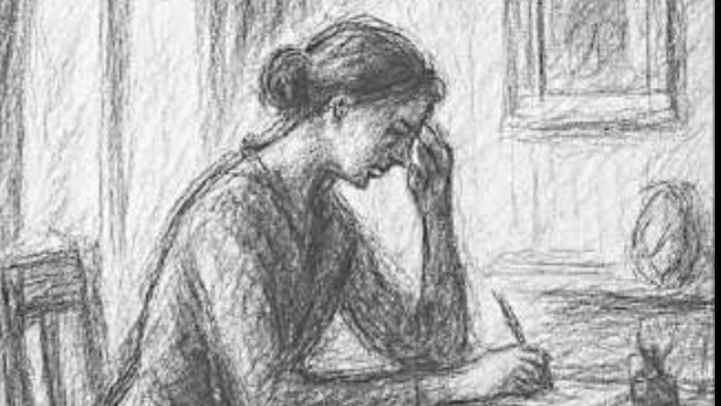
Woolf’s central metaphor—that women need a room of their own and financial independence to write—extends beyond the act of writing. It is a call for intellectual autonomy: space to think, imagine, and create without the weight of male-dominated expectations.
In a striking scene, Woolf recounts walking into a library at Oxford—a space historically closed to women—and examining books written about women. As she scans the shelves, she realizes almost all the books are authored by men. They discuss women as subjects to be analyzed, debated, or moralized over—but seldom as thinkers in their own right.
As she attempts to make sense of what she reads, her notes become chaotic—broken phrases, arrows, fragments. It’s as if the disjointedness of her sources infects her thinking. Meanwhile, she imagines a male student nearby, making tidy, confident notes, supported by a tradition that affirms his experience. Woolf is not envious; she is curious about why her own intellectual journey feels so much more difficult.
This moment is a powerful example of what philosopher Miranda Fricker would later call epistemic injustice—the unfair treatment of someone in their role as a knower. When certain perspectives are excluded or undervalued, it is not only an issue of representation but of truth itself. We lose the fullness of understanding when only some voices are heard.
Rethinking Authority, Rethinking Knowledge
Woolf's insight remains deeply relevant. As feminist philosopher Genevieve Lloyd notes, Western conceptions of reason have long been tied to masculine ideals: logic, detachment, abstraction. But expanding our idea of what counts as reason—or who gets to wield it—does not mean abandoning rigor. It means enriching our collective pursuit of truth.
The library scene in A Room of One’s Own is not just a literary vignette. It is a metaphor for how intellectual traditions are built, and who gets to build them. Woolf’s essay invites us to reimagine the architecture of knowledge itself—one where more people are invited in, and where the walls of the room are made just a bit more porous.
In Pakistan today, Woolf’s reflections carry urgent weight. According to UNESCO, female literacy in Pakistan hovers around 48 percent compared to over 70 percent for men. Even in universities, women are underrepresented in philosophy, history, and the sciences, while curricula remain dominated by male voices. The canon of school textbooks celebrates male poets, philosophers, and political leaders, but seldom women thinkers.
This absence has consequences. Just as Woolf found libraries filled with male-authored treatises on women, so too do Pakistani students often encounter syllabi where women appear more as objects of discussion than as contributors of ideas. And just as Woolf noted the weight of this exclusion in her own intellectual process, countless young women in Pakistan today feel the same silence—struggling to find reflections of themselves in the knowledge traditions they are taught.
The question, then, is the same as Woolf’s: who has the space—both literally and figuratively—to write, think, and be heard? Whose experiences shape the curriculum? Whose ideas are still waiting to be acknowledged?
As we consider these questions, we would do well to return to Woolf—not just as a writer of fiction, but as a thinker ahead of her time. Her essay reminds us that the pursuit of truth is strongest when it includes the full range of human experience. To build a more just intellectual tradition in Pakistan, we need to ensure that women are not just written about, but writing back.
— Iqra Mangi
- First Story
- Global