
Dignity dialogues
Aug 30, 2025
update
Seeking
Action

🌿 Coping Is Not Compliance: How GBV Survivors Architect Their Own Healing
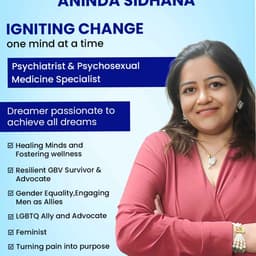
By Dr. Aninda Sidhana | Psychiatrist, Psychosexual Medicine Specialist, Survivor-Informed Advocate
---
🔍 Introduction: Survival Is Not Passive
In clinical spaces, we often reduce coping to symptom management. But for survivors of gender-based violence (GBV), coping is not compliance—it is architecture. It is the quiet brilliance of someone who has been harmed, yet refuses to be erased.
Survivors do not simply endure.
They strategize.
They recalibrate.
They reclaim.
And their healing is not linear—it is cyclical, relational, and often invisible to systems that only track pathology.
---
🧠 Emotional Intelligence as Survival
Survivors often develop a form of emotional intelligence that is both protective and poetic. They learn to:
- Scan for safety in silence
Not every room is safe. Survivors learn to read tone, posture, and digital subtext before they speak.
- Use self-talk as scaffolding
“I’m not crazy. I’m coping.”
“This isn’t my fault.”
These phrases become anchors when the world gaslights their pain.
- Reclaim identity through ritual
Whether it’s journaling, dressing with intention, or cooking ancestral recipes—these acts are not trivial. They are reclamations of self.
---
🛡️ Tactical Boundaries & Strategic Withdrawal
Boundaries are not emotional preferences.
They are clinical infrastructure.
Survivors often:
- Limit contact with unsafe individuals
Not out of avoidance—but out of necessity.
- Withdraw from performative circles
Especially those that offer “faux-care”: kind digital bullying, circle clichés, and relational neglect disguised as concern.
- Use silence as resistance
When systems demand disclosure without dignity, survivors choose silence—not because they have nothing to say, but because they refuse to be commodified.
---
🌿 Healing Modalities That Honor Complexity
Healing is not a checklist. It is a choreography. Survivors move between modalities depending on hormonal flux, relational safety, and emotional bandwidth.
- Trauma-informed therapy
EMDR, somatic work, and narrative reframing help survivors metabolize trauma stored in the body.
- Peer-led listening circles
These are not support groups. They are sanctuaries. Spaces where survivors are not asked to perform recovery—but are witnessed in their becoming.
- Cycle-aware emotional tracking
Hormonal literacy is essential. Estradiol dips, thyroid fog, and prolactin surges shape mood and memory. Survivors deserve tools that honor this biology.
- Digital companionship without surveillance
HealCycle offers a privacy-first emotional companion, CBT tools for depletion, and mood ↔ hormone dashboards. It doesn’t ask survivors to perform wellness—it companions them through it.
---
📚 Storytelling as Architecture
Survivors often use storytelling not for catharsis—but for control.
- Naming the pain
“He didn’t just hurt me. He rewrote my sense of safety.”
Naming is not confession—it is reclamation.
- Reframing the narrative
“I didn’t stay because I was weak. I stayed because leaving was dangerous.”
This reframing challenges cultural scripts that shame survivors into silence.
- Choosing when and how to speak
Disclosure is not owed. It is offered. And only when the survivor feels safe, sovereign, and seen.
---
🧩 Coping Is a Systemic Response
Survivors do not cope in a vacuum.
They cope in response to:
- Digital coercion
Trad-wife reels. Comparison as coercion. Kindness that isolates.
- Hormonal sabotage
Postpartum depletion. Thyroid dysfunction. Sleep debt.
- Relational abandonment
Partners who withdraw. Families who minimize. Institutions that pathologize.
Their coping is not a flaw.
It is a form of protest.
---
🕊️ Closing Reflection: Dignify the Mechanism
When we ask survivors “How are you coping?”—we must also ask:
What systems failed you?
What rituals saved you?
What boundaries did you build when no one else did?
Coping is not weakness.
It is wisdom.
And healing is not linear—it is layered, cyclical, and sacred.
Let us stop measuring recovery by silence.
Let us start honoring the mechanisms that survivors use to stay alive, stay whole, and stay sovereign.
- Gender-based Violence
- Digital Ambassador Events
- Training - Measuring Your Impact
- Training - Impact Lab Training
- South and Central Asia