
Elijah Wachira (ACTIL-Kenyatta) and Dr Martha Mutisi help Zimbabwean political leaders share stories of significant change
Jan 21, 2015
story
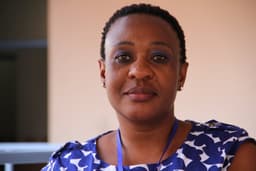
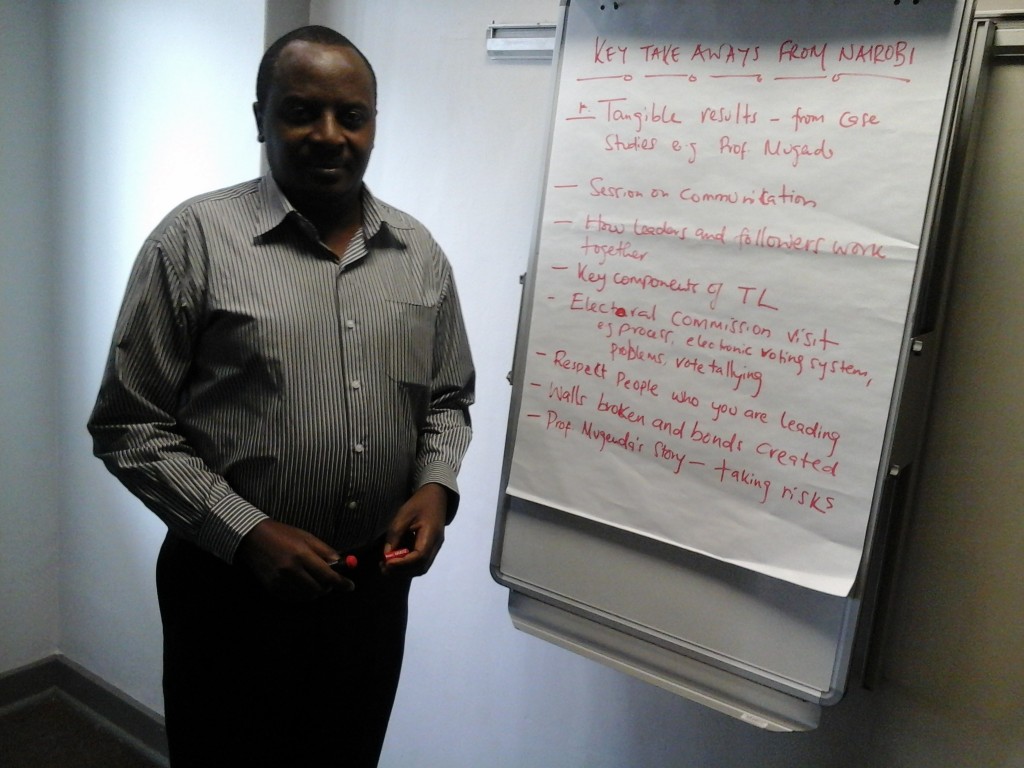
“Any leader who fails to invest in areas that uplift women are makes his or her country limp on one arm and one leg because development processes therein will be excluding half of the country’s population.” Elijah Wachira ACTIL Facilitator.
Elijah Wachira owes much of his success as a feminist mentor and consultant to UN Women, particularly to Christine Musisi, Director of UN Women Eastern and Southern African Regional Office, (ESARO), as well as to his mother. Today Elijah is co-facilitating a workshop for the 12 Zimbabwean women who were trained at the UN Women African Centre for Transformative and Inclusive Leadership (ACTIL) at Kenyatta University in Nairobi, Kenya from 24 – 31 May 2014. Elijah’s co facilitator is Dr Martha Mutisi, from Zimbabwe. During the training in Kenya, the 12 women developed personal development plans and chose personal mentors to guide them through their political journeys. Today’s workshop brings together for the first time the selected mentors and their mentees, and will culminate in a ceremony where all the 30 women will receive certificates for the training processes held in Zimbabwe tomorrow, 2 December 2014.
Located under the rubric of the broader Women, Peace and Security agenda, the training is a culmination of an elongated 3 level training curricula put together by UN Women Zimbabwe Country Office to benefit women parliamentarians and women leaders from the political party wings in Zimbabwe. Besides providing theoretical and practical knowledge on Leadership, Conflict Analysis and Conflict Transformation, this training has been a catalyst in uniting the women of Zimbabwe across their political party fragmentations. The course has also been an effective way of providing a safe space for women politicians from different political parties to reflect, share and hope for a better future.
The Zimbabwe political landscape is punctuated by both inter and intra political party divisions. Whilst these are hard for political engagement in general, they are worse for women who suffer these divisions at both societal and political party levels. In ACTIL, the twelve Zimbabwean women agreed to represent and showcase a small community of practice with a shared vision for unity, as well as to influence other women of Zimbabwe for same. Silently, they signed a pact for the women from the political parties to support each other in pursuit of a common political objective to build a united Zimbabwe, especially in parliament. In Kenya, the women political leaders highlighted as one of their major problems in parliament the hackling that they experience from men, and sometimes from fellow women.
Today, during the training at Cresta Masasa, the women shared their stories of significant change from the time they underwent the 3 stage training course offered by UN Women locally and in Kenya.
The story of significant change by one of the participants below is a microcosm of the different stages of growth and development the women have gone through since the first training by UN Women to date. The story is told by Thandiwe Mlilo Shumba, chairperson of the MDC women’s assembly. Thandiwe lives in Mberengwa. The first workshop in Nyanga enabled her to see eye to eye with women from other political parties, and for the first time she started viewing them as allies, not as enemies.
“When I got the first invitation to attend the training in Nyanga and met women from ZANU PF I did not see women, I saw my enemies. I was not happy at all. It was soon after elections and worse to it I had lost my aspired seat in the elections. Everything about the violence in the 2008 elections was still sitting with me and the more I saw women from across my party the more I got angry. During the first workshop in Nyanga when the facilitator asked someone to pray I volunteered because I wanted to really attack my ‘enemies’. I am sure everyone remembers my prayer because it was strange. I said, “God you know that we are amongst our enemies. Please protect us from our enemies.’
I remember there was so much chaos after that prayer because the ZANU PF colleagues knew that I was attacking them. My worst ‘enemy’ that time was Tsitsi Caroline Mugabe because we were in COPAC together and the divisions along political party lines in COPAC had really managed to further split us. At the second workshop Dr Mutisi took us through a lot of games and role playing activities that gradually socialised us to working together and to accepting each other, and the anger started going away bit by bit. I also learnt new communication skills. She taught us about the 5 levels of communication, and that communication takes place through the brain, the heart, the soul, the eyes and the ears. She told us that these make a person complete and communication more effective.
I started practicing that, looking at my colleagues in the eyes and seeking to feel them in my heart and soul, and also watching them and noticing that they meant well for me. But mostly I learnt to listen to them more carefully without rushing to judge them. This helped me to start appreciating my fellow women. Sabhina Mangwende, also from ZANU PF kept talking to me, and inviting me to conversations and I learnt to loosen up. Today Caroline Tsitsi Mugabe is my best friend and all my anger is gone.
I am very happy to be here and it is the first time I have boarded an aeroplane in my whole life, and in my whole political career. UN Women assisted me to get a bank account and an email address. I could not do that because my documents were destroyed in the election violence and I had given up on life. Now I feel motivated to start all over again and work with my fellow politicians from all political parties to over throw women’s oppression.
After the second workshop in Mutare that focused more on conflict analysis, I used the conflict analysis methodologies that I learnt to solve conflicts that existed between me and my brother. We were always fighting and quarrelling over our political affiliations. Adapting ideas from the conflict analysis tree, I drew up a plan on how to solve my own family conflict and did it. There was no way I could think of solving conflicts in my community when I was fighting with my own brother. Today my brother and I are best friends, and he has just called me to find out if I travelled well to Harare. After this I went into community and did same. I managed to solve the community conflict by approaching women leaders in my party to sit down and talk our differences over, and we ended up forming a women’s peace committee for women in Mberengwa west. The peace committee is a watchdog for peace in the area. We watch out for violence of any nature, and work together to provide peaceful solutions. We also carry out practical acts such as visiting the sick at hospital, building solidarity and shared interests for women in the church and facilitating peace at community gatherings.
I found it very easy to be accepted by women from all political parties, and we work together respecting each other’s party affiliations. It was however very hard to be accepted by men, both from my party and from other political parties. Dr Mutisi taught us the value of demystifying our roles during the training in Mutare. I used this strategy and took off my political jacket and make sure the men in my area accept me because it is easy to be accepted by women when in politics than by men, especially given my role as chairperson and political activist for another party. My target is to make sure men are allies in gender equality because women not there to take over processes but to share the cake with men for a lasting peace.”
UN Women has set up a number of women’s peace committee around the country, and the peace committee Thandiwe Mlilo has set up will add on to this initiative. No matter what the political context spells out, the work ignited by UN Women has laid the ground for unity of purpose and peace in Zimbabwe, and the strong bond now existing amongst the women stands as a permanent testimony to this initiative.
- Africa