
Food Security Has a Face, and It's Not Mine
Aug 6, 2026
story
Seeking
Encouragement


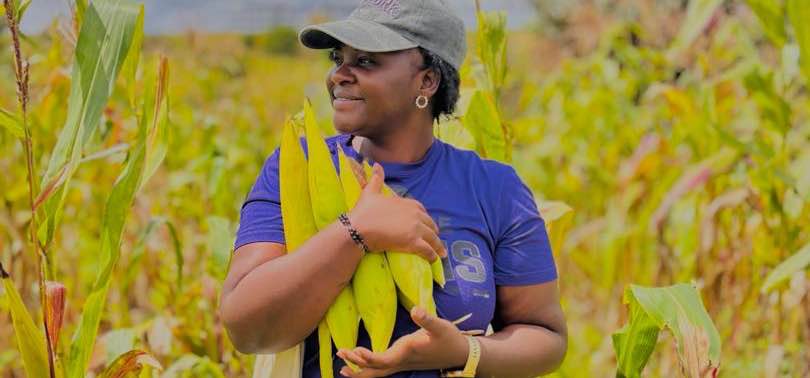
A season's worth of gambles, held in one armful of corn.
I picked up a bundle of corn from the field a while back, and it stayed with me longer than I expected. Not because of the corn itself, but because of everything that had to happen before it ended up in my hands.
That harvest didn't come easily. It came after a season of watching the rains behave unpredictably, of adjusting planting dates, of choosing seed varieties based on hard won experience rather than habit. None of that decision making was mine. I've spent years around rural women who carry that knowledge who know, almost instinctively now, how to read a shifting climate and still bring something home at the end of the season. Holding that corn, I felt proud, but it wasn't my pride to feel, not really. I hadn't done the waiting, the adjusting, the risking. I'd just shown up at the right time to see the result.
There's a version of this story where I could describe the field in detail the color of the husks, the sound of the leaves, the heat of the sun. But the truth is, none of that is the point. What matters is what it took to get there. Long before that corn was ready to be picked, someone had already made a dozen decisions that determined whether it would grow at all. Whether to plant early and risk a false start to the rains, or wait and risk losing time. Whether to trust a seed variety that had failed once before, or gamble on something new. These aren't small choices. In a bad year, they're the difference between a full harvest and an empty one.
I think about how rarely that decision making gets acknowledged. When people talk about food security, they tend to focus on outcomes yields, tonnage, numbers that go into a report. They don't talk about the woman who spent an extra hour each morning checking her field before the heat set in, or the one who changed her entire planting strategy after watching three seasons fail in a row. That knowledge isn't written down anywhere. It's carried, quietly, season after season, and it rarely gets credit. That's the thing about food security the visible part, the harvest, is only the last step in a much longer process most people never see. The early mornings. The failed attempts.
The quiet decisions made without any recognition. That's where the real work lives. I've come to think that if we actually want to talk seriously about resilience, we have to stop starting the story at the harvest. We have to start it back where the real risk was taken in the decisions nobody photographs, made by people nobody interviews.
I got to hold the corn. Someone else grew it. And if food security has a face at all, it's not the one holding the bundle for a photo. It's the one who spent a season making sure there was something to hold in the first place.
- Economic Power
- Environment
- Global