
For women in conflict zones, a resounding cry
Apr 14, 2025
initiative
Seeking
Collaboration


https://www.facebook.com/share/v/16SJnyDTPW/
I was not able to sleep all the night
The doctor gave me a saline solution and an injection to treat the drop in my blood pressure caused by the 13-hour journey, which involved riding a bus and a cart to reach the Damazin area, specifically the territory of the Emberro tribe.
The Emberro: ▪ They are part of the Fulani nomadic tribes who pursue their livestock. They have their own customs and traditions, not shared by any other Fulani tribe. They are primarily herders and do not sell their livestock. Their cows are called "kore" (red cows with medium horns). They also adorn themselves before marriage for both men and women.
Among the Emberro tribes, women represent the cornerstone of the men's responsibilities, such as building houses from straw, cloth, and wooden poles, as well as herding duties. Women in rural areas also choose their own life partners, with men not having the right to refuse.
The Ambroro tribes are pastoral tribes that settled in Sudan hundreds of years ago, migrating from Nigeria, Mali, and Cameroon. These tribes are spread across the areas extending from the Chadian border in the west to the Sudanese border in the east, and are also found in the regions of South Darfur, South Kordofan, and the Blue Nile. They represent a branch of the Fellata pastoralists.
According to historical documentation, the Fellata pastoralists are distinguished by their non-Negroid features, dark skin, long, flowing hair, and a straight nose.
Cows are a source of pride for the Ambroro tribes and an integral part of their authentic culture. They are reluctant to sell them, no matter what. Their cows are known as "korean" cows, with their long, massive horns.
The Ambroro have a distinct culture related to marriage, although it has recently begun to disappear, especially among groups that have assimilated with other Sudanese tribes and have been influenced by their customs. The girl would choose her life partner, and young men would line up at events in full finery for the girl to choose the one she liked. The young man would take her to the family's home and slaughter sacrificial animals for the feast, thus announcing the marriage. Before marrying his wife, the groom was required to kidnap her at night to be considered a desert knight. If he failed, he would have to repeat the attempt several times until he succeeded, otherwise his wife would remain in her family's home.
Ibrahim Tafli Idris, the sheikh of the Ambarro tribe in the Dinder region, told Al-Araby Al-Jadeed: "The Ambarro tribes have come to follow the Islamic method in terms of engagement and marriage contracts. However, a large portion of them still adhere to their original customs and traditions, rooted in their roots, while emphasizing marriage between relatives in general, especially cousins and maternal uncles."
Idris listed the challenges facing his tribe, including armed conflicts, shrinking irrigation areas, the tribe's confinement to a narrow area, and the looting and plundering of their livestock. The Ambroro tribe's adornment is not limited to girls. Boys also adorn themselves with the same ornaments, wearing necklaces and bracelets handwoven from colorful beads, and applying kohl to their eyes. Both girls and boys always carry a small jar of doum palm fruit around their necks, in which the kohl is placed, and it hangs over their chests.
The Ambroro's food culture is primarily based on corn, and they even rely on it in their drinks. They do not eat meat.
Tattooing is a cultural and customary practice among the Ambroro tribe. Everyone has decorative tattoos, a form of tribal custom and tradition. Severe cuts are also made on the face of each individual with a knife, with each tattoo consisting of between 60 and 70 cuts. Coals are placed on these cuts to cauterize them, leaving them on the cheeks or forehead for life. I arrived in this area with an international organization to identify the region's development needs and then submit them to donor agencies for implementation within the United Nations development plan, especially since it is one of the areas exposed to war, conflict, and landmines.
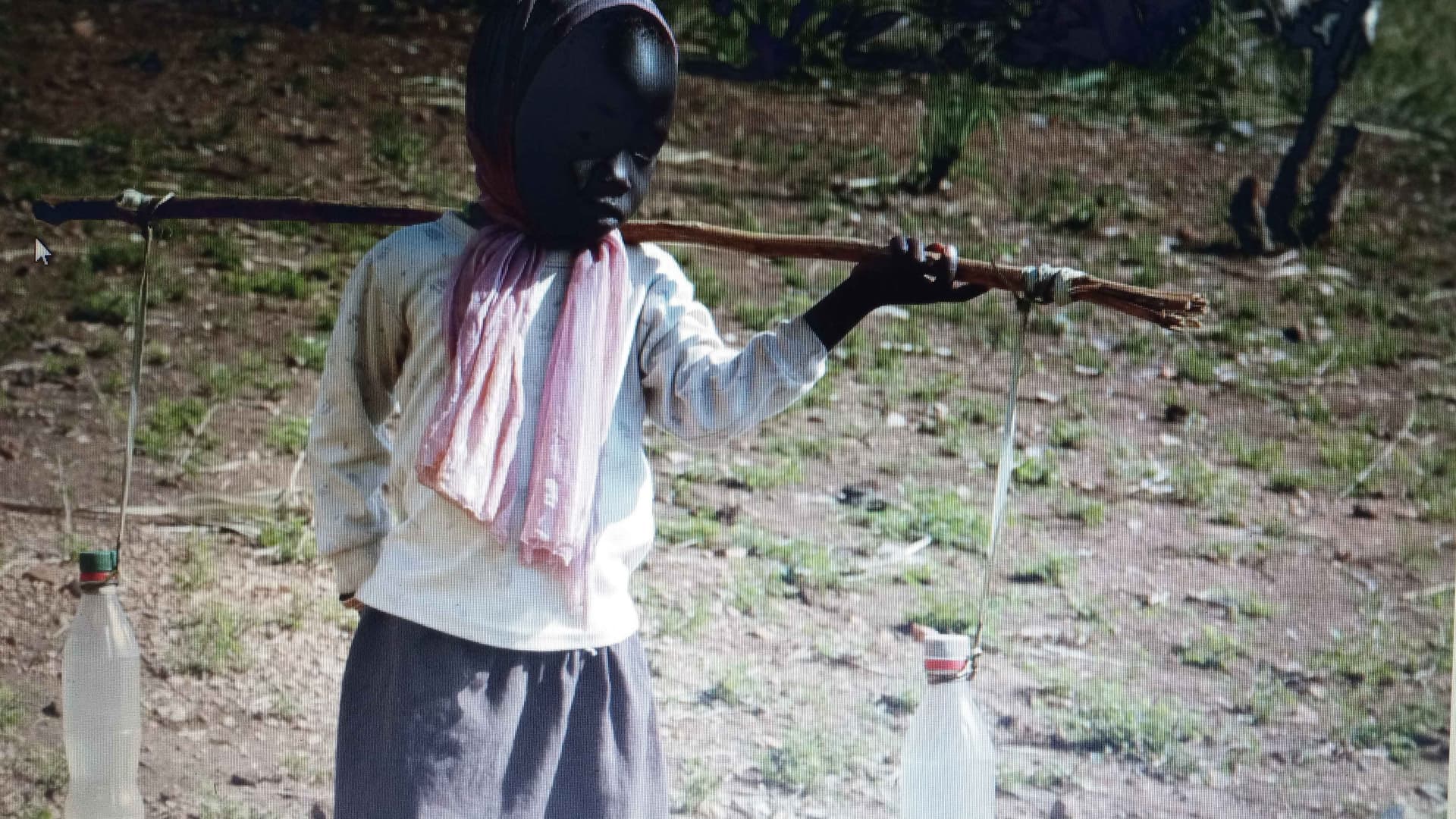
We visited the area from beginning to end, and the need for all development categories became apparent, from a health center to a maternity and obstetrics hospital, to funding water pumps and tanks, as women walk long distances to school and literacy programs, to agricultural projects, and electricity.
However, the greatest need emerged: the residents are vulnerable to night blindness, especially among the elderly.
We initiated an initiative to grow the bamby plant and give its seeds to women to plant in small fields in front of their homes.
This could contribute to eliminating night blindness among the residents.
It also contributes to empowering women and strengthening them economically.
The organization then purchases the bamby crop, sells it in the market, and gives it to the women.
In order to increase their income and, consequently, the village's GDP, the women were able to succeed and provide for their children and care for and treat the elderly. The initiative then expanded to other villages to achieve economic self-sufficiency for the village women. The organization donated 60 percent of the cost of the development projects, while the Sudanese government covered 40 percent of the remaining cost after the signing of the peace agreement in the region.
- Economic Power
- Human Rights
- Gender-based Violence
- Girl Power
- Peace Building
- Human Trafficking
- Global