
From Suicidal To Changemaker- Why Funding Women-led Organisations Matter
Apr 29, 2025
story
Seeking
Visibility

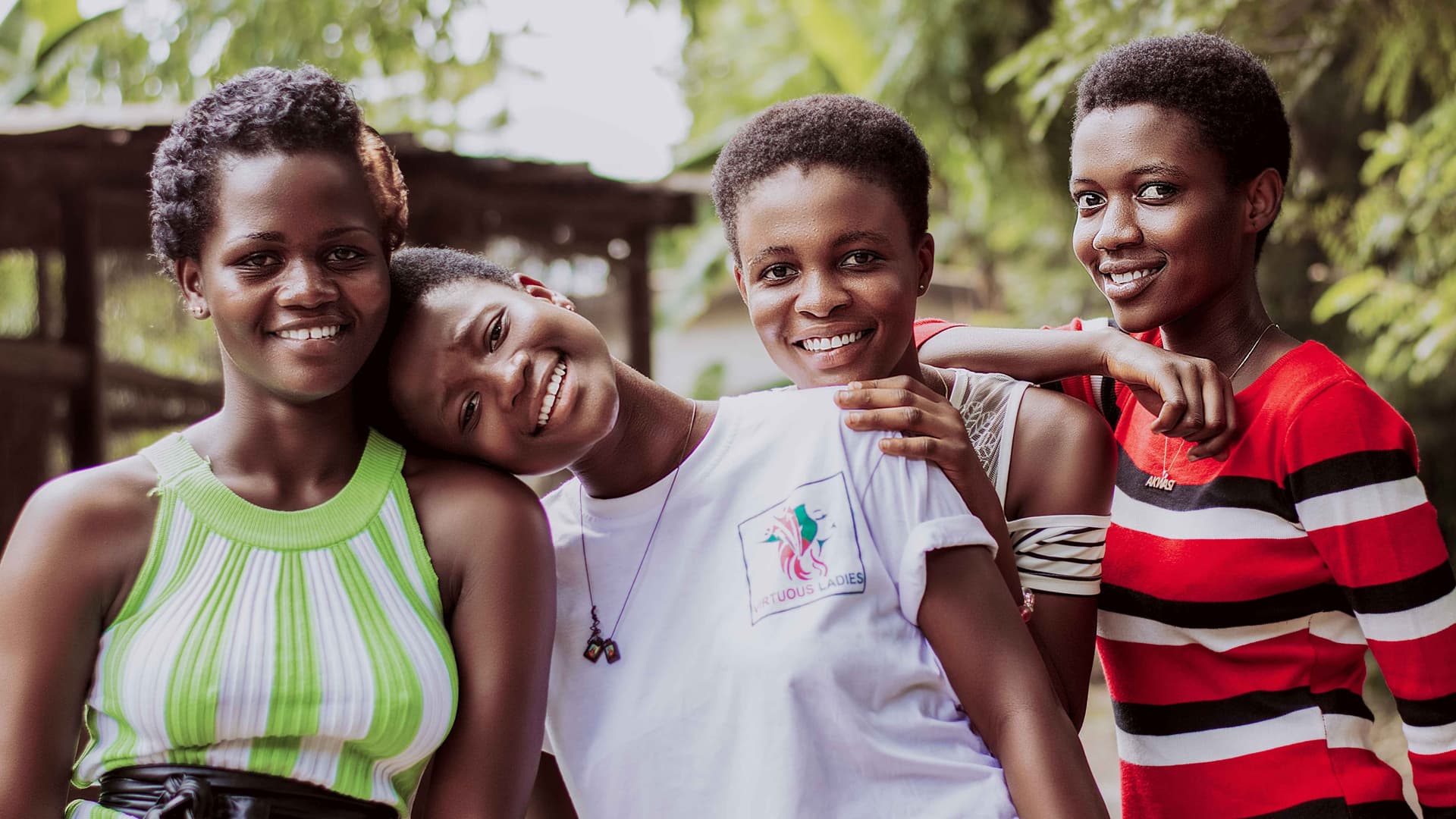
Four young girls in a row posing for a photograph and smiling
Dear Jennifer O.,
I am writing to thank you sincerely for the surprise donation of $200 you sent our way last week. You apologetically mentioned that it is the smallest donation you have ever sent, but I would like you to know that it went a very 'big' way in supporting our cause.
As you know, the termination of USAID assistance put an abrupt end to the supply of drugs and availability of treatment and care for us, People Living With HIV and AIDS (PLWHAs) in Nigeria. To access care, we now have to rely on dwindling government supply, queuing at general hospitals as early as 5 am. Naturally, this causes a bigger strain on a subset of our target beneficiaries: mothers. Many of them have to travel long distances to the hospitals, and have to make necessary provisions for food and care for their children. Whether the children are left at home or accompany them to the hospital. Add to that the current crushing economic hardship in Nigeria, and you will begin to understand why some people have currently abandoned treatment altogether.
With your donation, we were able to provide nine of our beneficiaries with funds to cover their transportation and feeding for their children for that day, and possibly a whole week. We also paid for medical tests for a newly diagnosed young lady. So it wasn't small to us.
But let me be transparent with you, Jennifer, I am worried about the future.
I've probably never told you this, but when I started this NGO in 2017, I was motivated by two factors. The first was the feeling of well-being after being on ARVs for a week. You see, I had just been taken into private treatment for HIV after years of abuse and ill-health from public care. A message I sent on a random website about being suicidal and needing help led me to this donor-funded treatment centre, and to the best care of my life. I'll never forget how my nurse monitored me the first few days of administering ARVs, and when I had no adverse reactions, she threw a dance party for me. This propelled me to become an ambassador for early treatment and care because I saw myself as proof that HIV is just an illness that can be managed.
The second motivational factor was a visit to a cooperative for Dalit women in India, at the behest of a women-led NGO. (This was in the early days when I was learning to run a social venture and we were being shown the ropes.) The ladies each told us personal stories of how community and microcredit helped rebuild their lives. As a result of economic empowerment, they were able to support themselves, stand up to their alcoholic, abusive husbands and be respected in their communities.
It was my first lesson in the fact that funding women changes the family and community dynamic and creates evident shifts in the balance of power. And I ran with it.
However, in the last 4 months, so much has changed. There are no more discreet treatment centres or One Stop Shops to refer vulnerable teenage PLWHAs. Our limited funds - usually used for the odd financial intervention to supplement treatment - are now almost solely being used for procuring treatment. And, the current limitations in the supply of ARVs and associated Sexual and Reproductive Health and Rights (SRHR) prophylactics make nonsense of our Behavioural Change Communication.
Because how do you say “HIV is manageable. Look at us! Just take your medication and use protection”, when there is practically no medication or protection available?
(Sigh. I seem to have gone off on a tangent, Jennifer. I apologise. It's just that before this, we made a lot of progress, and I would love that to be sustained.)
Remember *John? The little orphan boy in a village in Cross River state who was failing to adhere to his medication because he was neglected, hungry and depressed? We rallied around to give his family food for a year, keep him in school, assess his health and refill his meds at the treatment centre, and provide him with some clothing. All it took was about $650 in total. Now, however, only medication might take a chunk of that.
Then there was also *Uloma, whose husband died of undisclosed AIDS, infected her with HIV, and left her pregnant with their baby. His family accused her of being behind his death. We had to stage an intervention with her proximate family members and the management of the clinic over 3 days, paying for transportation for those to whom it was a problem, a total cost of roughly $120 then.
And I can't forget 13-year-old *Zinnat, who was born with HIV. She slipped a cryptic note in during the Q&A aspect of our SRHR classes asking “if I am on my period, will I ‘give’ my family HIV”. We went to her home to educate her family on HIV so she could no longer be treated as a pariah, support her single mum financially and teach her personal care/hygiene.
There have also been countless others who have gone for and adhered to treatment, revealed their status to their spouses, and developed more responsible sexual behaviour because of our evangelism and care.
My point is that working to help female PLWHAs and young women sometimes means providing information and counselling, or providing financial interventions, or (as is the case now) advocating for justice and equity at the (inter)national level. Because the well-being of women sits at the cusp of crucial but underserved socioeconomic issues (like health, education, poverty, etc). And I, as a woman, understand this.
So we will continue to humbly request and gratefully accept your donations (large and small); your voice calling for change in unison with ours, and your referrals as much as possible. Every vote in favour of a woman is a strategic bet for change.
Thank you so much, Jennifer, for being there for us all these years, and for the time taken to read this long letter.
Yours in change,
Mary Ero.
- Gender-based Violence
- Economic Power
- Girl Power
- Health
- #FundHerNow
- Africa