
How We Learned to Stop Worrying and Love Not Being Vaporized
Oct 4, 2025
story
Seeking
Visibility


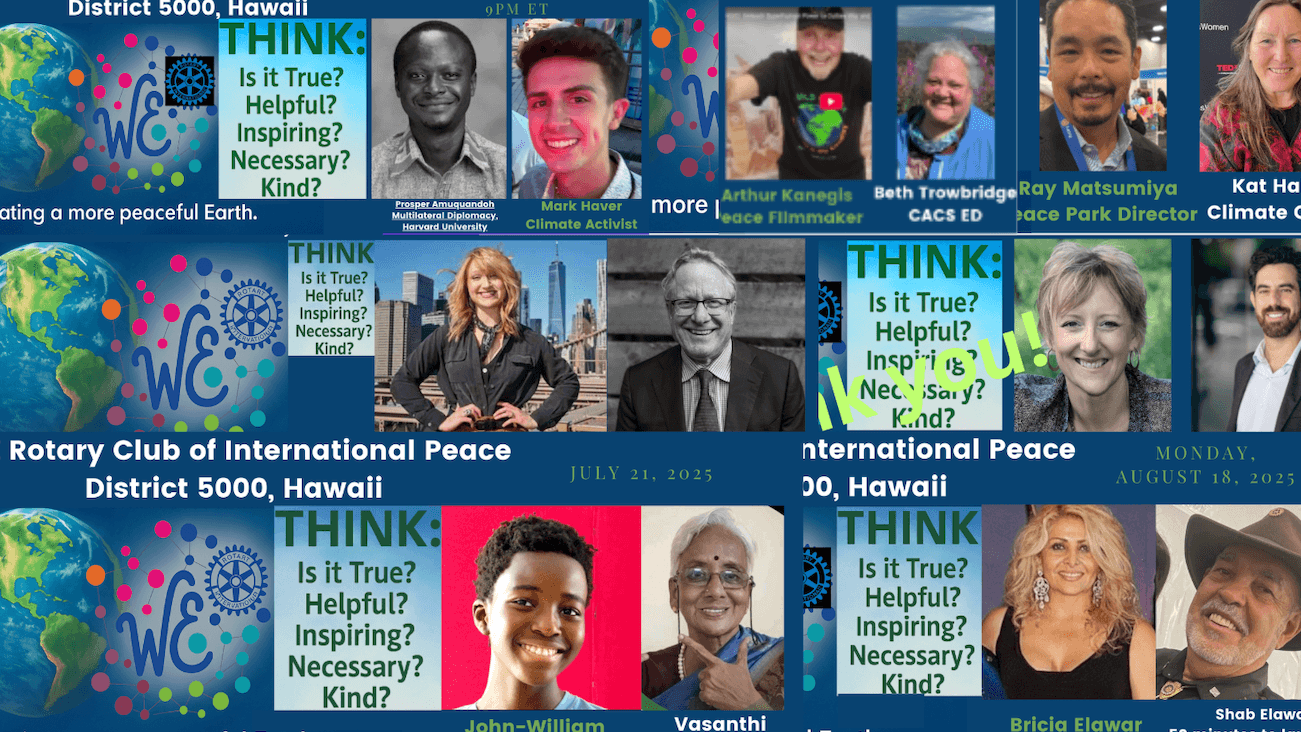
Photo Credit: Kat Haber
WE belong to each other: Peace Builders and Earth Keepers
In those quiet moments before your alarm goes off, while you're deciding whether to hit snooze, nine countries are sitting on enough firepower to turn all of us into historical footnotes. Nine! That's the same number of Supreme Court justices, and we all know how well that's going.
Somewhere beneath your feet right now—yes, right now—submarines are cruising around like apocalyptic Ubers, their drivers ready to deliver humanity's worst possible DoorDash order. "Your civilization-ending fireball will arrive in approximately 30 minutes. Please rate your experience!"
The Morning After (And We Don't Mean the Cute Rom-Com)
Picture this: You wake up to discover that "devastating morning commute" has taken on a whole new meaning. Those people permanently shadow-printed onto concrete walls? They were just trying to get to their soul-crushing middle management jobs. Now they're literally part of the architecture. Talk about commitment to the grind.
Cell towers? Gone. Instagram? Gone. The ability to text "u up?" at 2 AM? Tragically, also gone. Even worse—no Wi-Fi to doomscroll through what's left of civilization. The irony is almost poetic: we finally achieve the digital detox everyone's been talking about, and it turns out nuclear winter is involved.
The hospitals are vaporized, which is unfortunate because radiation poisoning is apparently quite unpleasant (citation: science). The firefighters are ash. Your favorite coffee shop? Well, the barista who always spelled your name wrong is now just a memory in a world where remembering things seems like showing off.
This isn't a bad Netflix series (though let's be honest, they'd probably green-light it). This is the actual, peer-reviewed, scientist-approved disaster that nine nations could trigger faster than you can say "Did anyone else hear that siren?"
One Guy Who Actually Knows What He's Talking About
George Shultz, former U.S. Secretary of State (and someone who actually sat in rooms where these decisions were made), put it bluntly: "the U.S. soon will be compelled to enter a new nuclear era that will be more precarious, psychologically disorienting, and economically even more costly than was Cold War deterrence."
Translation: "You thought the Cold War was expensive and terrifying? Buckle up, buttercup. You haven't seen anything yet."
More precarious. More disorienting. More expensive. It's like getting the worst possible upgrade on everything simultaneously.
But Wait—There's a Better Plot Twist!
Here's the wild part: We could just... not do that. Revolutionary concept, I know.
Imagine waking up to actual birdsong instead of the distant sounds of extremely expensive military toys being tested. Picture humanity's smartest people working on not perfecting new ways to murder millions. It's a niche concept, but hear me out.
We spend $95 billion annually on nuclear weapons. That's billion. With a B. Like, "we could probably solve a bunch of actual problems with that money" money. Americans could have nice things like healthcare, affordable houses, and natural disaster protection. But instead, we're maintaining thousands of world-ending devices like the universe's worst storage unit rental. "Yeah, I know I haven't used these in 80 years, but you never know when you might need to end all human civilization!"
Picture this alternative timeline: Those underground doomsday bunkers? Now they're underground gardens. The submarines? Carrying marine biologists instead of Armageddon. The uranium? Powering hospitals instead of powering nightmares. Scientists calculating coral reef restoration instead of blast radii. It's like the world's most wholesome career change program.
The Doomsday Clock—yes, we have an actual clock for this—could finally be retired, instead of being the closest to midnight ever. Future kids in museums would be like, "Wait, grandma, you're telling me we almost destroyed ourselves on purpose? That's the dumbest thing I've ever heard." And we'd have to be like, "Yeah, kiddo. Yeah, it really was."
People Actually Doing Something About This
Hosted in Glenview, Illinois by Ward Wilson—fellow WE Rotarian and author of It Is Possible. Ward makes homemade ice cream while writing about nuclear disarmament, which is the most aggressively optimistic thing I've ever heard. "Sure, humanity might vaporize itself, but have you tried my vanilla with blueberries?" He's currently working on his third book about nuclear weapons AND a teeny tiny guide about what each of us can do to stop rearming the world. Because apparently someone needs to write "Nuclear Weapons: For Dummies (Who Want to Get Rid of Them)." Think of the book, "On Tyranny," only for Nukes.
And speaking of jaw-dropping irony that would make a Geek tragedy seem upbeat: Remember Ukraine? They gave up their nuclear weapons in exchange for a pinky-promise from America and the EU that they'd be protected from Russia. "Just hand over the nukes," we said. "What could possibly go wrong?" Fast forward to now: Russia is threatening Ukraine, and we're all standing around like that "This Is Fine" dog in a burning room, except the room is the entire geopolitical order and the fire is nuclear rearmament. Ukraine is probably drafting the world's most justified "I told you so" speech, and honestly, they've earned it. It's like watching someone give up their security deposit and then having their landlord immediately try to evict them AND move in themselves. The audacity is almost impressive.
While the rest of us are doom-scrolling, the Rotary Club of International Peace is actually bringing together people who are building the world we need. This year's speaker lineup reads like the Avengers of peace and planetary healing:
- Ray Matsumiya and I debriefed the Calgary Peace Park at the Rotary International Annual Convention—that's 20,000 people learning about peace infrastructure. Not bad for a Tuesday.
- Vasanthi Ranganathan, a peace builder from India, advocates for peace first, then planet (because it's hard to save the Earth if we're all vaporized), alongside eco-activist John William Zziwa, who's keeping the planet livable while we figure out how not to destroy it.
- Arthur Kanegis, conservation filmmaker and peace builder extraordinaire, teamed up with Beth Trowbridge, Executive Director of the Center for Alaskan Coastal Studies—proving that protecting coastlines and building peace go hand in hand.
- Chris Rose, founder of Renewable Energy Alaska Project, and Sarah Brockley, head of Sustainability for Burning Man (yes, really), showing that even temporary desert cities can teach us about sustainable living.
- Chehab Elawar launched 34 Rotary Global Grants worth over a million dollars in 50 minutes at the Peace Park (speed-running peace funding like a boss), while Bricia Elawar cleans up the Rio Grande—because clean water is peace work too.
- Mark Panayiotis Notaras, a Rotary Peace Fellow researching TRUST (the thing we desperately need more of), collaborates with Dawn Byford, the Green Diet Diva, on building that foundation.
- And from Climate Week in New York City last week, I lined up Prosper A. Amuquandoh, diplomat of Ghana, partnered with Mark Haver, a young ocean conservationist proving that the next generation isn't waiting around for us to figure things out.
These aren't just talkers. They're doers. They're the people building the alternative timeline while the rest of the world is still arguing about whether we should maybe consider possibly thinking about doing something.
The Punchline (Except It's Not Funny)
Here's where we are: Climate change is literally on fire, democracy is having a nervous breakdown, and we're still pouring resources into weapons whose only guarantee is that we won't have to worry about any other problems because we'll all be dead.
It's like watching someone frantically arrange deck chairs on the Titanic while also drilling holes in the hull "for security purposes."
Nine nations. Thousands of warheads. One fragile planet. And somewhere, right now, someone's job is to make sure these weapons are maintained and ready to go—like the world's worst Geek Squad.
The good news? We can change this. The bad news? We're still having to convince people that "not ending all human life" is worth pursuing.
So here's your homework: Learn about nuclear weapons. Not because it's fun (it's decidedly not), but because understanding the problem is the first step to fixing it. Talk about disarmament. Support organizations working toward a nuclear-free world—like the Rotary Club of International Peace and the peace builders already doing the work.
Because honestly, the alternative is too stupid to contemplate.
We're the generation that gets to choose: Do we keep playing chicken with extinction, or do we finally grow up and put away the doomsday devices?
Choose wisely. The shadow you save from being permanently burned into concrete might be your own.
- Leadership
- Environment
- Stronger Together
- Peace Building
- Youth
- Climate Change
- Global