
INDIA: Let’s Make the Internet Safer for Women
Aug 1, 2021
story


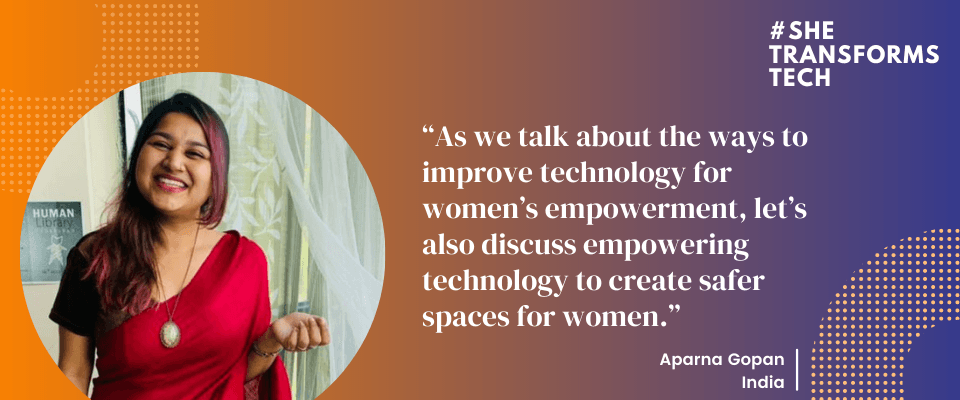
Journalist and nonprofit founder Aparna Gopan survived cyberbullying. Now she’s leading campaigns to protect other gender minorities from online abuse.
As we talk about the numerous ways to improve technology for women’s empowerment, let’s also discuss empowering technology to create safer spaces for women.
I am the founder of the Black and Blue Eye Project against cyberbullying, and I am a survivor of online abuse. Most women I know have experienced bullying online, yet because it doesn’t leave visible scars, people seem to be indifferent toward this crime. Where is the outrage against this mentality that it’s okay to cyberbully a gender minority into submission?
Gendered cyberbullying is more than just trolling. It is abuse. The number of people who systematically attack women and gender minorities is far too many to report. According to data by the National Crime Records Bureau, cases of cyberstalking or bullying of women or children in India increased by 36 percent between 2017 and 2018. Meanwhile, the conviction rate for cyberstalking or bullying of women and children fell from 40 percent to 25 percent during that period.
Every time a woman or a gender minority posts something that fires up debate, you can see how the comments quickly become sexist and threatening. Cyberbullies will often get into detailed character assassination, sometimes graphically describing how they would like to harass the woman. We continually fail new generations when we tolerate this behavior and disregard the humanity of the people behind the screen.
While the U. S. And Australia previously topped the list of countries with the highest number of cyberbullying cases, India has been a front-runner since 2018. This led me to act. I started by conducting sessions about gendered cyber abuse in colleges and schools in Kerala. Then, while researching new case studies, I read about Angelina Green, a 14-year-old American girl who died by suicide due to harassment and online bullying. Her story haunted me, especially the gruesome detail that she chose to hang herself from a tree next to her school bus stop so that her bullies would see her lifeless body.
That’s when I started The Black and Blue Eye Project, a campaign that partners with internet giants and policymakers to prevent cybercrime in public spaces. We work to illustrate the hidden bruises and consequences of cyberbullying. We are devising better ways of reporting cyber abuse and implementing preventive measures like enabling toggles to identify abusive words or phrases with our partners. We are also working with government organizations to discuss cyberbullying as a part of the school curriculum.
As the first campaign action, we organized an exhibition against online bullying in Trivandrum. The show featured screenshots of gendered cyber abuse and paintings of women, children, and gender minorities with black and blue eyes. These images highlight that every rape threat and insensitive comment leaves a lasting scar on the survivor.
We also detailed five cases of teenage suicide that resulted from online bullying, asking exhibit visitors to pledge they would act to stop this crime. Parents and educators praised the campaign, with detailed news reports on major media outlets. This gave us more visibility, but also backlash.
Still, we kept devising new ways to amplify our impact. We got parents to attend sessions where we suggested measures to prevent their children from becoming bullies. We introduced apps like rethink, which acts as a Google keypad and sends out a prompt to detect insensitive words or phrases.
Our next step with The Black and Blue Eye Project is to reach more cities. We’d like to expand to 10 educational institutions per city, maximizing our impact by offering a free exhibition like the one in Trivandrum. We’re also developing an app that records the number of verified reports against social media accounts. This will help create safer spaces and deter cyberbullies at an early age.
Cyberbullying can target anyone. Our project itself dealt with a lot of criticism for taking action against online bullying. At one point, we had our venue partners and sponsors back out because of our posters, which featured real-life screenshots of cyber abuse.
Some people thought what we are doing is an infringement of the abuser’s free speech. But those who argue fail to recognize that these public threats and comments contribute to the indifferent tolerance of gendered violence. Cyber abuse spreads a toxic mentality, leading to harassment, rape, and acid attacks.
As we talk about the numerous ways to improve technology for women’s empowerment, let’s also discuss empowering technology to create safer spaces for women online and otherwise.
This story was published as part of World Pulse's shetransformstech Campaign and is included in the #shetransformstech final report. Download the report to find out what grassroots women and gender-diverse individuals from 60+ countries say individuals, policymakers, and tech companies must do to make tech equitable for all.
- She Transforms Tech
- South and Central Asia