
INDIA: Men, Motorcycles, and Menstruation
Oct 18, 2020
story
Saurav Kumar
Changemaker Urmila Chanam rallies men to take to their motorbikes to end the isolation of menstruating girls and women across India.
We ride because together we can change the way women experience menstruation stigma and shame.
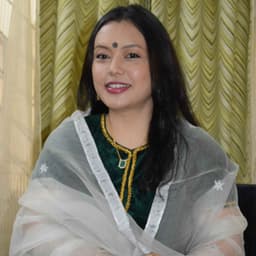
I am Urmila Chanam, menstrual health and women’s rights and founder of Breaking the Silence Worldwide Foundation. It is my passion and life’s mission to end the myths, taboos, and stigma around menstrual periods so that 336 million menstruating girls and women in India can live a healthy and dignified life.
In my work, I travel from one corner of India to another. I walk through the remotest of villages to deliver the message that menstruation is a life-giving phenomenon; menstrual blood is not impure, and that hygiene is key to keeping disease away and to living an empowered life based on accurate information about our bodies, sexuality, and reproductive health.
In a 2010 study by A. C. Nielson it was found that only 12% of menstruating women in India use sanitary napkins while 88% use unhygienic materials like old fabric, rags, or sand due to affordability issues and deep-rooted myths and taboos that create an illusion that menstruation is shameful, polluting, and dirty. Twenty-three percent of girls were reported to be leaving school at the onset of puberty and menstruation, and millions live in the dark about what menstruation is; what sanitary material to use; the importance of hygiene and self-care; and the necessity of educating our daughters.
Over the years, with global activism and grassroots intervention led by development agencies, the data is gradually changing. The percentage of menstruating girls and women who use sanitary napkins has risen from 12% to 36% (National Family Health Survey-4, 2015-2016: India Fact Sheet). But a new problem is emerging: Over 1 billion non-compostable sanitary pads are making their way to urban sewage systems, landfills, rural fields, and water bodies in India every month posing a hazard to humans, animals, and the environment.
There is an aspect that remains unchanged and that is the isolation of menstruating girls and women observed in varying degrees as per region, religion or community. Out of every 100 girls, 77 cannot enter places of worship or pray, 50 cannot touch other people or special food items, and 26 are forced to sleep separately during their periods (van Eijk et all (2016).
In November 2018, in Tamil Nadu, a 14-year old girl died in a cyclone after being forced to sleep separately in a hut isolated from the house because she was menstruating.
I know that we can undo the damage done so far by being agents of change. I know that statistics and stories like these can be created anew—but we first must break the silence and speak out publicly about taboos.
Involving Men
In my work at the grassroots level, I have come to believe that it is vanity to discuss women’s empowerment just amongst ourselves, as women, without also educating men. It is ineffective to approach menstrual hygiene without garnering support from our partners in life and those who control the family resources in a patriarchal society like India.
I have found that menstrual hygiene initiatives led by ngos and the government are focused on raising awareness amongst mothers, daughters, and girls. But, I ask, what is the benefit of only raising awareness amongst females when the decisions related to what happens at home, schools, hospitals, and office places are actually made by men folk?
For instance, 130 million of India’s households lack toilets, leaving women and girls with many challenges to manage their menstruation hygienically and in privacy. Involvement of men is absolutely necessary to ensure that women can have the infrastructure and facilities needed to manage menstruation, things like functional toilets; clean water to wash; soap, and disposal systems that are safe, environmentally friendly, and private.
That’s why the idea for the Men Take Lead Ride came to me three years back.
Menstrual Hygiene Day & The Bull Riders
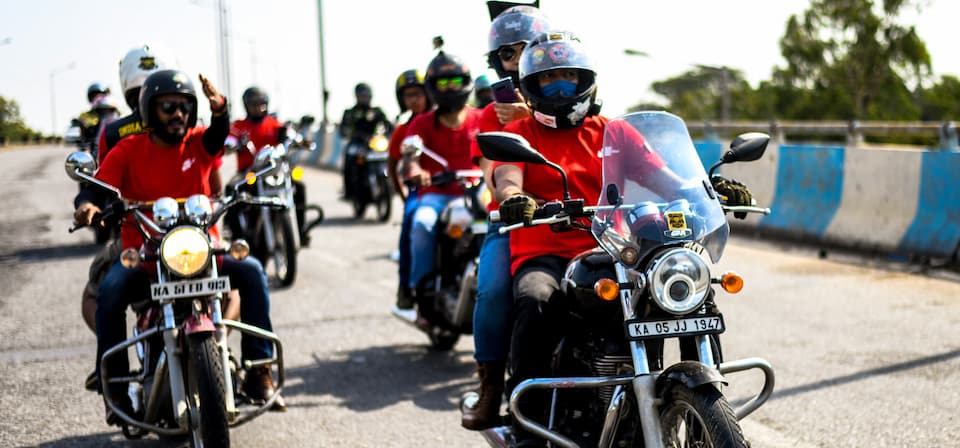
On 26 May, to commemorate International Menstrual Hygiene Day, Breaking the Silence, in partnership with India Bull Riders and Radio Active 90. 4 mhz, led a bike rally in Bengaluru to call for an end to isolation of menstruating girls and women.
We had close to 120 bikers who rode a distance of 40kms in the heart of the city, signifiying the 40 years a woman menstruates in her lifetime. The ride ended with pledge-taking led by men. Men took oaths to never isolate girls and women during their periods and, in the incidence of its occurrence, to intervene and sensitize others.
This is the second time I have organized the Men Take Lead Ride, the first being in the 2017. The event was recognized as one the leading events in the world happening on International Menstrual Hygiene Day by MH Day Secretariat and WASH United.
The Men Take Lead Ride is not just a bike ride on Menstrual Hygiene Day; it’s a movement involving many, especially men, to make menstrual hygiene a reality. What began as a deep conversation between me and Nujo John, my friend, one evening three years ago has given shape to a bike ride and a social movement that is changing the way menstruation is discussed and experienced in India.
We will ride again on 2 June 2019 in Kolkata, and we will ride in 2020 in different cities across India.
We ride because during periods, girls and women are pushed out of the kitchen and away from food items.
During periods, girls and women must sleep in different rooms, outside the house, in the barn where cattle are kept, in isolated huts away from the main household.
We ride because, during periods, girls and women are made to not interact with or touch others.
During periods, girls and women are not considered ‘pure’ enough to engage in any worship or spiritual activity.
We ride because the stigma and taboos attached to menstruation erode human rights and take away the dignity and self-respect of women and girls and affect our safety.
We ride to call for societal change. We ride because together we can change the way women experience menstruation stigma and shame.
This story was published as part of the World Pulse Story Awards program. We believe every woman has a story to share, and that the world will be a better place when women are heard. Share your story with us, and you could receive added visibility, or even be our next Featured Storyteller! Learn more.
- Girl Power
- Health
- Positive Masculinity
- Human Rights
- Salud menstrual
- South and Central Asia