
Like Wangari Mathaai, Zimbawean women politicians plant their 'Tree of Hopes' in Kenya
Jan 21, 2015
story
On 12 October 2004 Professor Wangari Maathai, Nobel Peace Prize Recipient and then Assistant Minister for Environment, Natural Resources and Wildlife planted a tree behind the United Nations Environment Programme (UNEP) headquarters in Gigiri, Nairobi Kenya. The tree is surrounded by 15 other trees planted by the 15 members of the United Nations Security Council (UNSC). The UNSC is one of the six principal organs of the United Nations charged with the maintenance of international peace and security. Its powers include the establishment of peacekeeping operations, the establishment of international sanctions, and the authorization of military through Security Council resolutions; and is the only UN body with the authority to issue binding resolutions to member states.
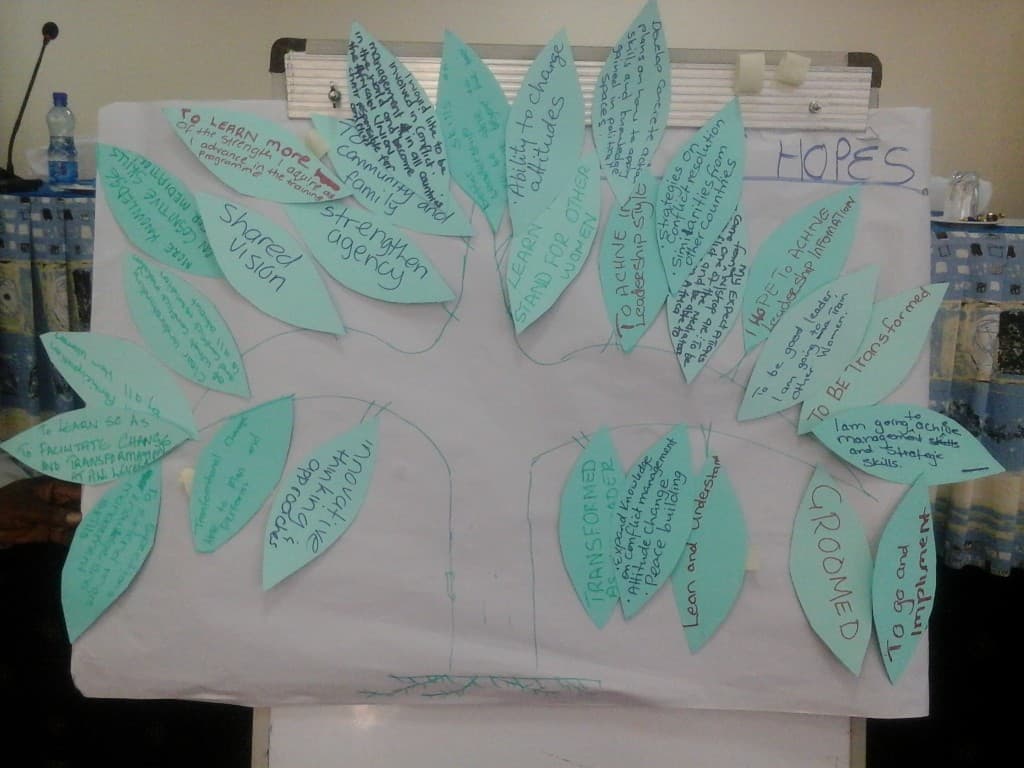
On 24th May, four days ago, thirteen women political party leaders from Zimbabwe planted their Tree of Hopes at the Training on Leadership, Conflict Mediation and Conflict Resolution taking place at the UN Women African Centre for Transformative and Inclusive Leadership (ACTIL) at Kenyatta University in Nairobi, Kenya. This metaphoric representation reflects the hopes and aspirations of the women who are participants at a training of Leadership, Conflict Mediation and Conflict Transformation to also influence and drive a binding agenda for women’s active participation in politics and for lasting peace and security in their country.
Located under the rubric of the broader Women, Peace and Security agenda, the training is a culmination of an elongated 3 level training curricula put together by UNW omen to benefit women parliamentarians and women leaders form the political party wings in Zimbabwe. Besides providing theoretical and practical knowledge on Leadership, Conflict Mediation and Conflict Transformation, this training has been a catalyst in uniting the women of Zimbabwe across their political party fragmentations, and has been an effective way of providing a safe space for women politicians from different political parties to reflect, share and hope for a better future. The Zimbabwe political landscape is punctuated by both inter and intra political party divisions, and whilst these are hard for political engagement in general, they are worse for women who suffer these divisions at both societal and political party levels. Zimbabwean women here present have agreed to represent and showcase a small community of practice with a shared vision for unity, and will seek to influence other women of Zimbabwe for same, and have silently signed a silent pact for the women from the political parties to support each other in pursuit of their political objectives, especially in parliament. The women political leaders have highlighted as one of their major problems in parliament the hackling that they experience from men, and sometimes from fellow women from oppose political parties.
“There is too much hackling in parliament. As women we are not free to debate, and worse to introduce gender sensitive motions because we are quickly hackled and booed down. But the pain comes when you are hackled by your fellow women simply because you belong to a different political party,” said Honourable Fanny Chirisa, former Civil Society political activist who was sworn into parliament in 2013.
The women of Zimbabwe here present have agreed never to hackle each other again in parliament and to stand up against such hackling from male counterparts. Using a feminist popular education teaching approach, the facilitator Dr Martha Mutisi paired the participants for ‘appreciative inquiry’ at the start of the workshop and this presented a good opportunity for them to highlight each other’s strengths. The revelations were brutally honest, candid and transformative. The general expectation was that the women would show appreciation along party lines but it was really shocking and revealing how they did this across their political party lines. Below are some of the testimonies from the women.
“When we started the Level I training in Nyanga there was so much tension and we were shouting at each other and calling each other names. There was so much anger and the facilitator Dr Martha Mutisi and UNW omen staff had to constantly watch out for these dynamics. One day two women from different political parties nearly got out of hand; I almost thought they were going to engage in fist fighting. I am surprised that now we have gone beyond our political party division and we are getting somewhere. I thank UN Women for bringing me to Kenyatta University. Here I am touched by the female leaders; they handle all the dynamics without the guidance of men. All key leaders are women and they are professors. After this training I want to go back to study, I also want to become a professor.” Trainer Ruzvidzo, MDC T
“I have a confession to make. When I got the first invitation to attend the training in Nyanga and met women from ZANU PF I did not see women, I saw my enemies. I was not happy at all. It was soon after elections and worse to it I had lost my aspired seat in the elections. Everything about the violence in the 2008 elections was still sitting with me and the more I saw women from across my party the more I got angry. One day when the facilitator asked someone to pray I volunteered because I wanted to really attack my ‘enemies’. I am sure everyone remembers my prayers, I said “God you know that we are amongst our enemies. Please protect us from our enemies.’ I remember there was so much chaos after that prayer because the ZANU PF colleagues knew that I was attacking them. My worst ‘enemy’ that time was Tsitsi Caroline Mugabe because we were in COPAC together and the divisions along political party lines in COPAC had really managed to further split us. At the second workshop Dr Mutisi took us through a lot of games and role playing activities that gradually socialised us to working together and to accepting each other, and the anger started going away bit by bit. I also learnt new communication skills, she taught us about the 5 levels of communication, and that communication takes place through the brain, the heart, the soul, the eyes and the ears. She told us that these make a person complete and communication more effective. I started practicing that, looking at my colleagues in the eyes and seeking to feel them in my heart and soul, and also watching them and noticing that they meant well for me. But mostly I learnt to listen to them more carefully without rushing to judge them. This really helped me to start appreciating my fellow women. Sabhina Mangwende kept talking to me and inviting me to conversations and I learnt to loosen up. Today Caroline is my best friend and all my anger is gone. I am very happy to be here and it is the first time I have boarded an aeroplane. UN Women assisted me to get a bank account and an email address. I could not do that because my documents were destroyed in the election violence and I had given up on life. Now I feel motivated to start all over again and work with my fellow politicians from all political parties to over throw women’s oppression. Thank you UN Women for uniting us.” Thandiwe Shumba-Mlilo, MDC N
“I was pushing my heavy trolley and trying to get it inside the bus at Kenyatta airport. Susan from MDC T just came unannounced and offered to help. I was shocked, and I said to her “Are you sure you know what you are doing?” Before I finished that statement Susan had lifted my bag and it was in the bus. My colleagues from ZANU PF looked at me and admonished me, “Why are you asking if she is sure, she is very sure.” This taught me to be more accepting of my colleagues from the opposition. Today I was sharing jokes with Monica from MDC M and I even told her how special she is.” Caroline Tsitsi Mugabe – ZANU PF Women’s League Executive Treasurer
“I have problems with my legs, I can hardly walk long distances after a long flight because of diabetes. When we got to Kenyatta airport I was really struggling to get into the UN vehicle. Honourable Sabhina Mangwende of ZANU PF took my hand and helped me into the car. Honourable Khupe from my party marvelled and said, “Fanny, Sabhina is from ZANU PF but look what is happening. We looked at each other and smiled.” Fanny Chirisa, MDC T
‘I had challenges attending the Level II training in Mutare because my father in law was not well and I could not catch the bus that UN Women had hired for us. I could not fill up my tank because I had a lot of hospital bills for my in-law. Honourable Toffa and Honourable Ndlovu from MDC N offered to fill up my tank and I was able to attend the workshop. I was surprised.” Sibusisiwe Budha, MDC T
“Honourable Mangwende sits directly opposite me in parliament. I see her listening carefully and nodding each time women are speaking, and she does the same for all women regardless of which party they come from. That nodding and affirmation motivates women to participate in parliament despite the hackling from men and I appreciate her for that.” Honourable Thokozani Khupe, MDC T
“When Honourable Mangwende appreciated me and told me that she was proud of me I felt encouraged. I pray for UN Women to lead us to our destiny so that I as a young woman can also become like these elderly honourable women members.” For me the issue is no longer so much about ZANU PF or MDC, I know we belong to these parties for our political identities but what matters more for me now is our aspirations as women to transform everyday perceptions of party politics in order to build our nation.” Susan Matsunga MDC T Defence and Security Officer.
“This training changed my thinking around our relationships as women in politics. When we first met I was so conscious of who belonged to my party but through interactions with women from across the parties I have risen above what divides us. As women we must get above our political party thinking and work together to build a transformative agenda for all women of Zimbabwe. We must challenge those barriers that stop us from participating in politics freely, and we must do it with a united voice as women of Zimbabwe. I admire all my colleagues across the parties, and also admire Honourable Khupe for all her courage as a woman leader in the MDC.” Honourable Sabhina Mangwende, ZANU PF
“UN Women has really collapsed the walls that used to separate us as women from different political parties. When we started this training at Level I everything was heavy and tense. I was afraid to name issues openly in the space for fear of being labelled. I feared to hug my sisters from ZANU PF for fear of my MDC colleagues. Now I am free to hug them and I call them comrades. If we continue with this attitude and perception we will have a changed country in no time at all.” Monica Ncube, MDC N.
“I am motivated by Honourable Thokozani Khupe. I started interacting with her when she was the Vice Prime Minister in the government of national unity in Zimbabwe. I tour guided her at the National Zimbabwe Monument and she gave me a very big tip that surprised me. Last night I came here in the same delegation with her and I was served food on the same table with her. I once served her, now we are being served together because I chose to seek leadership in the political party wing. Nothing is impossible. I can also become a strong woman.” Hlengiwe Sibanda, MDC N
“I want to appreciate Comrade Alice Mutindori. I admire her courage fighting in the liberation struggle for 6 years which she joined as a teenager. That says a lot about women as nationa builders, and to still have her here as a representative of the political party wings leadership for her party shows her commitment with politics through and through. I am motivated by her humility. She fought for the liberation of Zimbabwe no she is here fighting for the liberation of women.” Revai Makanje – Aalbaek, UN Women.
“I want to appreciate UN Women for the vision of this elongated approach. The decision and process to take the women from Level I to Level III was not always easy. There were a lot of challenges and I am sure sometimes the organisers faced a sense of being defeated but UNW omen stuck to the vision of binding the women together to bring change to their communities. I also want to thank Honourable Fanny Chirisa for working so hard to motivate women politicians to participate in politics when she was still a member of the civil society. I am touched also by the attitude of female professors here at ACTIL, their humility with effective results is an example for our women leaders from Zimbabwe to draw from. When I started working with these women in Nyanga, I shook in front of them on day one, out of fear. It is not always easy to stand in the midst of such phenomenal women. I was also afraid of worsening the dynamics given the divisions that existed amongst them, it was so glaring that they were divided from their conversations. Today I stand taller, the women have really proved their willingness to transform, and for them to give these testimonies of transformation for me is a key achievement. When women are united they can do a lot of transformative achievements together, this unity is the starting point.” Martha Mutisi, Independent Consultant.
The training happens at a key period in the building up of processes towards sustainable peace and security in Zimbabwe. On 24 April 2014, the Standing Rules and Orders Committee of the Parliament of Zimbabwe released a Call for Public Nominations for Persons to serve on the Independent Commissions in line with Chapter 12 of the Zimbabwean Constitution, and among the said Commissions are the Gender Commission and The National Peace and Reconciliation Commission (NPRC). The current situation in Zimbabwe presents a good opportunity and conducive environment for UN Women and other civil society organisations working for gender equality and women’s empowerment to start lobbying the policy makers and other relevant stakeholders for gender balance and gender mainstreaming in the work of the NPRC. For UN Women, The setting up of the NPRC is a critical process which needs to be followed up with support to ensure public, especially women’s participation in line with national, regional and international obligations. Given that women constitute the majority of the survivors of violence in Zimbabwe, it is important for them to participate in the process of creating the NPRC in order to increase their knowledge about the institution and its accessibility.
Reporting from UN WOMEN ACTIL, Nairobi- Kenya,
I am Yours Truly.
- Economic Power
- Leadership
- Africa