
Mama Aduni : The Quiet Revolution of a Nigerian Woman
Jun 12, 2025
story
Seeking
Encouragement


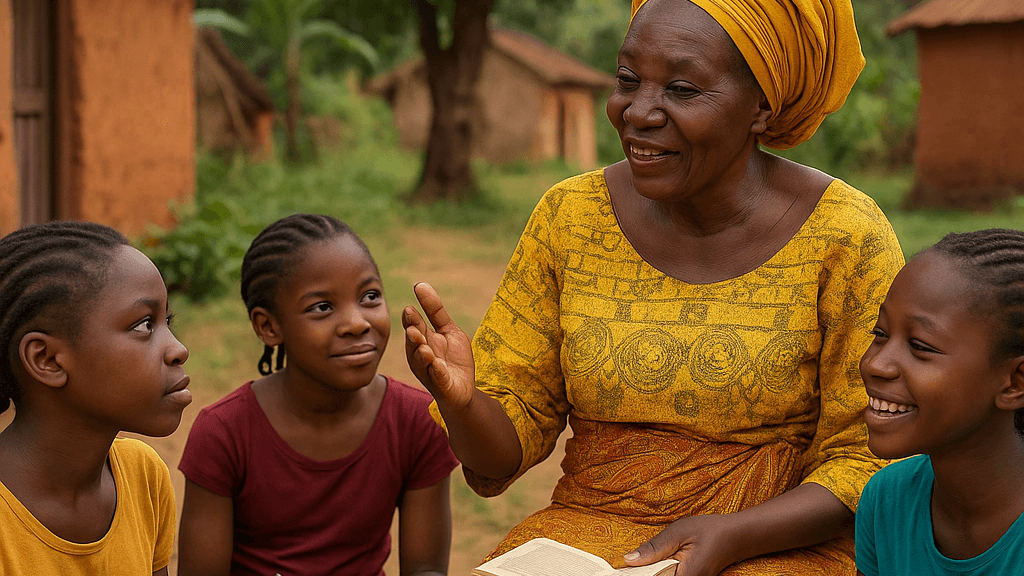
AN AI generated image of Mama Aduni teaching some girls
In a remote village in Western Nigeria, where we wear dust all over our faces due to the dusty roads, and wine tappers on their bicycles going to the farm to tap wine, there lived Mama Aduni, a woman whose story, though soft-spoken, echoes loudly across generations.
Mama Aduni is an Nigerian Woman born in the early 1930’s, not clear on that age now. She was married to Pa Amos an elder in the Anglican Diocese of their community but had no child of her own due to sickness here and there.
She was no politician, no celebrity. She had never seen the four walls of a university. But what she carried was more than formal education, she carried wisdom, dignity, and a fierce resolve to raise a generation differently.
Every Saturday morning, girls from nearby houses gathered under the mango tree in her compound. With her voice, firm but kind, she would teach them. Not just how to cook or tie a wrapper, but how to dream.
(In the early 1990s, long before mobile phones and digital distractions, children in many parts of Nigeria gathered under the moonlight for “Tales by Moonlight.” Stories were told not just for entertainment, but to teach us values, history, and identity. That quiet culture of wisdom-sharing is disappearing. But in Mama Aduni’s home at that time, she taught young girls something more powerful than folklore: she passed on vision.)
Her words, simple but powerful, pierced through the thick fog of patriarchy. She taught girls how to read their letters, recite multiplication tables, and believe they could become more than someone’s wife.
When a girl in the community was about to be married off at 15, Mama Aduni intervened not with noise, but with action. She went to the family and pleaded for time. “Let her finish school,” she said. And they listened.
(In the late 80s and 90s, especially in many parts of Northern Nigeria, early marriage was rampant, seen as a strategy to ease a family’s financial burden. Once married, a girl’s education was no longer the family’s concern. It was if at all the husband’s . Many young girls were married between ages 13 and 18. While progress has been made in urban areas, data from UNICEF still shows that 43% of Nigerian girls are married before age 18, and 16% before age 15. In some regions, the culture remains unchanged.)
The world may not know Mama Aduni. She never won an international award or received applause from the global stage. But the girls she mentored? Some became teachers. Some nurses. A few became the first in their families to attend university. One even became a lawyer, the same girls once thought to be destined for early marriage and child birth only.
In a time when democracy is tested, when women’s rights are threatened, and education is treated as a privilege instead of a right, Mama Aduni’s story matters more than ever.
According to the International Institute for Democracy and Electoral Assistance, Nigeria ranks 139 out of 167 on the Democracy Index (2023), with “low” ratings in political participation, civil liberties, and gender inclusion. In many grassroots areas, women are still far from decision-making tables. Yet, it is women like Mama Aduni quietly pushing for change who continue to uphold the spirit of democracy.
And today, like Mama Aduni, many Nigerian women are rising from different corners of the country, impacting lives silently, continuing the work Mama Aduni did with boldness and brilliance.
I cannot forget to celebrate some of those women today.
On World Pulse, I/we see these modern-day heroines clearly:
From Jefiter Mang and Bint Usman in Northern Nigeria to Busayo Obisakin in the West… From E.J (Emi Alawode) to men like Mr. Isaac and others.. championing girls' education and dignity. These are leaders blazing trails quietly, firmly, powerfully.
They are women and men upholding democracy with their lives, teaching under trees,classrooms without roofs, rebuilding broken schools, rescuing girls from early marriage, and giving voice to the voiceless.
These are not just names. They are living legacies.
Mama Aduni's story reminds us that influence doesn’t always wear a suit or stand on a podium. Sometimes, it wears a faded wrapper and sits under a mango tree.
This Democracy Day, I celebrate not just those in public office, but those who lead revolutions at home.
We remember women who shaped lives, shifted mindsets, and planted seeds of justice and education where there was once only silence.
May Mama Aduni’s story reminds us that democracy begins at home in the voices that dare to speak, and the hearts that choose to act.
HAPPY DEMOCRACY DAY TO NIGERIA.
Note: Nma Nma is what we call her but i wanted to use Mama Aduni for better flow..She is very old now but still alive.
#MamaAduni #DemocracyDayNigeria #GrassrootsLeadership #GirlsEducation #WorldPulse #WomenRise #SilentChampions
- Girl Power
- Leadership
- Human Rights
- Economic Power
- Caring for Ourselves
- Africa