
Messy women
Aug 27, 2025
story
Seeking
Visibility


Title:
Why I Speak About Mess, Masculinity, and Mental Health: Reclaiming Emotional Truth in a Gendered World
The Silence I Inherited
I grew up in a world where emotional pain was rarely named.
Sadness was called tiredness.
Anxiety was dismissed as overthinking.
And trauma—if acknowledged at all—was explained away as fate.
In my home, silence was survival.
We didn’t talk about breakdowns.
We didn’t ask why someone stopped smiling.
We didn’t question why boys were told to “man up” and girls were expected to absorb discomfort quietly.
I didn’t have the language for it then.
But I felt the weight of it.
And I carried it into adulthood.
---
Becoming a Psychiatrist: Naming What Was Never Named
When I chose psychiatry, I wasn’t just choosing a profession.
I was choosing to name what had been hidden.
To dignify suffering.
To make emotional health visible.
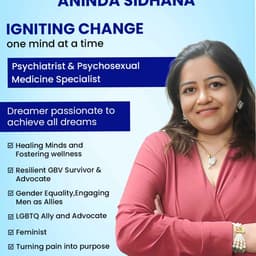
As a psychosexual medicine specialist and poetic systems architect, I’ve spent years listening to stories that rarely get told in public.
Stories of hormonal chaos.
Stories of emotional withholding.
Stories of people—especially men—who were never given permission to feel.
I’ve seen how systems treat emotional health as secondary.
How menstrual mental health is sidelined.
How survivor wisdom is sanitized into clinical language.
How masculinity is still defined by control, composure, and silence.
---
What I’ve Learned: Three Core Truths
Through my clinical work, podcast scripting, and panel advocacy, I’ve come to believe three things deeply:
1. Vulnerability is not weakness.
It’s a strength.
It allows people to connect, heal, and grow.
When men cry, when women set boundaries, when survivors speak—those are acts of courage, not collapse.
2. Healthy masculinity is not abnormal.
Men deserve spaces to feel, to break down, to be supported.
Masculinity should include tenderness, emotional literacy, and relational depth—not just stoicism.
3. Life is messy—and that’s okay.
Healing doesn’t happen in perfect conditions.
It happens in rupture, reflection, and redefinition.
We need care infrastructures that honor the complexity of being human.
---
Positive Masculinity: What It Looks Like, Why It Matters
In many of the spaces I work—clinical, spiritual, editorial—I’ve seen how masculinity is often framed as a problem to fix. But I don’t believe masculinity needs to be erased or rebranded. It needs to be reclaimed.
Positive masculinity is not the opposite of strength.
It’s the integration of strength with softness, responsibility with emotional literacy, and leadership with relational depth.
I’ve seen it in fathers who sit beside their daughters during hormonal storms, not to fix, but to witness.
I’ve seen it in sons who ask questions about boundaries, not because they were taught, but because they want to learn.
I’ve seen it in male survivors who speak about shame, grief, and healing—not as confessions, but as contributions.
---
🌿 What Positive Masculinity Offers
- Emotional presence: The ability to feel, name, and respond to emotions without fear of judgment.
- Relational accountability: A willingness to repair, to listen, and to honor boundaries.
- Protective tenderness: Not control disguised as care, but care that protects without overpowering.
- Cycle awareness: Understanding hormonal rhythms—not just in women, but in themselves—and respecting emotional shifts.
---
🔥 Why It’s Urgent
When masculinity is only defined by control, silence, and stoicism, we lose something vital.
We lose fathers who can model emotional literacy.
We lose partners who can co-regulate.
We lose leaders who can hold space for rupture and repair.
Positive masculinity doesn’t just support women—it transforms systems.
It challenges emotional withholding.
It dignifies vulnerability.
It makes healing relational, not just individual.
---
Sound Bites That Guide My Work
In my podcast Mental Health Bytes and in blitz panel presentations, I often share phrases that help people reframe their experience:
- “You are your first. Everyone else is your second.”
- “Breaking down is part of the process.”
- “Vulnerability is a superpower.”
- “The solution isn’t perfection—it’s presence.”
These aren’t just catchy lines.
They’re truths I’ve seen play out in therapy rooms, survivor circles, and spiritual communities.
---
Why I Speak: Challenging Silence, Reframing Systems
I speak because silence is dangerous.
When we don’t talk about emotional suffering, we allow shame to grow.
When we treat mental health as a private failure, we miss the chance to build public care.
I speak to challenge the curated contradiction in systems—where people say one thing and do another.
Where emotional withholding is normalized.
Where survivors are asked to be polite instead of powerful.
I speak to introduce frameworks like HealCycle, which help people understand their emotional rhythms and hormonal truths.
I speak to advocate for menstrual mental health, survivor-led care, and faith-rooted healing infrastructures.
---
What I Hope You’ll Take Away
- Emotional health is not gendered.
- Respect, love, and the freedom to feel should be available to everyone.
- We need care systems that honor the body, the mind, and the messiness of healing.
- Positive masculinity is not a contradiction—it’s a path toward relational integrity and systemic change.
---
Closing Reflection: Mess as Medicine
I no longer try to tidy my pain.
I’ve learned that healing is not about control—it’s about connection.
It’s about showing up, breaking down, and rebuilding with dignity.
So I choose to speak.
To write.
To architect care systems that reflect the truth of our lives.
Because the mess isn’t the problem.
The silence around it is.
---
#MessMagic #EmotionalHealth #MentalHealthBytes #HealCycle #SurvivorWisdom #WorldPulse #VulnerabilityIsStrength #HormonalTruth #FaithLedHealing #PositiveMasculinity
---
- South and Central Asia