
Murals of Gender Based Violence in Food Producing Communities
Dec 23, 2023
story
Seeking
Visibility


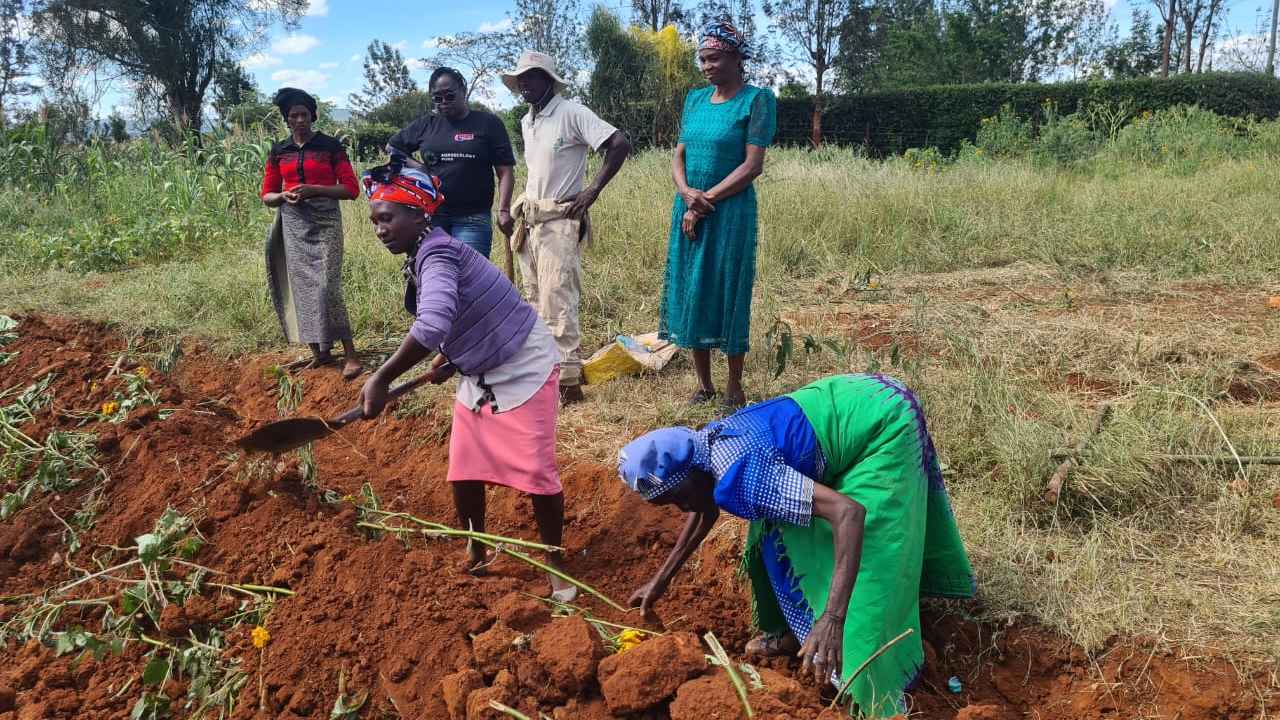
A visit to any food-producing community be it farmers, fisherfolk Indigenous Peoples, you will often find women working. In Africa, women form the bulk of food producers, till the land, grow crops, weed, and harvest, some are also responsible for value addition. Despite their footprints in the entire food production chain, when it comes to control of natural resources, they are often relegated to the periphery. Decision-making on land matters becomes invisible. In some Kenyan communities, when land is being sold, women are banished from these spaces. In others, culture is used to discriminate against women and silence their voices-forever muting their inputs. For example, how many women are members of Land Boards in Kenya, and how many women have title deeds in their name? , how many men would allow joint titling of the family land to ensure that it has the names of both the man and his wife(s). The numbers are very few.
In a conversation with smallholder farmers in Gatundu North, Muvuti in Machakos, and Sekenani in Maasai Mara, these are distinct communities of pastoralists and farmers, in all of them you will find that women work more. A gender analysis practical exercise involving what women do versus what men do a 24-hour cycle in these communities as part of human rights education, saw male community members share that they have time allocated where they go to the shopping centres to ‘get news’. Asked whether they had TV sets and radios, the majority was affirmative but still had to go to the shopping centres to talk to fellow men. While all this is happening, women continue either to the land or engage in other chores within the household.
The interesting part is at harvest. When the harvesting is done, of course with greater input from women, is the juncture where male family members come in. Either as the husband, or a brother. They take over control of the farm produce. When it is the female who takes the farm produce to the market, she will be questioned how much has been sold. If it is a male who has taken the farm produce to the market, he will become angry when questioned about the sales proceeds. Women have lost their limbs when they question the proceeds of farm sales. Many have been subjected to verbal abuse, and others have even gotten evicted or discriminated against. It is often assumed that women should not question natural resource governance, particularly land. Women are subjected to invisibility, yet they are the ones who toil the land.
Women and girls are not spared when it comes to livestock. Still, here they are relegated to livestock of lesser value for example chicken as compared to cattle. In many communities owning livestock, cattle, sheep, and goats belong to men whereas chicken belongs to women. This means that women only enjoy user rights for example getting milk from the livestock but cannot sell the livestock because they are not the legitimate owners.
Despite the existence of legislations that support gender equity and non-discrimination, women continue to suffer various forms of discrimination. When it comes to eating, women are the last to eat after everybody has eaten. Some communities even go ahead to define what women and girls should it. Drumstick, which is often the fleshiest part of the chicken as well as the gizzard is culturally allocated to men in many communities. There are even incidences of women being chased away from their homes because they have eaten gizzard.
Land rights are another area of discrimination when it comes to food production. In many Kenyan communities, women do not own land, the land is often in the name of the husband and if widowed the names of the father-in-law. This means that if a woman wants to develop the land, she must either be on good terms with her husband or the in-laws, or else she will be barred from using the land. There is also another negative attitude towards women who either champion land ownership or own land. They get discriminated against and are often derogatorily clustered as those who ‘ contravene culture’ and are often reminded of what culture says. In most African countries land is a symbol of identity , it is a burial site thus has spiritual connection, land can also be viewed as a source of wealth .
In Africa , majority of the population lives in the rural areas. For example in Kenya , 68% of the population (32.73 million) people live in rural areas.[1]This has significant implications particularly given that most of the land for food production is also found in rural areas where despite having a dual system ( legislative and customary laws) , the gender biasness of customary laws in a heavily patriarchal system means that women continue to fare worse than men. This is also echoed by Mathenge who notes that among many communities, there is a perception that women cannot own land and that are unable to make decisions regarding land allocations and transfers[2]. When you have limited control over something, you are not as productive on the same land. The power of men over women when it comes to land also forced women to have to seek permission whenever they want to utilise a piece of land within their homesteads. In Kenya , less than 2% of women own title deeds.[3]There is a sense of fear when women own land, this leads them to be labelled as lacking the requisite skills to manage land. This fear coupled with greed is one of the reasons why in-laws grab the land left behind to widowed women. This is tantamount not only to economic violence; it is also to emotional violence.
When there is a death in a family, relatives bent on stealing land from the widow are often on the lookout for either the title deed or identity card as these are vital documents when it comes to the administration of property. Many illiterate women are taken advantage of and told to sign documents they hardly understand. Many women are evicted from their matrimonial homes, and end up in informal settlements living in poverty.. The majority of these women are unable to fend for themselves and their children and cannot adequately provide for the most necessities such as food, clothing, and shelter.
Wife inheritance is another element of perpetuating Gender-Based Violence and depriving women of their right to live in peace and control land. Cultural practices such as wife inheritance -known as ter among the Luo community served the purpose of taking care of the widow after the death of her husband. But now it has become a practice of coercing widows into sexual relations for exploitation -the property left behind and of course land. Widows who refuse to be inherited are labelled as bad people and, in some cases, evicted from their matrimonial homes and their property taken away. Cases of widow disinheritance are rife in rural communities, but due to the culture of silence many cases are not reported, and even when reported widows are unable to access justice due to a myriad of challenges including lack of finances to follow up the cases through the courts, intimidation by in-laws and discrimination within the household and the community at large.
During a psychosocial support session organised by Haki Nawiri Afrika for rural women in Machakos County -it was evident that land is one of the key factors that cause stress to women.
Patriarchal tendencies also further contribute to women not being able to control land. This is despite the existence of legislations supposed to protect women. Women also suffer from a lack of access to credit, which they could use to develop their farms or acquire more portions of land. This hinders women from effective food production. Without a land title deed, women cannot get access to credit because they need collateral to get loans. Additionally, women are the majority of farm workers, a situation which makes them more vulnerable to exploitation through less pay compared to their male counterparts as well as being subjected to sexual violence. In pastoral communities, women rarely make decisions on the sale of livestock, this role is played by men, and women are not allowed to question because they are not owners of livestock.
Creating spaces for honest discussions about gender, creating safe spaces for women to share the challenges they go through when it comes to land and administration of land, and awareness raising on the benefits of supporting women in food production is at the heart of what Haki Nawiri Afrika continues to engage in communities such as Baringo with the Ogiek and Endorois Indigenous Peoples and with smallholder farmers in Machakos. These sessions often act as eye-openers. Sharing personal experiences of land loss, of fighting for land rights and the triumph of having a home that had previously been taken away by in-laws are the positive milestones of equitable engagement of women in food production.
To contribute towards equitable food production, it is urgent to ensure that mechanisms exist to allow for food production. Women need the necessary opportunities and support both technical and financial to be able to carry out effective food production. Additionally, there is a need to mount stronger advocacy work against retrogressive cultural practices that make women invisible and vulnerable to abuse.
References
[1] https://kenyanwallstreet.com/census-2019-datashows-kenya-has-a-youthful-rural-population/
[2] https://kessa.org/wp-content/uploads/2023/09/LAND-LEGISLATION-AND-WOMEN-IN-KENYA.pdf
[3] https://www.reuters.com/article/idUSKCN1GP22A/
- Human Rights
- Gender-based Violence
- 16 Days
- Africa