
NSF to PST Migration Guide: Manual Methods, Limitations & Professional Solutions
Aug 8, 2026
first-story
Seeking
Encouragement


Introduction
As firms incorporate newer communications and productivity options, email platforms evolve. IBM Lotus Notes, currently known as HCL Notes, still has a lot of essential mailbox information for many enterprises and individual users. These mailboxes are capable of storing years’ worth of vital emails, attachments, contacts, calendars and other business information.
This is where the issue begins for users who want to access this information through Microsoft Outlook. Lotus Notes generally employs NSF (Notes Storage Facility) files for mailbox data storage, and Outlook uses PST (Personal Storage Table) files for mailbox data storage. These are formats that are meant for distinct mail environments, and so, an NSF file cannot generally be opened directly in Outlook.
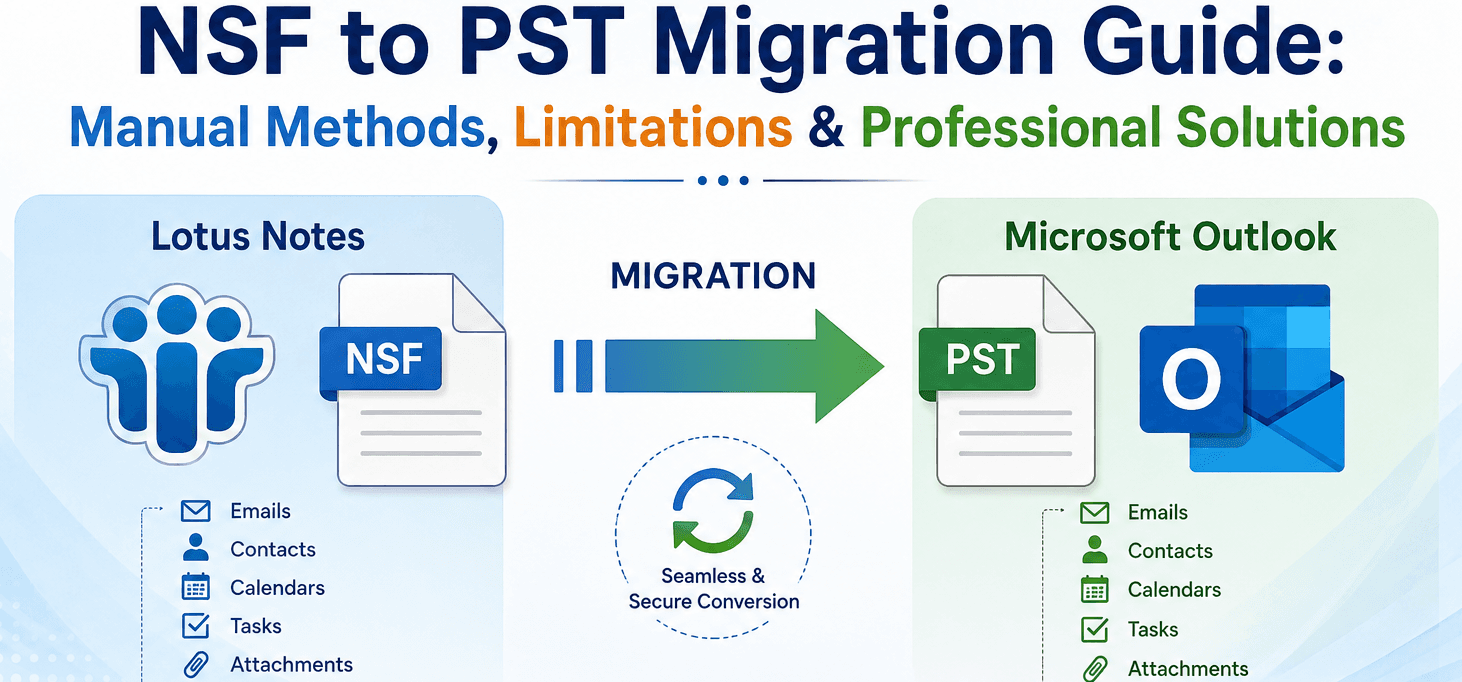
In this guide, we will discuss some common manual procedures that can convert NSF files to PST for users, and also learn about their limitations. Additionally, some professional methods are provided in this article for users who need a secure and quick migration.
What is an NSF file?
NSF Notes Storage Facility. This is the main database file format used by Lotus Notes to store many types of information.
The NSF database can contain: Depending on the use of Lotus Notes.
• Email and email folders
• Enclosures
• Contacts
• Schedule
• Operations
• Journals
• Notes and other stuff from mailboxes
NSF Files Contain Years of Valuable Communication and Organisational Data. Maintaining these databases is a crucial aspect of the migration process when a business moves away from Lotus Notes.
But NSF is not a native Outlook format. The majority of users need to transform the mailbox data to a format that can be used by their new email environment.
What Is a PST File?
PST means Personal Storage Table. It is a Microsoft Outlook data file that is used to save mailbox information locally.
A PST file can contain several types of Outlook data:
• Emails Attachments
• Contact Details
• Schedule
• Homework.
• Notes
• Directory structure
PST is designed for the Outlook ecosystem; thus, converting Lotus Notes mailbox data to PST format can make it easier for you to access and manage the information after you move to Outlook.
This makes PST a viable destination format for users doing Lotus Notes to Outlook migration, mailbox archiving, or moving email data.
What do you mean by NSF to PST Conversion?
NSF to PST conversion is the process of taking mailbox information from a Lotus Notes NSF database and moving it to an Outlook-compatible PST file.
But you don't simply alter the file extension. The conversion method has to read the source database and re-create the mailbox information in a manner that Outlook can understand.
A successful migration should preferably keep critical information like:
• Email content
• Sender and receiver details
• Date and time information
• Attachments
• Folder structure
• Other Message Properties of Interest
Therefore, the conversion can assist users in accessing the historical Lotus Notes mailbox information even after migration to Outlook.
Manual Methods for NSF to PST Migration
If you look for some NSF migration procedure, you will get different manual approaches. Two of the most popular strategies described include the use of Lotus Notes in conjunction with Outlook.
Method 1: Export NSF Data to Outlook Import
One method is to export the data from Lotus Notes and then import the resulting data into Outlook via a compatible intermediate format.
The workflow as a whole is:
1. Open Lotus Notes and open the NSF database you need.
2. Choose the mailbox information that needs to be transmitted.
3. Use the correct export options in Lotus Notes to export the available data.
4. Save the exported data in a format that can be further processed.
5. Open up Outlook and head to the import or data management features as appropriate.
6. How to Sort Imported Data in Outlook.
The specific process will vary according to your version of Lotus Notes, the export choices you have, and the kind of mailbox information you’re moving.
This technique can be useful when the volume of data is relatively minimal, and the user has an appropriate understanding of these methods.
Method 2: Lotus Notes and Outlook Combined Data Migration
Or, during migration, you can use both email clients and transfer chosen mailbox data from one to the other by using the provided export/import processes.
A typical workflow to convert files:
1. Open the Lotus Notes NSF database.
2. Find the emails or folders you need.
3. Export the selected information.
4. Generate the data for Outlook.
5. Enter the information into the right place in Outlook.
6. Check folders, messages and attachments after migration.
This method gives you more flexibility over selective migration but can get unwieldy when you are working with a large mailbox database.
Limitations of Manual Methods
While manual procedures can be handy in some cases, it might not be the best approach for a large-scale mailbox transfer.
1. Multiple Steps
Manual migration can entail multiple export, preparation, and import processes. Generally, more stages mean more potential for configuration difficulties.
2. Technical Requirements
Lotus Notes should be available to access and handle NSF databases. You can also require Outlook and proper setups, depending on the migration technique.
3. Time-Consuming for Large Mailboxes
Transferring a few emails manually is easy, but thousands of messages and several folders can be a daunting task.
4. Challenging Attachment Management
Attachments and other message attributes have to be transferred correctly. Manual processes need further validation.
5. Arrange in folders
Passing data through many intermediary steps can make it difficult to preserve the original mailbox hierarchy.
6. More chance for human error
Incorrect destination selection, missing mailbox items or choosing the wrong folders can influence the end migration.
As such, users who manage large Lotus Notes databases might opt to use a specialist migration software.
Advanced Technique: Converting NSF Files with Professional Software
Softaken NSF to PST Converter is a Windows platform-based tool that is designed to change Lotus Notes NSF mailbox data into PST format. The utility enables users to load NSF files, preview the mailbox data, select the data they need to convert, and export the data into PST file format.
Features and Core Capabilities
The application is built on numerous characteristics to make it easier to convert mailboxes.
Secure conversion of NSF Files
Users can choose the NSF data they need, without having to process everything. This can be beneficial if you want to move only some mailbox information.
Mailbox Data Preview
The software provides a preview-driven process enabling users to analyse selected NSF data before the final export.
Local Data Processing
The converted output can be saved to a user-defined location, which helps to organise migrated mailbox data.
User-friendly workflow
The software features a simple browse, preview, pick and export experience, making it ideal for users who wish to avoid complex transfer processes.
How to Convert NSF Files Using This Utility
1. Download and run the converter software on a Windows system.
2. Use the file selection option to find and add the required NSF database.
3. Once the NSF file is loaded, the preview interface allows you to explore available mailbox folders and data.
4. Select PST from the list of export formats.
5. Choose the location where you want to save the converted PST file.
6. Click on the conversion option to start conversion of selected NSF mailbox data to PST format.
Once done, open or import the resultant PST in the proper Outlook environment and check for key messages, folders, and attachments.
Why choose a professional solution instead of manual methods?
The largest benefit of specialist converting software is convenience.
Manual methods can require the user to operate on different apps and complete numerous intermediate activities. A dedicated software integrates the conversion process workflow into a single interface.
A professional solution can be better if:
• The NSF database is large.
• Want to transfer multiple folders.
• Users wish to convert selectively.
• Manual migration will take too much time.
• Get your mailbox in order.
• Migration needs a simplified workflow.
• Users want more output formats.
• Limited technical knowledge.
For firms with legacy email archives, less manual intervention might make the transfer process easier to manage.
Conlusion
You don’t need to migrate ancient Lotus Notes mailbox data to Outlook. NSF and PST are different mailbox formats that were developed for various email environments, and therefore, users will need to employ a suitable way to migrate the information from one to the other.
Manual procedures can work for modest requirements, but can become time-consuming when dealing with large datasets, many folders, attachments and a significant history of correspondence.
A dedicated tool provides you a simple way to load NSF data, evaluate mailbox data, pick PST as the destination, and execute the conversion through a guided procedure. Its official documentation says that you need to have Lotus Notes installed, although you do not need to have Outlook installed for the conversion itself.
If you’re a user who wants to retire Lotus Notes, migrate to Outlook, or transfer a legacy email archive, evaluating a professional conversion technique will help make the whole process more manageable.
FAQs
Q1. What are the advantages of NSF to PST Conversion?
Ans. PST is an Outlook-compatible data format. NSF to PST conversion makes it easier to see and manage old Lotus Notes mailbox data in an Outlook environment.
Q2. Do I need Microsoft Outlook for NSF to PST conversion?
Ans. No, if you are using the professional tool then it is not required to have Outlook installed on the system to execute the conversion.
Q3. Are professional software tools better for large NSF databases?
Ans. For larger migrations, a dedicated converter might be more useful, since it lowers the number of manual export and import procedures and provides a focused workflow for mailbox conversion.
- Education
- Technology
- First Story
- Northern America