
On Palestine: A Conversation through the Rearview Mirror
Oct 16, 2024
first-story
Seeking
Visibility


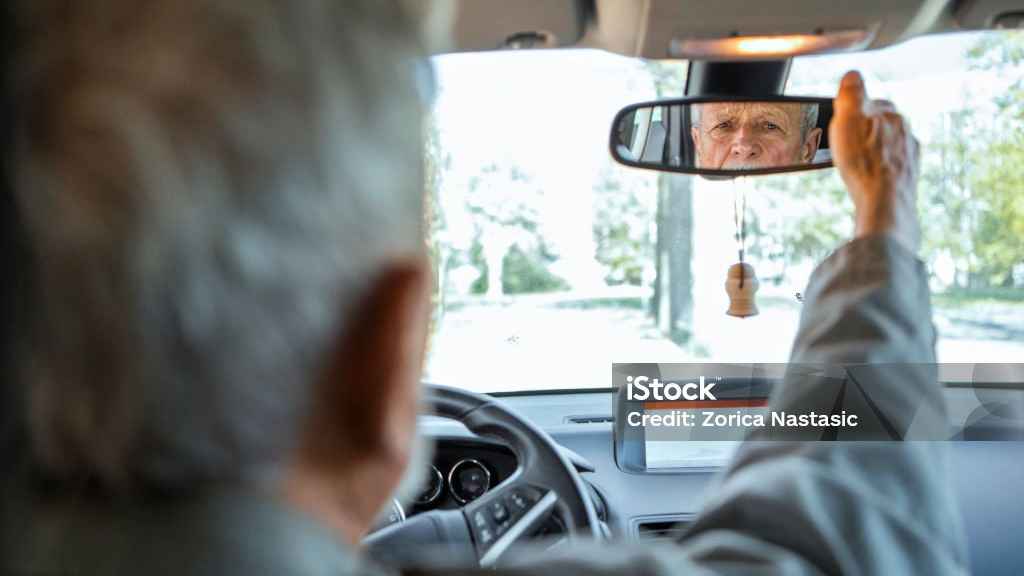
Photo Credit: Zorica Nastasic/ iStock
Illustration of an old man as a driver setting the rearview mirror in the car
Recently I had to travel solo to the US for a business trip. With the rising Islamophobia and heightened tensions, particularly after October 7, 2023, I felt a sense of apprehension about flying again to the US. The current political climate stirred those familiar feelings of unease of my previous trip in 2017.
At that time, I went to Boston just weeks after Trump’s executive order banning entry from seven Muslim-majority countries. Immigration checks were tightened, and I felt the increased scrutiny towards Muslims firsthand.
On arriving in the US this time, I was surprised by how seamless the immigration and security checks were. However, my anxiety lingered as I prepared to use Uber, concerned that the driver might hold anti-Muslim sentiments.
Still, I opened the app and requested a driver, hoping for someone kind. The app quickly assigned me a driver named Raed (a pseudonym).
As soon as he arrived, he stepped out of the car, to help me with my luggage. Noticing me with a veil, he quickly greeted me, “Assalamualaikum, sister. May I call you sister?”
“Waalaikumsalam. Sure,” I replied, smiling back. What a coincidence, I thought, relieved—my first Uber driver in the US was a fellow Muslim. It felt like a sign, and my anxiety began to ease.
As I climbed into the backseat, I noticed a small red tasbih (prayer beads) hanging from the rearview mirror, gently swaying as we drove.
“So, where are you from?” Raed asked, his voice friendly and curious.
“Indonesia,” I replied. “And you?”
“I’m from Palestine,” he said.
I felt a surge of excitement mixed with a sense of fate. Alhamdulillah, I thought. I had long hoped to meet someone from Palestine again and hear their story firsthand, especially given the ongoing situation. It felt as though this meeting was meant to happen.
“I’m so grateful to meet you,” I told Raed. “I’ve always wanted to hear the stories of people from Palestine, to know what it’s really like beyond the news we see. How do you feel about everything happening there?”
Raed adjusted his rearview mirror. I could sense this wasn’t going to be a casual conversation. I braced myself for the depth of what he was about to share.
Raed began telling me that he had just returned from visiting Palestine two weeks ago.
“You can still visit Palestine?” I asked.
“I’m from the West Bank, not Gaza. I can go there, but Gaza? No,” he replied, his voice firm but tinged with sorrow.
“How was it?” I asked, sensing that the answer wouldn’t be good.
“Terrible, sister. Terrible,” he said quietly, his voice heavy with the weight of the situation. “There were so many checkpoints, with 500 troops surrounding us before we could even enter Palestine.”
According to the United Nations, Palestinians holding West Bank IDs need permits from Israeli authorities to enter East Jerusalem through specific checkpoints, except for older individuals—men over 55 and women over 50. However, these checkpoints are unpredictable, sometimes closing without warning.
It was hard to imagine the constant checkpoints and the troubles that Raed must have experienced just to visit his homeland.
“What does the news say about Palestine in Indonesia? Is it good or bad?” he asked.
“Our news mostly shows the suffering, the bombings, the endless terror and killing by Israel,” I replied.
“That’s true. Believe that. It’s true,” he said. “But here, in the US? The news is all lies.” He added.
I understood why he felt that way. While in the US, I tried watching mainstream news. The coverage was heavily biased in favor of Israel that barely touched on the suffering experienced by Palestinians.
Then, with quiet intensity, Raed added something that caught me off guard: “Our enemy is actually not Israel.” He repeated the statement, looking at me through the rearview mirror to make sure I understood.
“Our enemies are Saudi Arabia, Qatar, UAE, Egypt. These are the Muslim armies…”
This statement is understandable as Arab nations such as Saudi Arabia, Iraq, Egypt, Qatar, and the UAE jointly own the Arab Petroleum Pipeline Company, which continues to supply crude oil to Israel, indirectly supporting its genocide in Gaza (read the article here).
Raed then pulled out his phone. “I have a video of those Muslim armies who could have saved us…” He began scrolling through his phone, despite driving on the highway. I felt a bit nervous but leaned forward to take the phone so he could focus on the road.
The video showed donkeys running. I was caught off guard by the satire. “They’re like donkeys,” he said bitterly. “Following the US as allies.”
I smiled uneasily, placing his phone back on the console, and leaned into my seat as he continued speaking. His voice was heavy with grief. “We’re used to this—the killings, the destruction. My father was imprisoned three times by the Israelis. Our house? Destroyed.”
“As Palestinians, we’ve grown used to this.”
His words hit me hard. I could not imagine to feel the weight of his pain. I cautiously asked about the Palestinian government.
Raed let out a bitter laugh. “The government? Thieves. Corrupt. They live in luxury with bodyguards, but they have no freedom. They have money, but what’s it all for?” His eyes met mine in the mirror, searching for understanding.
“What do you think is the solution?” I asked softly, almost afraid of the enormity of the question.
Raed took a deep breath and spoke calmly, yet with conviction. “I love peace. I don’t want war. But what was taken by force can only be taken back by force. InshaAllah, someday we will get it back. Maybe not in my lifetime, but it will happen. I believe that.”
His words lingered in the air, like a prayer filled with both pain and unwavering hope.
As we neared my destination, Raed remarked, “I’ve met Indonesians here before, but they didn’t wear veils. When I greeted them with Assalamualaikum, they didn’t respond.”
“They might not have been Muslim,” I explained.
“Perhaps,” he said softly. “You’re the first Indonesian I’ve met here who wears a veil.”
I felt fortunate to be the first Indonesian wearing a veil that Raed had met, and grateful for the opportunity to hear his story about Palestine.
As I stepped out of the car, I glanced back through the rearview mirror one last time. It wasn’t just Raed’s reflection I saw—it was the weight of his journey, his resilience, and the enduring scars of a homeland left behind. #freePalestine
Mutiara Me
A veiled Muslim woman who travels solo
*This story is part of Muslim Berkelana (Muslim on Journey). Muslim Berkelana is a collection of snippets and reflections from my solo travels as a veiled Muslim woman to various countries. Each story in Muslim Berkelana serves as a mirror—one that reflects not just my journey, but the broader human quest for connection, belonging, and understanding.
- Human Rights
- First Story
- Indigenous Rights
- Moments of Hope
- Behind the Headlines
- Global