
Philippine Democracy Tested: Religious Freedom, Gender Equality, and the Fight Against Pov
Sep 2, 2025
story
Seeking
Encouragement
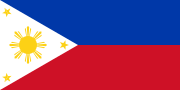
The Philippines has long celebrated democracy in principle, but the real test lies in protecting religious liberty, advancing women’s rights, and breaking cycles of poverty. What’s at stake for the nation’s democratic promise?
Democracy is often measured not only by the strength of its institutions but by how it upholds the dignity and rights of its people. The Philippines, hailed as Asia’s oldest democracy, has a Constitution that guarantees freedoms and equal rights on paper. Yet, decades into democratic practice, significant questions remain: How secure is religious liberty? How far has the women’s rights movement come? And can poverty alleviation campaigns truly translate into lasting social change?
This article explores what’s in store for the Philippines as it navigates these three critical pillars of human development within the framework of its democratic commitments.
Religious Liberty: Upholding Freedom in a Pluralistic Nation
The Philippines is predominantly Catholic, with more than 80% of its population identifying with the faith. Yet, its Constitution enshrines the separation of church and state and guarantees the free exercise of religion. On paper, religious liberty seems secure. In practice, however, challenges persist.
Religious minorities—such as Muslims, indigenous spiritual practitioners, and smaller Christian denominations—sometimes face social exclusion and, in certain areas, outright discrimination. In Mindanao, historical conflicts rooted partly in religious and cultural divides continue to impact peacebuilding efforts. Beyond security issues, subtle forms of prejudice persist in workplaces, schools, and even government programs.
What’s in store? The Philippines must go beyond tolerance toward inclusive pluralism. Democracy should mean creating safe spaces where religious minorities can freely practice their beliefs without fear of marginalization. This will require stronger anti-discrimination policies, interfaith dialogues, and a justice system that actively protects marginalized groups. If the country fails to protect religious freedom consistently, its democratic foundations will remain fragile.
Women’s Rights: Between Legal Advances and Cultural Barriers
The Philippines has been recognized for its progress on gender equality, consistently ranking high in global gender gap indexes. Laws such as the Magna Carta of Women (2009), the Anti-Violence Against Women and Their Children Act (2004), and the Reproductive Health Law (2012) are testaments to strong legal frameworks in support of women.
But the struggle lies in implementation. Women still face disproportionate burdens of unpaid care work, underrepresentation in politics and business leadership, and persistent gender-based violence. Cultural attitudes rooted in patriarchy often delay the full realization of legal protections. For instance, reproductive health services remain politicized, and women leaders still confront stereotypes that question their authority.
Looking ahead, the women’s rights movement in the Philippines is likely to focus on three fronts:
- Political Representation – Ensuring more women in decision-making spaces at both local and national levels.
- Economic Empowerment – Strengthening women’s participation in the workforce, addressing pay gaps, and promoting entrepreneurship.
- Ending Violence – Expanding awareness and protection against domestic abuse, harassment, and online gender-based violence.
The Philippines has the legislative tools in place, but the next stage of democracy must be about cultural transformation—changing mindsets, dismantling stereotypes, and translating rights into lived realities.
Poverty Alleviation: The Unfinished Democratic Promise
Perhaps the most telling indicator of democracy’s strength is whether it lifts its people out of poverty. Despite being classified as a lower-middle-income country, the Philippines continues to grapple with high poverty incidence. While recent statistics show declining poverty rates, millions of Filipinos still live below the poverty line, especially in rural and conflict-affected areas.
Poverty alleviation campaigns have historically centered on conditional cash transfers, livelihood programs, and infrastructure development. The Pantawid Pamilyang Pilipino Program (4Ps), for example, has provided safety nets for millions of poor households, particularly in education and health. Yet, structural barriers remain: limited access to quality education, weak healthcare systems, vulnerability to climate disasters, and dependence on precarious jobs.
What lies ahead is the need for inclusive and sustainable approaches. Democracy will be tested by how equitably economic opportunities are distributed. This includes supporting agricultural modernization, improving social protection, and ensuring that the benefits of digital transformation reach the poor, not just urban elites. Poverty alleviation should also integrate grassroots participation—allowing communities to co-create solutions that reflect their real needs.
A Democracy Tested by Realities
On paper, the Philippines has strong democratic credentials. Its Constitution provides for religious liberty, gender equality, and social justice. But democracy cannot thrive on paper alone—it must manifest in the daily experiences of citizens.
The country’s future hinges on addressing three realities:
- Religious liberty must be protected not only for the majority but especially for minorities, ensuring that peace and pluralism are more than aspirational words.
- Women’s rights must evolve from laws into everyday practice, breaking cultural barriers that undermine gender equity.
- Poverty alleviation must go beyond temporary relief and toward long-term structural change that uplifts entire communities.
Ultimately, the strength of Philippine democracy will not be judged by how eloquently its principles are written but by how justly and inclusively they are lived.
- Economic Power
- Peace & Security
- Human Rights
- Global