
Religious Freedom, God-Given Free Will, and Democracy in the Philippines
Jul 8, 2025
story
Seeking
Encouragement

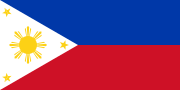
In the Philippines, democracy flourishes where faith and freedom meet—upholding religious liberty, honoring God-given free will, and empowering every citizen to shape a just and inclusive society. Ask ChatGPT
The Philippines, as a nation deeply rooted in religious traditions, occupies a unique space in Southeast Asia when it comes to the interplay of faith, individual freedom, and democratic values. As the only predominantly Christian country in the region, its cultural identity is intricately linked to religious belief, especially Catholicism, which shapes its citizens’ worldview. Yet, beyond faith affiliation lies a broader and more profound principle: the respect for religious freedom and God-given free will, which are both fundamental to the very fabric of democracy.
The Constitutional Foundation
Religious freedom in the Philippines is enshrined in the 1987 Constitution. Article III, Section 5 of the Bill of Rights clearly states: “No law shall be made respecting an establishment of religion, or prohibiting the free exercise thereof.” This constitutional guarantee protects every citizen’s right to practice, change, or abstain from religion. It recognizes that belief is a personal matter that must be free from coercion, intimidation, or state endorsement.
In essence, the Philippine Constitution recognizes God-given free will — the ability of individuals to make moral choices without compulsion. This principle is not only biblical but also resonates across various faith traditions, including Islam, Buddhism, and indigenous spiritualities. Free will underpins human dignity. To honor it is to respect every person’s ability to seek truth, make decisions, and express devotion (or non-devotion) in a way that is meaningful to them.
Faith and the Democratic Spirit
Democracy thrives where diversity of thought and belief is allowed to flourish. In the Philippines, where over 86% of the population identifies as Roman Catholic, with significant Muslim, Protestant, Iglesia ni Cristo, and indigenous religious populations, pluralism is more than a political concept—it’s a lived reality.
Despite the Catholic majority, the democratic state does not endorse a single religion. Political leaders often invoke God in their speeches, and religious symbols are widespread in public spaces, but there is an ongoing effort—sometimes imperfect—to preserve the line between church and state. This separation is not meant to drive religion out of public life, but to protect the state from religious domination and ensure that all faiths, including non-belief, are respected.
Religious freedom also contributes to civil participation. Faith-based organizations in the Philippines play a vital role in nation-building, from disaster response to poverty alleviation, education, and peacebuilding efforts, particularly in conflict-prone areas like Mindanao. They embody democratic values—solidarity, compassion, volunteerism, and justice—rooted in their beliefs yet aligned with the common good.
Challenges to Religious Freedom
While the Philippines upholds religious liberty in law, there are ongoing challenges that test this principle. Religious minorities sometimes face marginalization, particularly in conservative or remote areas. Muslims, especially in non-Moro communities, have historically experienced discrimination, from stereotyping to unequal access to resources.
In addition, the rise of religious nationalism or politicization of religion—where political actors exploit religious sentiment for personal or partisan gain—can be dangerous. It risks alienating minority groups, sowing division, and weakening democratic institutions. True democracy, anchored in free will, requires that religion not be used as a weapon to silence dissent or impose uniformity.
Another concern is religious intolerance on social media, where online harassment against certain beliefs, sects, or non-believers is common. While freedom of expression is protected, there must be a balance to ensure that platforms are not breeding grounds for hate or misinformation disguised as religious zeal.
Free Will and Moral Accountability
The idea of free will, as a God-given gift, goes hand in hand with moral responsibility. In a democratic society like the Philippines, citizens are called to make informed choices—not only in elections but in daily life. From civic engagement to social justice advocacy, the freedom to choose must be exercised ethically.
Religious institutions play a key role in guiding conscience. They remind people that freedom is not mere license, but an invitation to do what is right, even when it is unpopular or difficult. Whether standing up for the poor, defending the environment, or protecting the rights of others, Filipinos are encouraged to live their faith through action. This blend of spirituality and civic virtue strengthens democratic life.
Democracy and Dialogue
In a rapidly changing world, democracy in the Philippines must evolve while remaining anchored in its core values. This means promoting interfaith dialogue, fostering understanding among diverse groups, and cultivating a culture of respect for difference. Religious freedom must not only be tolerated—it must be celebrated as a source of richness, wisdom, and strength.
Free will, when nurtured within a democratic framework, empowers citizens to participate meaningfully in governance. It allows them to challenge injustice, demand transparency, and shape a future that reflects their hopes and beliefs. As Filipino democracy matures, the integration of religious freedom and moral agency will remain essential to its vitality.
Conclusion
Religious freedom, God-given free will, and democracy form a powerful triad that defines the soul of the Philippine nation. Each supports the other: democracy provides the space for religious liberty; religion upholds the dignity of free will; and free will enables active participation in shaping a just and compassionate society. As Filipinos continue to navigate political, cultural, and spiritual challenges, these principles offer both grounding and guidance. In honoring them, the Philippines affirms its identity as a democratic nation with faith at its heart and freedom in its spirit.
- Peace & Security
- Human Rights
- Peace Building
- Becoming Me
- South and Central Asia