
Setback for Sisterhood: Tanzania’s Crackdown Threatens Women’s Leadership Across Africa
Oct 31, 2025
story
Seeking
Visibility

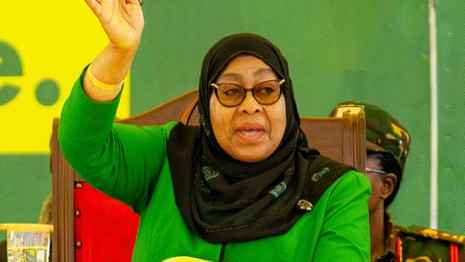
Tanzanian President Samia Suluhu
Setback for Sisterhood: Tanzania’s Crackdown Threatens Women’s Leadership Across Africa
By Dennis Weche – Opinion | Africa
As Tanzania emerges from one of its most contested elections in recent history, President Samia Suluhu Hassan’s tightening grip on power has sent tremors far beyond her nation’s borders. Once celebrated as a pioneer for women’s leadership in Africa, Suluhu now faces accusations of authoritarian overreach, repression, and democratic erosion that threaten to undo years of progress for women in politics across the continent.
In the lead-up to the October 2025 elections, authorities barred several major opposition figures — including long-time challenger Tundu Lissu — from running. Protests erupted nationwide, prompting the deployment of the military and the imposition of curfews in multiple regions. Reports from The Guardian, The Wall Street Journal, and AP News describe arrests of activists, allegations of enforced disappearances, and the silencing of independent media. What began as an election season meant to consolidate democracy has devolved into a stark warning of how fragile democratic institutions remain in East Africa.
When Suluhu assumed office in 2021 after the death of John Magufuli, her rise was widely hailed as a watershed moment. As the first female president in East Africa, she embodied the hope that women could lead differently — with empathy, restraint, and inclusivity. Her early gestures toward reconciliation and openness seemed to mark a break from the strongman politics of her predecessor. Yet four years later, the promise of her presidency is overshadowed by the same heavy-handed tactics she once appeared to renounce.
The belief that women’s leadership inherently yields more just or democratic governance — a powerful narrative across African feminist movements — now faces a sobering test. Suluhu’s increasingly repressive record risks confirming patriarchal narratives that women, too, are vulnerable to authoritarian temptations. For female politicians across the continent, this may deepen entrenched skepticism about their capacity to govern differently and could set back the cause of women’s political legitimacy for years to come.
Gender symbolism, moreover, is being cynically weaponised. Across the world, authoritarian regimes have learned to use the presence of women in high office as a form of soft power — a way to win legitimacy from international partners while consolidating control at home. Tanzania under Suluhu appears to be following this script. Women have been elevated to prominent ministerial posts, and gender representation in government has slightly improved. But critics argue these gestures remain largely cosmetic. A 2024 FEMNET report warned that Tanzania’s gender policies under Suluhu celebrate “numbers over transformation,” pointing to the absence of structural reforms and persistent restrictions on women in civic and political spaces.
The broader consequences are particularly severe for women in public life. Research consistently shows that political repression and shrinking civic space disproportionately affect women. In Tanzania, the atmosphere of fear and intimidation has made political participation increasingly dangerous. According to a USAID-backed study, nearly 70 percent of female candidates in the country reported facing verbal abuse, while others endured physical or sexual harassment. These conditions discourage women from running for office and deepen their exclusion from governance.
Tanzania’s trajectory represents a serious setback for the broader African movement toward gender-inclusive politics. Over the past two decades, countries like Rwanda, South Africa, and Senegal have achieved historic gains through constitutional quotas and civil-society pressure. Tanzania once stood as part of that hopeful narrative — proof that democratic progress and women’s empowerment could advance together. But the repressive turn under Suluhu threatens to undo that progress, reinforcing the argument that representation alone is not synonymous with reform.
The international response has been swift and critical. The European Parliament and European Union both declared that Tanzania’s elections could not be considered free or fair, citing the exclusion of opposition candidates, restrictions on media, and widespread intimidation. “The fraud did not begin at the ballot box — it has been unfolding for months,” read one EU statement. Tanzanian authorities have dismissed such criticism as foreign interference, insisting that the elections were conducted in accordance with national law and that the judiciary remains independent.
Regional institutions have been more hesitant. The African Union’s pre-election observers initially praised Tanzania’s preparations, but after reports of violence, curfews, and internet shutdowns, regional civil-society groups began describing the vote as “a crackdown disguised as democracy.” Human-rights watchdogs including Amnesty International and Human Rights Watch have condemned the arrests of opposition figures and activists, as well as the blackout of communication platforms on election day, calling them “a deliberate assault on transparency.”
These developments have implications that reach well beyond Tanzania’s borders. In East Africa — a region already grappling with contested elections, restricted freedoms, and patriarchal political cultures — the Tanzanian case risks setting a dangerous precedent. If the international community’s response remains largely rhetorical, other leaders may interpret it as a green light to suppress dissent while maintaining the façade of electoral legitimacy. Development partners, too, may grow cautious about tying support to gender representation alone, insisting instead on tangible commitments to democratic governance and accountability.
For African women aspiring to political leadership, the lesson from Tanzania is clear: the fight for equality cannot be separated from the fight for democracy. Representation without justice is hollow. A woman’s presence at the top is not, in itself, liberation. What matters is how power is exercised — whether it opens the space for others to participate, question, and dissent.
President Samia Suluhu Hassan’s legacy is still unfolding. She could yet reverse course and reaffirm her earlier commitment to dialogue and reform. But for now, her tenure offers a sobering reminder that symbolic breakthroughs can quickly curdle into cautionary tales when power eclipses principle. Across Africa, the promise of women’s leadership must not only be about who occupies the highest office — it must be about how they lead, and whose voices they allow to be heard.
Dennis Weche is a political analyst and writer based in Nairobi, focusing on governance, democracy, and gender in Africa. His work explores the intersections of political reform and social justice across East Africa.
- Girl Power
- Peace & Security
- Gender-based Violence
- Human Rights
- Elections
- Peace Building
- Global