
#Shift the power to sudanese women
Apr 5, 2025
story
Seeking
Collaboration


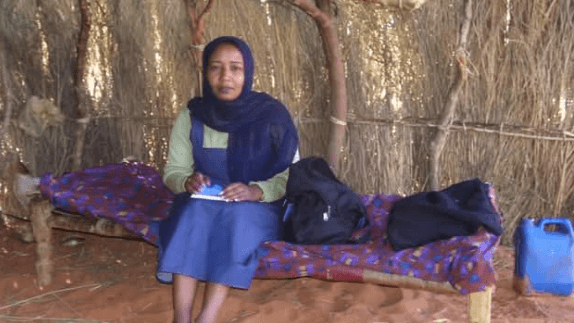
The image comes to my mind clearly.
I was three years old.
My younger sister was sick.
I felt responsible for her.
I would never leave her small bed, kneeling on my knees.
Despite my parents' attempts to dissuade me from spending most of my time near her, I vehemently refused.
I didn't play much, and I didn't have many dolls except for a little girl's doll that was neglected in the corner of the room most of the time.
These qualities prompted my father, may God have mercy on him, to confide in my mother a secret:
I wanted this girl and her sister to receive an education.
I felt she was a great woman.
When I was five, my mother enrolled us in a nearby school and entrusted me with the care of my younger sister.
The school refused to accept me because of my young age, but then agreed on the condition that I be a listener only.
But they were surprised when I came in third place in the final exams.
Here, my father's determination to send me to the final stages of university education was renewed, a process that was unimportant to girls at the time and discouraged.
Like any other Eastern society, male dominance prevailed over boys and men. All I had left was education to prove that I was a successful and dependable woman.
To prove that I had the right to choose the college I attended, the education I desired, the husband I wanted, and the type of work I wanted to pursue.
I entered university as the first woman in the region to attend university, with a large number of boys and no girls.
Here, it dawned on me that my voice should be the voice of the voiceless among women. I developed my plan and began researching. I was guided to the field of journalism and the power of words and opinions to express girls and women. I faced a challenge: how to work in journalism without an intermediary? If the work involved acquaintances in influential positions, where would I find these acquaintances?
I was guided to poetry to tap into journalism, and I succeeded in pursuing a career in journalism. Then came the biggest challenge: how would I be the voice of marginalized women? How would I get to know them and reach them? Where would I find funding? Newspapers don't pay for this, unless the funding was self-supporting.
I was guided to the field of organizations and learned that national organizations have limited funding, but foreign organizations can fund my stories according to annual funding programs, especially United Nations agencies and their partners.
The biggest challenge was mastering the English language, which I had never studied. I was guided to MBC English, which produces engaging, humane films and wonderful valuea bout humanity and high moral .
So I started watching MBC TV.
I memorized a significant number of words and translated them.
I continued doing this for a whole year.
Then I started going to UN agencies and their partners and giving them my address, email, and newspaper.
I also contacted the European Union and foreign embassies.
The voices of women must now be heard.
I then learned computer and software programs to communicate with specific agencies. And international NGOs
The door was wide open.
I adopted development as the theme of my journalistic coverage.
I went to western Sudan with Panos London NGO to write about women affected by desertification and their economic suffering, with their animals dying and their children emaciated due to lack of milk.
The valleys are dry of the grasses that animals feed on due to desertification.
and the miscarriages they experience due to carrying water from a well long distances.
Then I traveled to Ethiopia to write about pastoralist women and the challenges they face due to climate change.
I was then assigned to work in Indonesia with Journalists on Earth, a UN partner covering the UN Climate Change Conference in Bali.
I went to darfur camps to record sudanese women voices and stories on 2003 and get award about this stories from American NGO.
I went to Juba, south Sudan to write how women can participate in election and parliament . Apply their decisions and lead parties.
and Ed Damazin, on the border with South Sudan. To write about
Women affected by conflict, war, and mines and the challenges they face
I couldn't sleep because there were scorpions under my bed. There were no vaccines there other than lemon and ginger.
I was stung by a scorpion that nearly killed me.
The journey lasted for days, and sometimes we ran out of food and water in the desert, causing dehydration, which led to me being hospitalized for days.
Then we were arrested once because foreign members of the organization were interrogating us about climate change.
they released us after confirming that we were journalists interested in climate change.
to obtain all these stories and faced all these challenges to prove one thing:
We women exist and need support, strength, and power to effect change. The core of power and control resides within us, and it requires the actors and financial support to implement the desired goals of the community seeking change.
The first stage was to disseminate the stories, then attract financial support to finance projects to build schools and health centers, and cultivate small fields in front of the homes of village women, to support them economically, increase their income, and boost the community's GDP. A small loan program was designed with active partners
This program then evolved into partnerships with national ministries, such as the Ministries of Agriculture, Education, and Health, to finance awareness and literacy campaigns and provide loans to female farmers, which are repaid after harvesting.
This program also evolved into partnerships with local communities and foreign organizations, through local or foreign organizations operating in villages and funded by the World Bank. Transforming women's power means achieving development goals and advancing societies. Women are the light that shines on the earth, igniting knowledge, progress, and development
- Environment
- Education
- Economic Power
- Girl Power
- #ShiftThePower
- Africa