
Stories of Gender Equality Fights from 2015
May 28, 2019
story


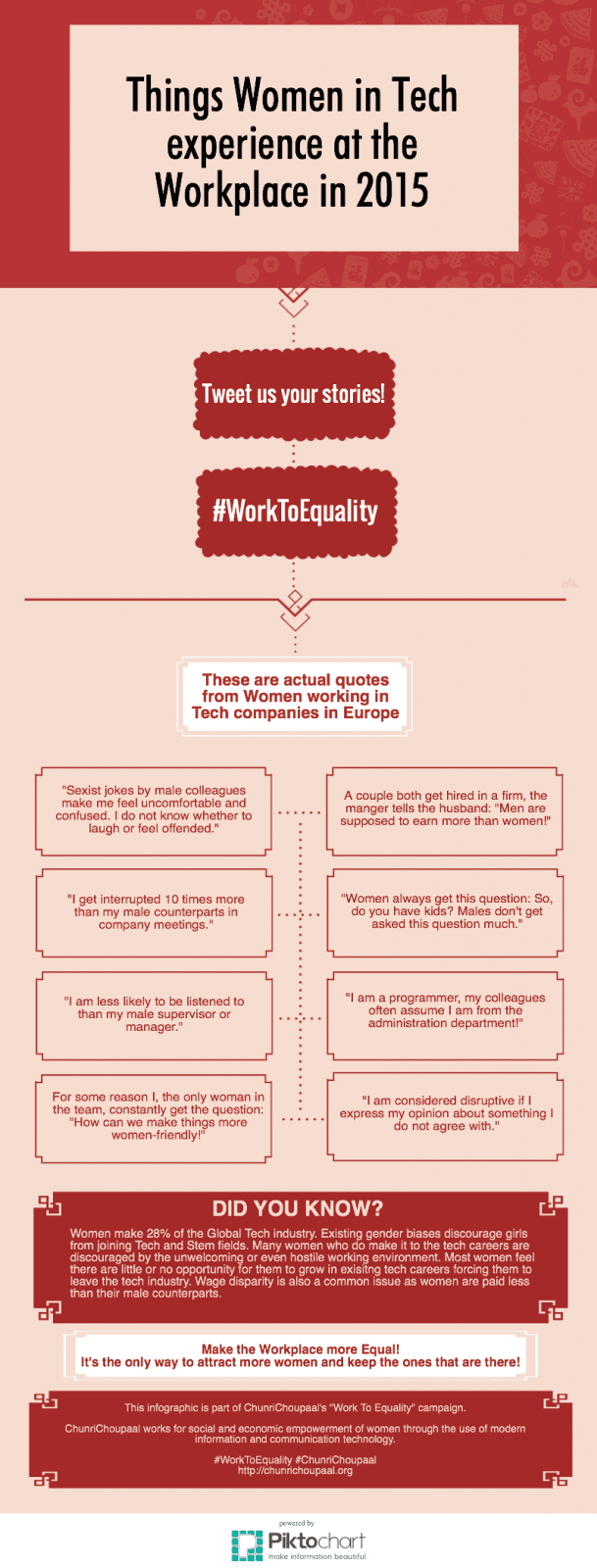
Things Women in Technology experience at the Workplace in 2015
I recently launched an online campaign ‘Work To Equality,’on the occasion of International Women’s Day 2015. The campaign is a result of a brainstorming session on issues faced by women currently working in technology field. It was attended by fifteen women and thought leaders from different technology companies. One of the purpose of the meetings was to identify possible solutions and collaborations for an action based campaign to empower and train more women and girls to join technology fields.
One story that left me speechless was when a hiring manager said these words: “Men are supposed to earn more than women.” Yes, it is 2015. And yes, it is a company in Europe. Yes, women still need to fight for an equal status, that of a full and complete human being and not of a sub-species.
Here are a few more ‘actual quotes’ we heard:
"Women always get this question: So, do you have kids? Males don't get asked this question much."
"I get interrupted 10 times more than my male counterparts in company meetings."
"Sexist jokes by male colleagues make me feel uncomfortable and confused. I do not know whether to laugh or feel offended."
"I am considered disruptive if I express my opinion about something I do not agree with."
The sad thing is, managers or male colleagues may not even be aware of the impact their unconscious bias might have on their female employees or team members. Unconscious bias and sexism at work is a contributing factor for women to change career paths. Women make up only a quarter of the work force in STEM related jobs, and that number only goes down when you look higher in the organisations. Not only that, but wage discrimination is common. Uncomfortable, sometimes even hostile, work environments are commonplace. Women continue to face challenges that either discourage them or force them to leave the work force.
The world has reached an age where digital skills are as fundamental as literacy itself for finding a job. Given the relatively low number of women working in technology fields, urgent measures need to be taken to create an inclusive, diversified and welcoming work environment. This is to ensure both talent acquisition and retention.
To encourage more women to choose technology careers, we need to focus on capacity building and identifying and funding trainings. We also need to address the factors that lead women to leave the work force. With our campaign, we aim to highlight some of the issues including unconscious bias, gender stereotypes and wage disparity. It is clearly unproductive to introduce more female talent into the unwelcoming working environments that eventually force them to leave.
We have launched this campaign to highlight stories so that we can start debates and discussions around the issue. Realising that there is a problem is the first step towards making a change. We want to invite stakeholders to become part of our first step and start these debates in their companies, networks and events. We are also organising activities to address issues and build capacity of women to handle difficult or uncomfortable situations at work.
If we want to achieve gender equality, there is no other way but to push for women’s economic independence, which is not possible with achieving equality at workplace. Even if we manage to successfully train more women to join workforce, biased mindsets, behaviours and policies are going to continue affecting the efficiency and quality of their work. Therefore urgent measures need to be taken by policy makers in corporate and government stakeholders and to address the issue to uproot gender bias at workplace.
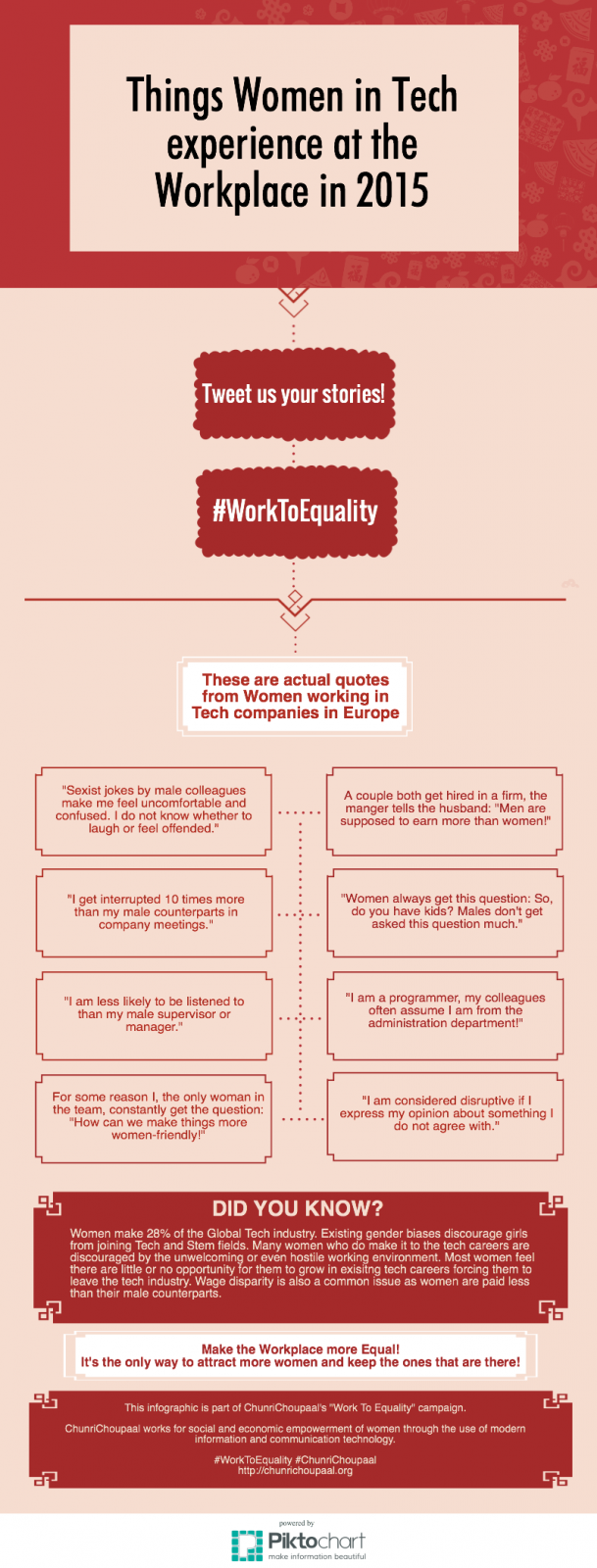
(For more, please take a look at our campaign infographic: “Things Women in Tech Experience at Workplace in 2015”)
Want to join us?
Tell us your stories and help organisations look at their recruiting, employment and maternity leave policies, as well as make their company a more inclusive and inviting environment to work in!
Call to Action:
1- Tweet us your story!
If you are a working woman and have faced challenges based on your gender, share your stories with us. It could be things you experience, hear, overhear or see at work. It could be things that made you uncomfortable, upset or repulsed! Don’t forget to tag it with the hashtag #WorktoEquality.
2- If you are a man who supports equality at workplace, share the work you are doing to support your colleagues with the #WorktoEquality hashtag.
3- Support our work by sharing this infographic in your network!
We will compile your stories in a downloadable report. The report will be shared them with different stakeholders, industry leaders and policy makers at the end of the campaign.
- Economic Power
- Technology
- Education
- South and Central Asia