
Strategies to drive women and Girl's rights
Oct 28, 2024
update
Seeking
Collaboration

- According to the convention for the elimination of all forms of discrimination against women (CEDAW),
- According to the UN declaration of women’s rights, focusing on the basis for equality between women and men, and ensuring women’s equal access to equal opportunities in political and public life, including the rights to vote and to stand for elections, as well as education, health and employment is concern,
- Mindful of the Beijing declaration on environment, the UN women report of 1995 on the Beijing declaration, outlining women to be amongst the most affected persons as far as climate change is concern,
And mindful of resolution 66/170 to declare October 11 as the international day of the girl child, to recognize girls rights and the unique challenges girls face around the world,
In a bit to understand the challenges girls face and to promote girls empowerment and fulfillment of their human right, examine the socio cultural, economic and political factors shaping girl’s rights, identify barriers to girl’s empowerment and development and craft collective strategies for positive change, motivated us to organize a Pan African Webinar, to get first hand stories and experiences on the situation of girls rights and the facts concerning their wellbeing in different parts of Africa.
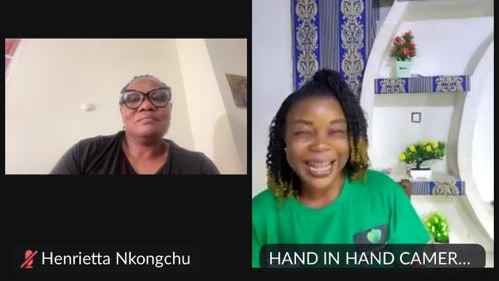
The webinar took place on Saturday 12th of October, 2024 on the theme: Girl’s Rights and Facts: The fate of Girl’s in Africa. This was aimed at bringing together women living in Africa and Africans living in the global North, to shed light on the plight of girls across Africa, exploring their experiences, challenges and opportunities through expert insights and interactive discussions. In attendance were 50+persons.
we began from 2pm-4pm, fostering dialogue, inspire actions and promote collaborative solutions. We had the following as guest speakers;
- Madam Akwa F. Asibi who is a professional and impact-driven creative writer, social Justice Activist, Researcher and Spoken-Word Artist from Jos, Plateau state, Nigeria and founder of Rekuma Foods Processing and Sibiscus Coterie LTD.
- Diallo Korotimi, have been a militant since 2014, under an association called: DEUX Heures Pour Nous, Deux Heuares Pour Kamita and in charge of women related issues in Burkina Faso.
- Madam Sevidzem Ernestine Leikeki who is a cofounder and Women Empowerment Officer of Cameroon Gender and Environment Watch (CAMGEW) and president of North West Bee Farmers Messengers (NOWEFAM).
- Dr. Taku Catherine epse Ogork. She’s an educationist and a humanitarian Gender Specialist, poet and writer of Short Stories and a Folklorist, human rights and peace activist and founder of Hope For All (HOFA).
- Mrs Esunge Beatrice Epie Epse Sone Nkoke, who is a dedicated High School Teacher and class administrator with over 10 years of experience. She is a member of the Africa Women Summit (AWS) and the Project Manager, AWS-Cameroon Chapter.
- Madam Mawuena Deegbe, an environmental activist and passionate advocate for children’s rights and education. With over seven years of experience as a project coordinator and founder of the Green Cycle Evolution Foundation.
- Madam Moh Harriet is a UNESCO Peace Ambassador and Gender Activist. She is the Founder and protection Officer for MOH Foundation and currently a Girl’s Mentor for GBLOBAL GLOW.
- Madam Fella ECHIKH is the founder of Diaspora Zone Hospitality, former co-President of AI’Terre Breizh association
- Prof. Eunice Fonyuy Fondze-Fombele, an Associate Professor of African Literature, Gender and Eco-Cultural Studies in the department of English and Cultural Studies in the University of Buea. She’s a pioneer president of the ASFI, Vice Secretary of the Cameroon Professional Research Oriented Women Network (CaPROWN), writer of many books and member of several academic associations.
- Madam Tandungang Laura Njiju is a passionate advocate for humanity and grassroots communities. She’s is the president of the Foundation for the Environment, Development, and Good Governance (FENDEGG).
Thereafter, we went straight to the agenda for the day which comprised of:
-Examining the socio-cultural, economic and political factors shaping girls’ lives
-Identifying barriers to girls ‘empowerment and development
-Craft collective strategies for positive change.
During this webinar, we interacted and learned from the experiences of the different speakers who brought out the reasons why the international day of the girl child was instituted on October 11,
During the webinar, our discussions were centered on seven major thematic areas ranging from education, conflict resolution, climate change, politics, peace building, health and gender based violence.
- Education
Generally the enrolment rate of girls have increased and gender parity has also improved in Africa. The initiative like the AU agenda 2063 and the UN sustainable goals have prioritized girl’s education. However, over the last 40 years girls have faced numerous challenges in accessing quality education, faced with challenges like - child marriage, female genital mutilation , gender roles like societal exploitation prioritizing domestic work over education , stigma and biased (girls education often undervalued), lack of resources, poverty and child labor, conflict, teenage pregnancies
- Climate change
Girls are usually the first persons to come into contact with waste, during cooking, packaging, and more, there are also the first to bear the brunt of the impacts of climate change. During climate disasters like drought and floods, yet their voices and decisions are limited in the advocacy on climate and environmental related issue
- peace and conflicts
Conflicts can better be mange when women get involved, there have the ability to influence decisions at diver levels, beginning from household levels, community levels and national levels to influence peace policies and peaceful negotiations that can foster peace building.
- Politics; women are underrepresented In the political spheres and are very much less represented at decision making positions, cable of influencing norms that supports gender inclusion and foster gender involvement in decision making processes or influence gender actions and leaderships at divers levels.
At the end of our discussion, a few strategies where presented to help enhance gender inclusion in areas that are lacking
● Education
In other to achieve this Education was proposed as a necessity to educate the community
while sensitization campaigns were proposed as one of the techniques to achieve the
rights of girls in Africa. Through organizing workshops, seminars and events to educate
communities about Girls' Rights.
● Another speaker added that
Awareness programs is a key strategy too, though, social media and local platforms to
raise awareness on girls' issues around the local community including urban areas.
● Mentorship programs were also
proposed as key factor to amplify girls voices. By pairing girls with positive role models for
guidance and support. While ensuring sustainability after the mentorship through
volunteering.
● Engaging Men and Boys
In the Pan-African Webinar engaging Men and boys were proposed as another strategy to
Amplify the voices of women and girls collectively. This could be done by Identifying
Influential men to advocate for girls' rights, Involving men in community activities
promoting girls' empowerment. Teaching boys about girls' rights and equality. Fostering
positive relationships between fathers and daughters, husbands and wives, brothers and
sisters in the movement.
● Influencing Policies
Another speaker during the Webinar said
We can achieve the rights of girls by influencing policymakers to support girls' education
and rights, Collaborating with governments, NGOs and communities leaders to support
programs that Girls Rights.
● The Role of Non-Governmental Organizations (NGOs)
NGOs in Africa and in the diaspora should work hand-in-hand together to amplify girls'
voices, build capacity, reach out to the community and mobilize resources for girls'
programs and projects.
● Female Leadership
Another strong proposal was to support female politicians advocating for Girls' Rights.
Training girls' and Women on leadership skills. Celebrating Women's achievements to
Inspire girls. And Encouraging girls to participate in decision-making processes from the
local to the National and the International level.
● Funding and Resources
To crown it all an important strategy that was proposed was to provide financial support
for Girls' programs and projects.
In other to achieve this technique, CSOs should engage businesses in supporting girls'
Empowerment; Mobilize local resources for girls' initiatives and seek funding models, that
will support the amplification of Girls rights in Africa.
Other Strategies that were randomly proposed were as follows:
● Providing Girls with digital skills.
● Supporting Girls' in entrepreneurship and financial literacy.
● Addressing health issues of Women and Girls including menstrual health.
● Girls' safety: Address violence and abuse against girls.
● Ensuring programs that cater to girls with disabilities.
These were the key strategies proposed during the Pan-African Webinar to create a
comprehensive approach to empowering and achieving the rights of Girls and Women in
Africa.
- Human Rights
- Economic Power
- Education
- Peace & Security
- Leadership
- Environment
- Global