
Tears on the Tarmac: A Mother’s Lament and a Nation’s Cry for Safer Roads
May 13, 2025
story
Seeking
Feedback


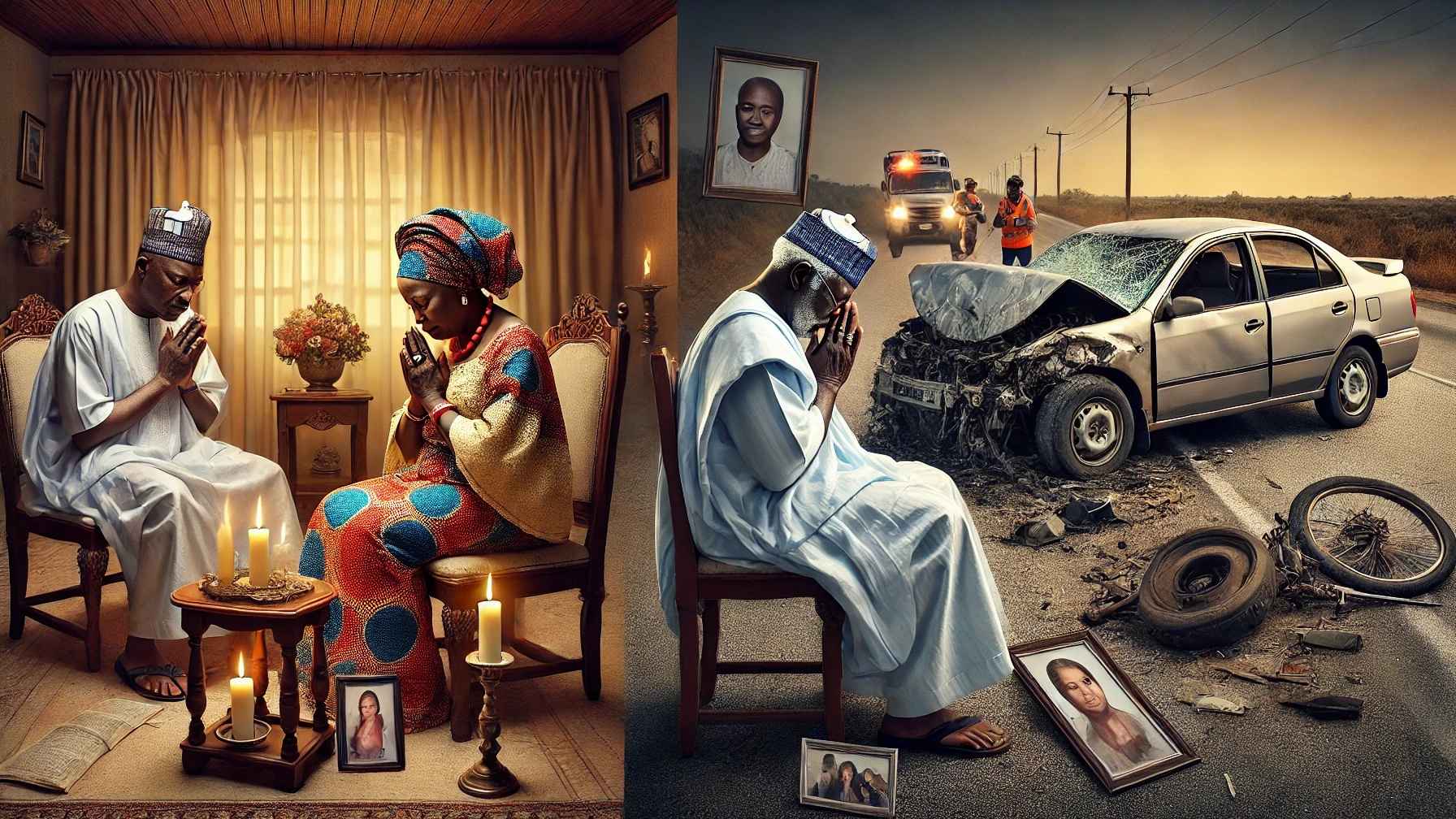
Photo Credit: AI
Picture of a couple who just lost their children and picture of an accident scene
Every morning across Nigeria, people step out of their homes full of hope. Hope to get to work safely. Hope to arrive at school, church, or market in one piece. Hope to come back home and see their loved ones again. But for many families, this hope is shattered on the very roads that are supposed to connect us. For too many Nigerians, the road does not lead home, it rather leads to heartbreak.
According to data from the Federal Road Safety Corps (FRSC), thousands of Nigerians die each year in road crashes. Sadly, many of these deaths are avoidable. They are not acts of fate. They are the result of recklessness, negligence, and failure of enforcement systems.
I write this with a heavy heart, not as a distant observer, but as someone who has watched her community grieve. Someone who has cried with mothers and comforted classmates. Someone who has mourned the deaths of close friends who lost their lives as a result of terrible road accidents.
On Friday, May 9th, 2025, two boys, brothers lost their lives in a tragic road accident in Abuja, Nigeria. One of them was an alumnus of my school, who completed his secondary school education in 2021. A bright and promising young man who had studied abroad and returned to Nigeria for the compulsory National Youth Service Corps (NYSC) program.
He had come back to serve his country, a country that could not protect him.
His younger brother was a Grade 9 student in our school, just beginning to carve out his place in the world. They were they only children of their parents.
Let that settle in for a moment: one reckless driver, one moment of negligence, two lives lost, a future erased, and a family destroyed forever.
Their car was run over by a fire truck, a government emergency vehicle that was reportedly speeding. It never stopped, It didn't pause to check the wreckage it had left behind. There were no emergency ambulances, no paramedics, no first responders. The boys were left to fght for their lives alone.
By the time the concerned passerby managed to bring them out of the crushed car, it was too late. They died before help could arrive.
No parent should ever bury their child. It is a grief that bends the soul and breaks the spirit. For the parents of these boys, life has changed irreversibly. The dreams they once had, their children’s graduations, weddings, careers, and families, are now ashes in the wind.
There are no words to fully describe the grief of losing not one, but both children. What is left for these parents? The bedrooms remain untouched. The toothbrushes, schoolbags, books, and shoes lie as they were left. The mother wakes up, sometimes forgetting, only to be reminded by the deafening silence of the house. The father, once proud and hopeful, now stares out the window in a daze.
The psychological effects of such a loss are lifelong. Many parents suffer from depression, anxiety, insomnia, and a sense of helplessness that no therapy can fully cure. Some lose the will to live; others become shadows of who they once were. The trauma is made worse by a system that rarely provides justice or closure.
The problem of road accidents in Nigeria is multifaceted. Common causes include:
Reckless driving: Over-speeding, overtaking dangerously, and ignoring traffic signs.
Poor vehicle maintenance: Many vehicles on the road are not roadworthy.
Corruption among law enforcement: Unfit vehicles and unlicensed drivers often "settle" their way past checkpoints.
Bad roads and poor lighting: Potholes, unmarked roads, and inadequate street lighting increase risks.
Lack of pedestrian walkways and crossing bridges.
Distracted or intoxicated driving.
Most of these causes are preventable. The tragedy lies in the fact that we have normalized road deaths. We've become desensitized to sirens and emergency scenes. We move on too quickly, leaving grieving families to suffer in silence.
We need more than condolences. We need action. Here are steps that can make a real difference:
1. Enforce Traffic Laws: No more bribes. No more turning a blind eye. Traffic laws must be strictly enforced with severe penalties for reckless driving.
2. Introduce Mandatory Road Safety Education in Schools: Teach children the importance of road safety early. Let the next generation grow up with a respect for life and the law.
3. Install Speed Cameras and Monitoring Systems: Surveillance and speed-limit enforcement can deter dangerous driving, especially in cities.
4. Improve Road Infrastructure: Repair potholes. Install streetlights. Build pedestrian walkways and crossing bridges. Ensure roads are clearly marked.
5. Conduct Regular Vehicle Inspections: All vehicles should undergo safety checks. Commercial drivers especially must be properly trained and certified.
6. Strengthen Emergency Medical Response Systems: Nigeria must invest in rapid response teams, well-equipped ambulances, and paramedic training. No one should die because help didn’t arrive.
7. Support Grieving Families: There must be systems in place, mental health counseling, legal aid, and financial support, for families who lose loved ones in road crashes.
8. Community and Media Advocacy: Platforms like World Pulse can amplify stories like this. Advocacy groups, women-led organizations, teachers, students, we all must raise our voices.
If you’ve read this far, I ask you stand with us. These boys were not nameless victims. They were sons, brothers, cousins, nephews, friends, bright stars extinguished too soon. Their parents now live a reality no one should have to face.
We cannot afford to be silent. We cannot let this be just another tragic story buried beneath the news cycle.
Let’s demand safer roads. Let’s demand accountability. Let’s speak out until the roads stop claiming our children.
Because no mother should bury her child.
Because no father should stand by two graves.
Because no family should be left with echoes instead of laughter.
Let us turn mourning into movement. Let us turn pain into policy. Let us say, with one voice: ENOUGH IS ENOUGH.
- Environment
- Peace & Security
- Africa