
The Childhood We Give Shapes Who They Become as Adults
Apr 17, 2026
story
Seeking
Visibility


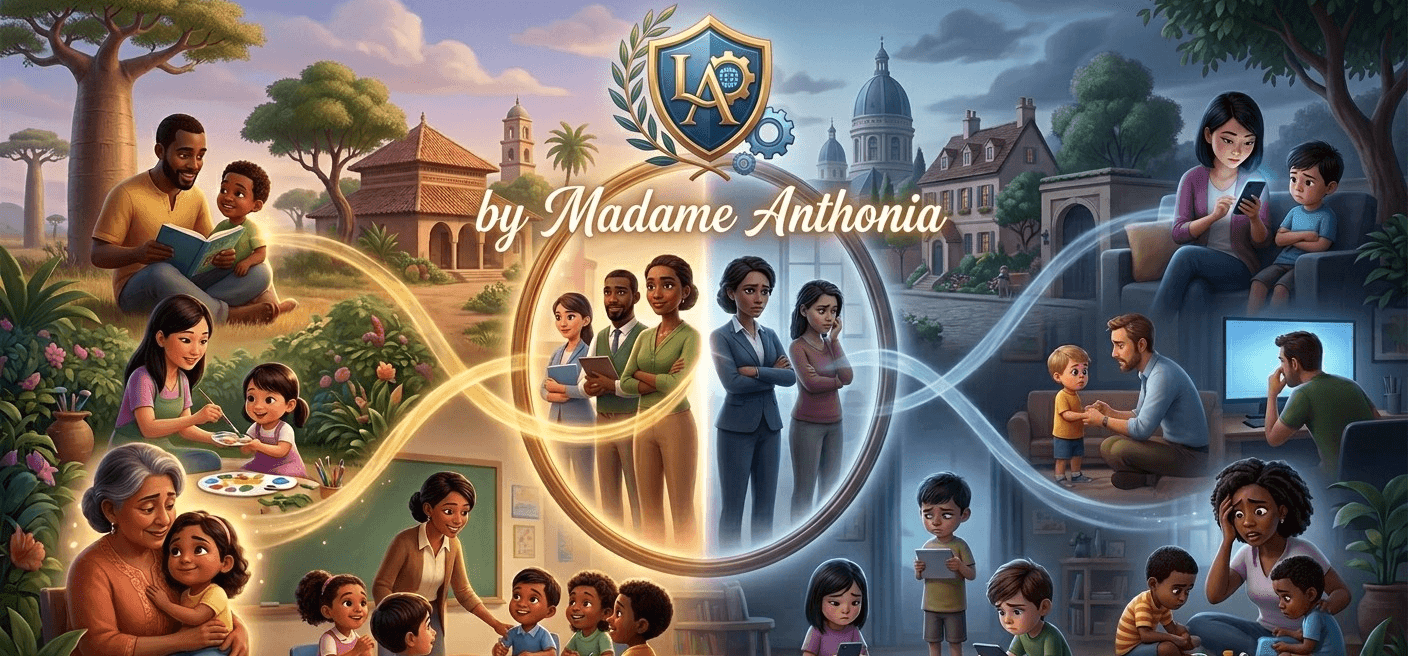
Photo Credit: Ai image generated by myself learnfrenchwith mafameAnthonia
Ai image crested by me to illustrate the impact of the subject in the story from the bright side and the other side .
Childhood does not end when we become adults—it continues to live inside us.
In the way we love and trust.
In the way we respond to the world.
And sometimes, without realizing it,
we are shaping that inner world for a child right now.
Because whether we see it or not,
children are always learning from us.
Not only from what we teach them—
but from how we live around them.
This is a reflection on something deeply human:
the responsibility we carry as parents, caregivers, teachers, and family members in shaping the emotional world of a child.
Before we talk about children,
I think we need to pause and reflect on ourselves as adults.
Because sometimes we are parents.
Sometimes we are caregivers.
Sometimes we are simply the relatives children are left with.
And in those moments, whether we realize it or not,
we are shaping their world.
Children are always watching.
They notice how we speak.
They observe how we respond.
They feel when we are present—and when we are not.
And over time, these small moments begin to form something bigger.
They shape how a child understands love, safety, and connection.
I have come to understand this not just through observation,
but through my own experience.
There was a time in my childhood when everything shifted.
I went from feeling secure and seen…
to learning how to navigate life on my own much earlier than I should have.
Nothing dramatic was said.
But I felt it.
The absence.
The emotional distance.
The quiet expectation to grow up.
And even now, as an adult, I recognize how deeply those moments shaped me.
Looking back, I realize something important:
A child can have their basic needs met
and still feel unseen.
As adults, we often focus on providing:
food
shelter
education
And these things matter.
But there is something children carry with them long after childhood:
how they were made to feel.
When emotional presence is missing,
children find ways to adapt.
They observe.
They absorb.
They learn from what is around them—
from other children, from environments, from what they are exposed to.
And sometimes, they are introduced too early to things they are not yet ready to understand.
In today’s world, access to technology has made this even more complex.
Without guidance, children can be exposed to influences that shape their thinking, behavior, and identity in ways we may not immediately see.
But this is not about blame.
It is about awareness.
Because many parents and caregivers are doing their best under pressure—
working, providing, trying to keep everything together.
And yet, even in the middle of all that,
there is something small—but powerful—that can make a difference:
intentional presence.
Not perfection.
Not having everything figured out.
Just being present.
Listening.
Creating space for a child to feel safe enough to express themselves.
And when children are placed in the care of others—teachers, relatives, caregivers—
that responsibility does not disappear.
It is shared.
Because every adult in a child’s life contributes, in some way,
to who that child becomes.
When we look closely at the world around us today,
we begin to see how deeply childhood experiences shape adulthood.
The way people respond.
The way they connect.
The way they cope.
It often starts much earlier than we think.
This is why these conversations matter.
Not to judge.
But to reflect.
To become more aware.
To do better where we can.
Every child deserves:
to feel seen
to feel heard
to feel safe
and to experience the fullness of childhood
Because when children are raised with care and emotional presence,
they grow into adults who understand how to give the same.
So perhaps the question is not whether we are raising children—
but how we are raising them.
As parents, as caregivers, or even as relatives entrusted with their care,
what kind of presence are we offering?
What kind of childhood are we helping to shape?
As a mother and a teacher, I have come to see that beyond education and provision, one of the greatest things we can offer a child is a childhood that feels safe, seen, and truly lived.
- Education
- Technology
- Environment
- Collaboration Stories
- Youth
- Behind the Headlines
- Global