
The Modern Guide to Managing Legacy Email Archives with GainTools DBX to PST Converter
Jun 25, 2026
first-story
Seeking
Visibility


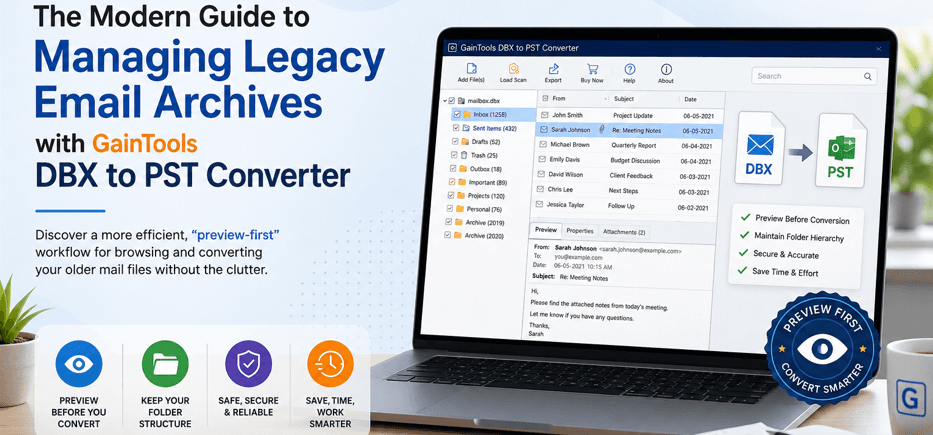
Photo Credit: Image created by me for illustrative and editorial use. Based on software interface concepts related to GainTools DBX to PST Converter.
A preview-first approach to managing and converting legacy email archives with GainTools DBX to PST Converter, helping users browse, organize, and migrate older mail data efficiently.
How to Audit and Manage Files to Get Control of Your Digital History
In a world where we are constantly looking for the latest and greatest in communication tools, many professionals are still faced with a major roadblock: the “data silos” created by legacy email clients. If you've ever opened up an old hard drive and found folders stuffed with .dbx files (the default storage format of the now-defunct Outlook Express), you know the frustration. These files are not just data . They are often repositories of project histories, client communication, and vital historical records that are effectively “trapped.
Many people go the brute-force conversion route. A more intelligent approach is to make these archives a management task. Today we are going to look at how a utility like the GainTools DBX converter acts as a bridge not only for the transfer of data but for taking back control over your digital archives.
The Real World Challenge: Data Recovery Case Study
To understand why this tool is needed, think about the mid-sized marketing firm I worked with recently. The firm had been archiving years of client correspondence from an older server into a set of huge DBX files. One client wanted evidence that a project had been approved six years ago. The firm found it was unable to search the files, because the original mail client was no longer supported on its Windows 11 workstations.
They were looking at a two-day manual process of installing legacy software in a virtual machine just to browse the files. So they used this utility instead. They were able to upload the files directly into the software.
• Instantly preview the contents of the archives without the legacy software installed.
• Find the exact correspondence in seconds with the built-in viewer.
• Export only the necessary threads to a PST file which was imported into their modern Outlook environment.
What might have been a multi-day ordeal was cut to 10 minutes. The value of the tool is that it is an archival browser that allows you to audit your data before you commit to a migration strategy.
Why Management Needs Preview First
The defining feature of this tool is that it presents your emails in a structured, familiar way. When you will use the software, you will see a clear table with Sender, Recipient and Subject fields.
This “Preview-First” philosophy changes the migration workflow from a risky “all-or-nothing” into a surgical, selective one. This way you can check exactly what is inside, and not convert a corrupt or bloated file into a new format and possibly bring over years of "junk" mail. This is necessary for:
• Legal Discovery: Rapid discovery of specific threads without changing original file metadata.
• Personal Archiving: Cleanup 10 years of newsletters and spam for a tidier, more effective final archive.
• Troubleshooting: View an email in real-time, with attachments and formatting, before you decide to migrate it to another platform.
Managing Your Legacy Archives: A How-To Guide
If you’re ready to get your old data back, we’ve made the process simple, even if you’re not tech-savvy.
1. Importing Data
Getting started Run the utility. First you need to add your DBX file. The tool is designed to recognize and mount the database so you can browse the contents as if you were using a native email client. Here, you use the file browser feature to find your legacy folders on your hard drive.
2. Auditing and Preview
Take a moment to scan the list when the file is loaded. A complete list of messages will be displayed. Clicking on a message will display the body of the email on the right hand panel. Use this time to conduct a “data audit.” Identify folders that contain critical business communications vs. just old system notifications.
3. Your Export Path
When you’re ready to export, choose the messages you want to move. You can choose from a number of modern formats the tool offers:
• PST: The standard for Outlook. You can save them in a new PST file or add these messages to an existing one (great if you want to merge fragmented archives).
• MBOX/MSG/EML: These formats are highly interoperable for users of Thunderbird, Apple Mail, or other modern email clients.
4. The Last Migration
Choose your desired output location and click Convert Now. The software will process your selection and preserve the integrity of the email metadata, not touching the "From," "To," "Date," and "Subject" fields.
Some practices for your archiving strategy
Here are some tips based on my experience managing large data sets to keep your archives functional:
• Always Have a “Golden Copy”: Keep original DBX files in a secondary read-only backup even after conversion of your data to PST.
• Consolidate, Don’t Scatter: Rather than having lots of tiny PSTs, use this to combine related emails into categorized archives (like “Project_X_Correspondence.pst”).
• Regular Audits: Don’t wait until you need a file to audit your archives. Set aside a time each year to review your legacy data to keep it accessible.
Final Thoughts
Data migration software should be about empowerment, not just moving. GainTools DBX to PST Converter succeeds because it knows that the hardest part of legacy email management is knowing what you have. It gives you a clear window into your archives, making the daunting task of retrieving old emails a simple, logical and highly controlled process.
If you’re a professional who needs to pull up client records, or a long-time user trying to organize years of personal history, the ability to selectively manage your data is the key to maintaining a healthy, searchable, and useful digital archive. Keep your old emails from becoming digital artifacts. Use the right tools to bring them into the modern era.
- Technology
- Leadership
- Education
- First Story
- Behind the Headlines
- Internet Access
- Digital Skills
- Global