
The Women Who Refuse to Let Tomorrow Disappear✨
Sep 4, 2026
story
Seeking
Action


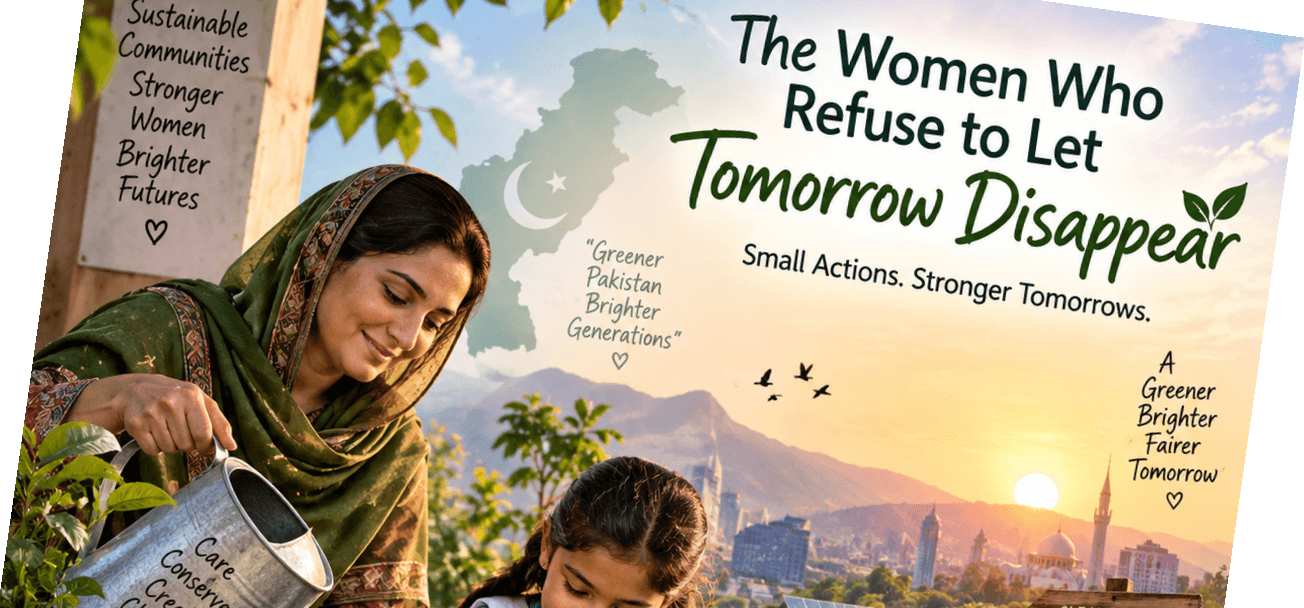
Photo Credit: AI-generated image created for this story by the author
A woman and a young girl work together in a green garden, watering and planting a young tree. The image represents women’s leadership, environmental care, sustainability, education, and hope for future generations. In the background are green communities, clean water, solar panels, mountains, and a city at sunrise.
The Women Who Refuse to Let Tomorrow Disappear
What if saving the planet did not begin in a laboratory?
What if it began in a kitchen?
With a woman turning off a running tap.
With a girl reusing an old notebook.
With a mother saving yesterday’s food instead of throwing it away.
With a family planting a tree whose shade they may never sit beneath.
We often imagine sustainability as something enormous: solar panels covering rooftops, forests being restored, oceans being cleaned, governments signing climate agreements.
But sustainability also lives in ordinary homes.
It lives in the hands of women.
And these hands are often doing more for our planet than we realize.
Across Pakistan, environmental challenges are becoming part of everyday life. Water scarcity, extreme heat, unpredictable weather, pollution and increasing waste are no longer distant environmental stories. They affect what families eat, how they travel, how they use water and how they imagine their children’s future.
Women experience these changes in deeply personal ways.
A woman may be the first person in a household to notice that water is running out faster.
She may be the one deciding how much water can be used for cooking, cleaning and washing.
She may be the one finding a way to prepare a meal with fewer ingredients when prices rise after environmental disruptions.
She may be the one caring for children during extreme heat.
Yet when we discuss sustainability, we often discuss technology before we discuss these women.
We discuss innovation before we discuss lived experience.
Perhaps we need to change the question.
Instead of asking only, “How can we save the planet?”
We should also ask:
“Who has been protecting it all along?”
Sustainability Begins at Home
For many women, sustainability is not a new concept.
It is something they have practiced for generations.
Use what you have.
Waste as little as possible.
Repair before replacing.
Save water.
Share what you can.
Grow something if you have the space.
These habits may not carry fashionable names like “zero waste” or “circular living,” but they reflect the same principle:
Resources are precious because someone, somewhere, may need them tomorrow.
A grandmother who keeps glass jars instead of throwing them away is practicing reuse.
A mother who transforms leftovers into another meal is reducing food waste.
A girl who uses both sides of a sheet of paper is conserving resources.
A woman who grows vegetables at home is strengthening household resilience.
These actions may seem insignificant when compared with the scale of global environmental problems.
But sustainability has never depended on one person doing everything.
It depends on millions of people doing something.
But Women Need More Than Responsibility
There is a danger in celebrating women only for their ability to cope.
We praise women for saving water, stretching food, managing households and surviving difficult circumstances.
But resilience should not become an excuse for inequality.
We cannot keep telling women to adapt to environmental change while excluding them from decisions about the environment.
If a community is deciding how water will be managed, women should be at the table.
If a city is planning public transportation, women’s mobility and safety should be considered.
If governments are creating climate policies, women from affected communities should have a voice.
If new green technologies are being introduced, girls should be encouraged to learn, design and lead.
Women should not only carry the consequences of environmental decisions. They should help make those decisions.
A Girl With a Seed
I often think about the power of a girl holding a seed.
It looks tiny.
Almost too small to matter.
But inside it is a possibility.
A tree.
Shade.
Cleaner air.
A home for birds.
A future.
That is how I see girls’ education too.
A girl who learns about sustainability today can become tomorrow’s environmental scientist.
She can become an engineer developing clean-energy solutions.
She can become a teacher who inspires hundreds of students.
She can become a policymaker who ensures that communities are not forgotten.
She can become an entrepreneur creating products from recycled materials.
She can become the voice of a community whose environmental problems were once ignored.
Education turns concern into capability.
And capability turns hope into action.
That is why sustainability and girls’ education cannot be separated.
The Future We Build Together
Imagine a community where girls learn how to test water quality.
Imagine women receiving training to run small environmentally friendly businesses.
Imagine schools where students grow gardens, compost food waste and learn where their water comes from.
Imagine neighborhoods where plastic waste is collected and transformed into useful products.
Imagine clean-energy solutions reaching families who currently depend on expensive or polluting sources of energy.
These are not impossible dreams.
They begin with investment.
Investment in women.
Investment in girls.
Investment in education.
Investment in local ideas.
Investment in communities that already understand the problems because they live with them every day.
The people closest to an environmental problem often understand its solutions better than anyone sitting far away from it.
We simply need to listen to them.
Small Acts Are Not Small
Sometimes people become discouraged because climate change feels too large.
How can one person make a difference?
How can one family matter?
How can one girl change anything?
But perhaps we have misunderstood what change looks like.
Change is not always dramatic.
Sometimes it is a girl reminding her family not to waste water.
Sometimes it is a teacher starting a recycling project at school.
Sometimes it is a woman turning discarded fabric into something useful.
Sometimes it is a group of neighbors planting trees together.
Sometimes it is a young person speaking about climate change when everyone else is silent.
One action inspires another.
One person teaches another.
One community influences another.
And slowly, what once seemed unusual becomes normal.
That is how movements grow.
We Cannot Afford to Leave Anyone Behind
The environmental crisis is not only about the future of forests, rivers and oceans.
It is about people.
It is about whether children can grow up healthy.
Whether families have access to clean water.
Whether girls can continue their education during climate-related disruptions.
Whether women have safe ways to earn livelihoods.
Whether communities have the resources to recover after environmental disasters.
Sustainability must therefore be more than environmental protection.
It must be social justice, opportunity and dignity.
A sustainable future should not ask poor families to carry the greatest burden.
It should not ask women to sacrifice their dreams so their families can survive.
It should not ask girls to inherit problems they had no role in creating.
Instead, it should give them the tools to become part of the solution.
Tomorrow Is Watching Us
One day, today’s children will become tomorrow’s adults.
They will inherit the rivers we protect—or pollute.
The air we clean—or contaminate.
The forests we plant—or destroy.
The opportunities we create—or deny.
They will live with the choices we make now.
That thought changes the meaning of sustainability for me.
It is not simply about saving something.
It is about leaving something worth inheriting.
A safer environment.
A healthier community.
A world where girls are educated and women are heard.
A future where progress does not require destroying the planet that makes progress possible.
The women who save water today may never be called environmentalists.
The girls who plant trees may never appear in newspapers.
The mothers who reduce waste may never receive an award.
But their actions matter.
Because every sustainable choice is a message to the future:
We remembered you.
We knew you were coming.
And we tried to leave you something better.
So perhaps saving the planet does begin in a kitchen.
Perhaps it begins in a classroom.
Perhaps it begins with a woman, a girl, a seed, a reused bottle, a saved drop of water.
Perhaps it begins with us refusing to believe that our small actions are meaningless.
Because the future is not something waiting for us somewhere ahead.
We are building it today.
And I want to build a future where women and girls are not merely surviving environmental change.
They are leading the change that saves tomorrow.
#Sustainability
#WomenAndClimate
#ClimateAction
#WomenEmpowerment
#GirlsEducation
#ClimateJustice
#WomenLeadingChange
#SustainableFuture
#EnvironmentalJustice
#GenderEquality
#YouthForClimate
#GreenFuture
#Pakistan
#WomenOfPakistan
#ClimateChange
#SDGs
#LeaveNoOneBehind
#SustainableDevelopment
#EcoFeminism
#FutureGenerations
- Leadership
- Girl Power
- Education
- Environment
- Digital Ambassador Events
- Climate Change
- Global