
Theory of Change Canvas: Making ToC Accessible & Successful for All
May 23, 2024
initiative
Seeking
Collaboration


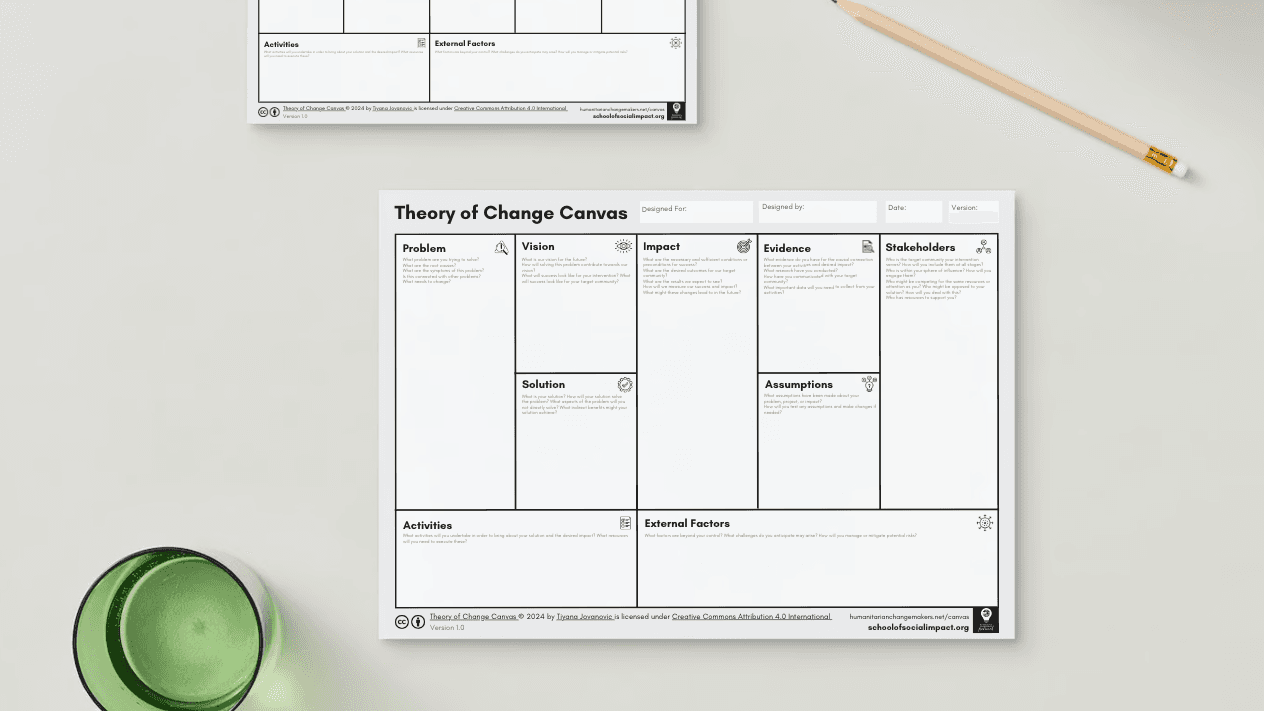
Digital mockup of the first version of the ToC Canvas
The Theory of Change Canvas is a tool that empowers changemakers to create impactful and sustainable social interventions. It offers a unique approach to addressing complex social issues by providing a structured yet flexible framework for comprehensive planning and strategic action. At its core, the Theory of Change Canvas is designed to address critical problems and challenges that hinder progress and equality. Whether it's tackling poverty, gender inequality, environmental degradation, or any other pressing, this tool equips you with a holistic perspective to identify the root causes, interconnected problems, and necessary changes.
Why Theory of Change Matters?
To reach any social impact goal, a Theory of Change should be the first step you take to set the foundation and understand how your project will contribute to positive change within the unique context you are working in. Yet most changemakers struggle to know what should go into their theory of change, what differentiates it from their strategy, or how they can communicate their theory of change to other stakeholders. Currently, logframes (logic frameworks) are the standard approach taken to developing a ToC, but while these might be useful for illustrating the linear progression of activities, outputs, and outcomes, they tend to fall short in capturing the multifaceted and interconnected nature of social change. Their linear structure tends to oversimplify complex problems and interventions, often neglecting the broader context and the dynamic interactions between various factors that influence change. This narrow focus can lead to gaps in understanding the root causes of issues, the nuanced relationships between different stakeholders, and the external factors that can impact the success of an intervention. As a result, the traditional logic model can hinder the development of a comprehensive and adaptive strategy, which is essential for addressing the real-world complexities of social change. Therefore, a more holistic and flexible framework is necessary to provide a thorough and nuanced understanding of the pathways to achieving sustainable impact.
The Theory of Change Canvas is an innovative and comprehensive resource I have designed for changemakers who are looking to create impactful and sustainable social interventions. Modelled after the popular Business Model Canvas, this tool provides a structured yet flexible framework that encourages a deep and broad consideration of the various elements that contribute to successful social change. The Theory of Change Canvas guides you through a comprehensive process. It prompts you to define a clear vision for the future that aligns with long-term objectives and ensures that your interventions are purpose-driven. It helps you formulate innovative solutions that address both the direct and indirect aspects of the problem, maximising the benefits and minimising potential limitations.
Why Use the Theory of Change Canvas?
- Holistic Perspective: The Theory of Change Canvas prompts users to explore and articulate the problem they are addressing from multiple angles. It encourages a thorough analysis of root causes, symptoms, and interconnected issues, ensuring a well-rounded understanding of the problem landscape.
- Vision-Driven: This framework places a strong emphasis on the vision for the future. By defining a clear and inspiring vision, changemakers can ensure that their interventions are aligned with long-term goals and contribute meaningfully to the desired future state.
- Comprehensive Planning: The canvas covers all critical aspects of designing a social intervention, from problem definition and solution formulation to impact measurement and stakeholder engagement. This comprehensive approach helps ensure that no important element is overlooked.
- Flexibility and Adaptability: The Theory of Change Canvas allows for iterative development and continuous refinement. It acknowledges that assumptions may need to be tested and adjusted and that external factors may influence outcomes. This flexibility is crucial for adapting strategies to real-world complexities.
- Stakeholder Inclusion: The framework emphasises the importance of involving the target community and other stakeholders at all stages of the intervention. This inclusive approach helps build trust, ensures relevance, and enhances the likelihood of achieving sustainable impact.
- Evidence-Based Approach: By encouraging the collection and use of evidence, the canvas helps changemakers build robust theories of change that are grounded in research and data. This evidence-based approach enhances the credibility and effectiveness of interventions.
- Preparation for Linear Models: While the canvas itself is not linear, it provides a rich foundation for developing a logic model or strategy. Once the various elements of the theory of change are thoroughly explored and articulated using the canvas, they can be organised into a linear format for communication with stakeholders who prefer or require such models.
What is the Impact I hope to have with the ToC Canvas?
The Theory of Change Canvas is the culmination of my doctoral research and experience as a social impact strategist: I have seen far too many interventions “fail” to achieve the desired impact despite the best intentions of leaders, and it is often due to a poorly tested, assumption-heavy theory of change. I want to ensure that anyone who wants to turn their vision for a better world into reality is equipped with the ability to create, test, and refine a ToC in their change-making toolkit. My aim for the Theory of Change Canvas is to:
- Test and refine the canvas, creating any necessary tools to help grassroots changemakers use the framework in their own interventions
- Publish the theoretical framework underpinning the model in relevant academic journals and present the model to scholars who can apply it in their research.
- Translate the framework in as many languages as possible so that changemakers globally can benefit from the model!
- Leadership
- First Story
- Global