
Together, We Rise: The Power of Collective Care
Jun 20, 2025
story
Seeking
Visibility


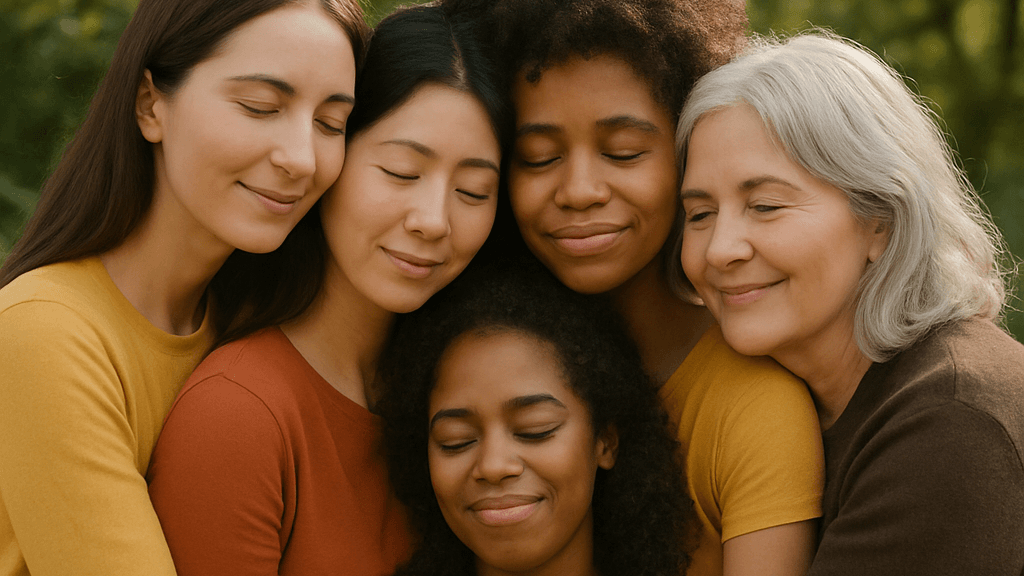
Photo Credit: AI
An AI-generated image of a community of women depicting collective care.
In a world that often praises independence and self-sufficiency, I’ve come to cherish something far more enduring, collective care.
For a long time, I believed I had to carry my burdens alone. I was taught to be strong, to keep pushing, and not to be “a burden” to others. I believed that success meant doing it all alone, all by myself.
But somewhere along my life's journey, especially in moments of weakness, pain, discouragement, and disappointment, I realized that this belief was not only limiting but also deeply isolating.
To me, the term “collective care" means showing up for one another in ways that honor our shared humanity. It is the practice of caring for each other in the community, not out of obligation, but out of a deep awareness that our well-being is interconnected and intertwined. It is love in action, empathy with arms, and solidarity that speaks louder than sympathy.
I had my most vivid encounter with the concept of collective care when I became a mother. No matter how many books I had read or advice I had received, nothing quite prepared me for the emotional whirlwind that followed childbirth. Sleepless nights, hormonal shifts, and postpartum anxiety were days I felt like I was barely holding on.
And then, unexpectedly, the community happened. My friend kept on encouraging me, though she was far away in Lagos, but a day never passed without her sending words of encouragement to me. Those words kept me going in that difficult time.
Strangers in a new mothers’ group I joined online shared their experiences openly, making me feel less alone.
It wasn’t just people doing kind things or saying kind words, it was a web of intentional and genuine support of others reaching out not because they had to, but because they understood that life is easier when we hold each other up.
In many African cultures, collective care is not a new idea. It is woven into the fabric of daily life. In the village, when someone falls sick, everyone contributes to their care. When a woman gives birth, other women rally around her. During weddings or funerals, the entire community plays a role. Meals are shared. Labor is communal. Children are raised not just by parents, but by aunties, uncles, neighbors, and elders.
I stumbled on a post on Instagram a few days ago, where Taraji P. Henson was giving a speech at Spelman College in Atlanta, Georgia, United States, to the Class of 2025.
Taraji talked about a beautiful ritual in the Babemba tribe in the Southern African Region, she said:
“When a person acts irresponsible or harmful, he is placed in the center of the village alone and surrounded by the tribe for 2 days, every woman, man, and child gathers and speaks positive affirmations to the person, reminding him of all the good things he's doing every good deed, every experience they can recall and they take their time, 2 whole days. The tribe believes that each human comes into the world as good. Each one of us only desires safety, belonging, happiness, and dignity. But sometimes, when we're so focused on trying to achieve happiness, people make mistakes but we don't throw them away. The tribe sees those mistakes as a cry for help. They come together to lift him, to reconnect him with his true nature, to remind him who he is until he remembers the truth of which he has been temporarily disconnected, ‘I am good’. At the end, the tribal circle is broken, a joyous celebration takes place and the person is symbolically welcomed back into the tribe”.
This for me, is what I'll boldly call “collective care”.
However, with modernization, urban migration, and digital isolation, we’ve seen some of these community practices erode. Many now live far from family, and the pace of life is faster. People are lonelier, and asking for help feels shameful. And yet, the need for care hasn’t disappeared.
Now more than ever, we must intentionally return to collective care, not just as a cultural practice, but as a necessity for emotional, physical, and mental survival.
So, what does collective care look like today? It’s not always grand or dramatic. Most times, it’s simple and small. But those small things carry enormous weight.
- It’s organizing a meal for a sick colleague.
- It’s creating a safe WhatsApp group for single mothers to vent, laugh, and pray together.
- It’s checking on your friend who always says “I’m fine” but posts cryptic things on social media.
- It’s offering your skills freely to a cause that uplifts others.
- It’s choosing to stay and listen instead of walking away.
- It’s showing up at a protest for justice, even if the issue doesn’t affect you directly.
- It’s mentoring a younger woman who reminds you of your past self.
- It’s raising your voice to speak out for the vulnerable when they are being silenced.
Collective care is radical because it disrupts systems that benefit from our exhaustion and isolation. It challenges the idea that we must keep grinding at all costs. It affirms that rest is a right, that healing is communal, and that no one should walk through life alone.
The importance of collective care becomes even clearer during times of crisis.
In times of natural disasters, war, pandemics, or political unrest, official institutions often fail. But communities, especially women-led groups, rise. I saw this during the COVID-19 pandemic. Women, churches, and Non-Governmental Organizations (NGOs) organized food drives, created community relief funds, shared health information, and advocated for mental health resources. While governments struggled, communities mobilized.
It was women, mothers, sisters, neighbors, friends, and teachers, who kept families and neighborhoods afloat during those trying times.
That is collective care in action. It is a form of resistance, it is how we survive, not just as individuals, but as people who are deeply connected by love, pain, and the shared desire for a better society, better community, and a better world.
One of the most profound aspects of collective care is how healing it can be, how soothing and how relaxing it can be. Collective care is therapeutic.
We often think of healing as something that happens alone, in silence, behind closed doors. But sometimes, true healing comes when someone else says, “Me too.” When someone brings soup, when someone gives you breakfast or lunch, when you can't seem to figure out where the next available meal will come from, when someone listens without judging, when someone reminds you that you matter, when someone tells you “you're not alone” even on days when you feel invisible.
Through collective care, we are reminded that we don’t have to carry everything alone. That it's okay to rest, that it’s brave to ask for help, that it’s beautiful to offer it, too.
So when I say collective care, I mean:
- Holding hands through the storms.
- Saying, “I see you,” even when someone doesn’t have the words to cry out.
- Reaching back to lift those coming behind, even as you keep climbing.
But even much more than that, collective care is a lifestyle, a mindset, and a choice. It’s a quiet, everyday decision to recognize that each person we meet is carrying something, grief, joy, battle, struggle, or hope, and we are capable of lightening that load, even in small ways.
To me, collective care means creating a world where empathy guides our actions more than ambition, where community matters more than competition, and where success is redefined, not by how far one person gets, but by how many we bring along.
It means:
- Choosing softness in a world that often rewards hardness.
- Making space at the table instead of hoarding seats.
- Offering our hands, our time, our resources, not because we have extra, but because we believe in abundance through sharing.
Collective care is in the stories we tell, the spaces we create, and the systems we challenge. It’s how we mother one another, support strangers, hold space for healing, and pass on strength across generations.
As someone who once struggled silently and thought asking for help was a weakness, I now know better. I’ve learned that vulnerability is strength. That receiving care is just as sacred as giving it. And that there is no shame in needing others, rather there is, in fact, deep beauty in that need.
I’ve come to see collective care as one of the most powerful tools for transformation, personal, relational, societal, and even spiritual. It reminds us that healing does not happen in isolation and that movements are not fueled by heroes alone, but by ordinary people choosing every day to care deeply, intentionally, and radically for others.
In the end, collective care means hope. Hope that even when the world feels heavy, we’re not alone in carrying it.
Hope that through the cracks in our systems, our communities can still bloom.
Hope that if I show up for you today, you’ll show up for someone tomorrow and that this ripple will grow into a tide that changes everything.
That’s the kind of world I want to live in.
That’s the kind of world I want to help build, and it starts with us, you and I.
You are not alone, I'm with you all the way, holding your hands, guiding you through this rough phase of your life, I'm praying for you and asking God to give you the strength you need to scale through this phase and come out refined as gold.
If you need someone to listen, someone to share those burdens with, a shoulder to cry on, I'm right here and I'm whispering in your ears, “YOU ARE NOT ALONE, I GOT YOU”.
- Survivor Stories
- Stronger Together
- Becoming Me
- Global