
TrustVare IMAP to IMAP Case: Seamlessly Moving 520 GB of Email Data Between IMAP Servers
Jul 14, 2026
first-story
Seeking
Feedback


IMAP to IMAP
Introduction: The Difficulty of Changing a Critical Business Email Environment
For a quickly growing digital marketing firm managing SEO efforts, paid ads, content marketing and customer service for more than 150 active clients, email served as the primary means of contact. After operating for several years, the organization had about 520 GB of IMAP mailbox data, which was distributed among 86 staff accounts. Management made the decision to switch to a new IMAP hosting company because the current mail server was becoming slower and more costly to operate.
Maintaining every email, attachment, folder structure, timestamps and read/unread status without interfering with regular communication was the main priority. Due to the fact that client approvals and campaign conversations were communicated by email, even a minor loss of data might have led to missed deadlines and unhappy clients.
This case study describes the migration strategy, contrasts automated and manual methods, shows quantifiable results and assesses if the selected solution fulfilled business requirements.
Knowing IMAP and the Significance of IMAP-to-IMAP Migration
What is an IMAP?
An email system called the Internet Message Access Protocol (IMAP) stores messages on a mail server rather than a local computer. While keeping folders, emails, attachments and message status synchronized, users can access the same mailbox from several devices.
Businesses that need centralized communication frequently utilize IMAP since emails are kept on the server.
IMAP to IMAP Conversion's Significance
There are various reasons why organizations switch between IMAP servers:
- Changing to a better source of email hosting
- Lowering the cost of infrastructure
- Increasing the capacity of mailboxes
- Enhancing safety
- Improved server performance and uptime
- Acquisitions or mergers of businesses
- Combining several email systems into one
- Enhancing preparation for disaster recovery
Every mailbox component should be preserved and operational downtime should be minimized in a successful migration.
Techniques Assessed Throughout the Project
Method 1: Manual Migration
Initially, the IT team tried a manual migration by synchronizing mailbox folders separately and setting up both new and old IMAP accounts within desktop email clients.
Authentication, folder verification, synchronization, and frequent monitoring were necessary for every mailbox.
Manual Results
The team tested ten mailboxes, roughly 58 GB, over the course of two working days and found:
- Several synchronization issues
- A slow upload speed
- The absence of folder mappings
- Duplicate emails
- Transfers that are interrupted during network disconnections
- A substantial level of administrator participation
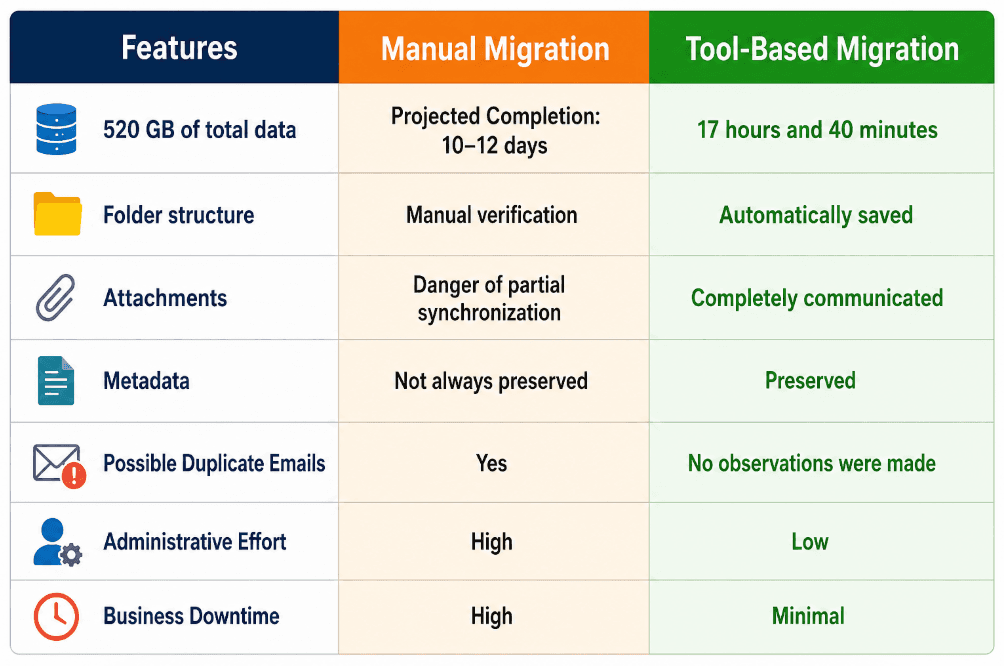
All 520 GB were expected to take more than 10–12 working days to complete, which was deemed unfeasible.
Restrictions and Difficulties with Manual Migration
- Constant observation was required.
- During synchronization, large mailboxes often halted.
- Manual verification of the folder hierarchy was necessary.
- Attachments significantly lengthened the synchronization time.
- Following interrupted sessions, duplicate messages surfaced.
- A human mistake is highly likely.
- Outlook was busy throughout synchronization, which had an impact on business productivity.
- Depending on the stability of the internet, migration speed varied considerably.
The company came to the conclusion that the operational risks associated with manual migration were intolerable.
Method 2: Migration Based on Tools
The company decided to use the TrustVare IMAP to IMAP Migration Tool for direct server-to-server migration in order to resolve these problems.
Among the migrants were:
- 86 mailboxes
- A total of 520 GB of email data
- Over 1.4 million emails
- Thousands of subfolders and folders
- Attachments that range in size from 40 MB marketing assets to KB files
Tool-Based Result
It took about 17 hours and 40 minutes to complete the move.
Final confirmation revealed:
- 100% success rate for mailbox transfers
- There are no missing attachments.
- The entire folder hierarchy is maintained.
- The read/unread status is maintained
- The original timestamps were preserved.
- No duplicate emails were found.
- Scheduled maintenance takes less than thirty minutes.
Following DNS upgrades, the marketing and support staff promptly began regular communication.
Final confirmation revealed a 100% success rate... It took about 17 hours and 40 minutes to complete the move in this specific high-bandwidth environment, though individual migration times will vary based on network speeds and server-side rate limits.
Comparison of Manual and Tool-Based Methods
Advantages of the Software
Direct Transfer from Server to Server: In order to minimize needless handling, mailboxes were sent straight across IMAP servers without first creating any files.
Full Preservation of Folders: Following the conversion, every folder and nested mailbox looked just as users had anticipated.
Integrity of Attachment: Campaign assets, invoices, presentations and marketing materials were all still available.
Preservation of Metadata: Timestamps, flags, read/unread status and original sender information were all unaltered.
Quicker Processing of Large Mailboxes: Even mailboxes larger than 25 GB were successfully moved without data splitting.
Decreased Administrative Tasks: The move was finished by the IT department with significantly less manual input.
Minimal Downtime: With the exception of a brief maintenance window during final switching, workers carried on with everyday operations.
Dependable Large-Scale Migration: Hundreds of gigabytes of data were successfully handled by the project without any discernible data discrepancies.
Difficulties
- A reliable internet connection is necessary.
- Continuous communication between the two IMAP servers is essential for migration performance.
- Authentication of the server is required.
- Before starting the migration, administrators must have working login credentials for each mailbox.
- The overall migration time may go up if either email server uses bandwidth restrictions.
Steps Taken in Migration
1. On a Windows computer, install the migration software.
2. Start the program.
3. Choose IMAP for both the source and the destination.
4. Enter the credentials for the source server.
5. Enter the credentials for the destination server.
6. Verify mailbox access.
7. Choose the necessary mailboxes.
8. Examine the folder mapping.
9. If necessary, set up migration options.
10. Begin the migration process.
11. Track real-time progress.
12. Check mailboxes that have been moved.
13. Modify email routing or DNS.
14. Complete the last user verification.
Recommendation
This solution is advised for companies that need to transfer substantial amounts of IMAP email data while preserving business continuity, according to the case study's findings. With no discernible data loss or extended downtime, it handled 520 GB of mailbox data with good performance, maintaining emails, attachments, folder hierarchy and mailbox metadata.
It is especially appropriate for:
- Digital marketing firms that handle various client communications.
- Small and medium-sized companies are switching to a new IMAP hosting company.
- Businesses are moving hundreds of employee mailboxes.
- Client email migrations carried out by Managed Service Providers (MSPs).
- Businesses that depend on secure email records, such as financial institutions, law firms, healthcare organizations and educational institutions.
- IT managers seeking a quicker substitute for IMAP synchronization by hand.
Before migrating all mailboxes, organizations preparing a migration should make sure they have a reliable internet connection, correct credentials for both IMAP servers and a small pilot migration. The automated approach provides a reliable choice for companies that value data integrity, low downtime and effective large-scale email migration, according to the project's successful conclusion.
Frequently Asked Questions
1. Why was 520 GB of email data moved by the agency?
For regular corporate communications, the old mail server had grown less dependable, slower and more costly.
2. Did the attachments get transferred?
Yes, following the move, all email attachments were still available.
3. Was the original hierarchy of folders preserved?
Yes, the folders and subfolders that were already present in each mailbox were kept.
4. What was the amount of downtime throughout the migration?
The last server switch only required roughly thirty minutes of scheduled maintenance.
5. Were any emails lost by users?
During post-migration verification, no email loss was found.
6. Is this strategy appropriate for companies with a large number of employee accounts?
Yes, businesses that manage numerous IMAP mailboxes and significant email archives should use it.
Conclusion
This case study showed that a manual migration of 520 GB of business email data would have involved more administrative work, longer downtime and higher operational risk. In addition to preserving mailbox integrity, maintaining folder hierarchy, removing duplicate emails and minimizing interference with continuing client communication, the automated technique finished the migration in 17 hours and 40 minutes.
IT administrators, managed service providers, businesses, marketing organizations, law firms, educational institutions and any organization contemplating a large-scale email server migration are advised to use this solution based on this project. Accurate data preservation, less human labor, reliable management of big mailboxes and less disruption to business were its greatest benefits. The necessity of reliable internet access and legitimate server credentials is the main factor to take into account.
Note: Migration times may fluctuate because of specific network infrastructure and server API limits.
Overall performance: 4.5 out of 5
For businesses looking to migrate their IMAP mailboxes securely and accurately, the migration is a sensible option because it produces consistent outcomes with quantifiable efficiency gains.
- Technology
- First Story
- Member Introductions
- Digital Skills
- Global