
VALID DREAM FOR GIRL CHILD
Apr 12, 2024
first-story
Seeking
Encouragement

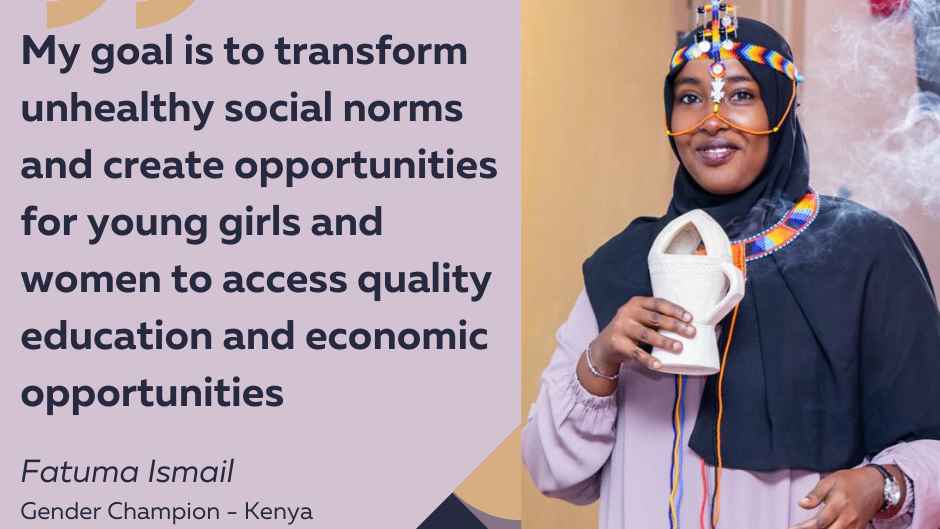
My name is Fatuma Zahra Ismail, and I hail from Isiolo County. Growing up as a pastoralist girl in a community with rich cultural diversity, I've been fortunate to receive an education, unlike many other girls in my community. Isiolo boasts a multi-ethnic and multicultural environment, with a predominant pastoral community deeply rooted in their traditions and religion. Understanding the challenges faced by girls in my community, including issues such as illiteracy, FGM, and early marriages, I have always harbored a dream of mitigating these obstacles. My goal is to ensure that every girl in my community can lead a life free from such barriers, akin to girls elsewhere, thereby contributing to a brighter future for them and our world.
Fortunately, in 2018 I got an opportunity to join Mercy Corps International Organization as Girls Improving Resilience Through Livelihood (GIRL) Officer, responsible for technical oversight and management of the GIRL Model. This is a safe space model focused on the empowerment of adolescent girls to support human capital development for resilient individuals who are well-placed for commercial engagement.
The young people in my community face a lot of challenges around here including scarcity of food that leads to poor nutrition contributed by drought that is mainly faced in the Northern part of Kenya where pastoralism is largely practiced, and high illiteracy levels caused by frequent cases of school dropouts by young people who are in search of livelihoods to support themselves or their families. The young girls also face additional challenges such as female genital mutilation ( FGM), early marriages, or early pregnancy that force them to drop out of school. This here particularly is a unique type of challenge since it is a cultural practice or belief that is mostly limited or practiced in the Northern part of the country.
Ngaremara Ward, situated in Isiolo County in Northern part of Kenya, is predominantly inhabited by the Turkana community, who are pastoralists deeply committed to preserving their traditional and cultural practices. Conversely, Burat Ward, also within Isiolo County, hosts a blend of Somali, Borana, and Turkana communities. In these communities, polygamy is widely accepted, allowing men to marry multiple wives. It's common for older men to marry a teenage girl. We noted that illiteracy and cases of school dropout for girls were prevalent in those two Wards. This was because girls get married off early and have children at the young age of 14 years. Education for girls is not a priority and sometimes “dreams” for young girls end up being long forgotten. Girls often drop out of school because of early pregnancy which has over the years become a major common challenge. Additionally, the young men who drop out of school and join the “morans” end up becoming drug abusers and thieves due to unemployment and idleness!
The “GIRL” model’, which was under the USAID-funded Livestock Market Systems (LMS) program was implemented in Burat and Ngaremara Wards, where the first cohort of girls was selected. The initiative established 30 groups, comprising 24 groups for out-of-school girls aged 15 to 19, 1 group for girls aged 10 to 14 who are out of school, and 5 groups for in-school girls aged 10 to 14. Additionally, 30 mentors aged 20 and above were involved. The groups go through a nine-month structured training and mentoring under the stewardship of a self-selected group Mentor. The Mentor is trained in different modules each month and subsequently trains the girls under the supervision of a GIRL Officer. During the training and mentoring process, the girls identified various transition pathways such as going back to school (education), vocational training and business. The mentorship program allowed girls who unfortunately had previously never set foot in a class. Now almost every girl who did not know how to read and write can write their names comfortably.
As part of the trainings and mentorship, I linked the groups with other public and private sectors to expand the scope for opportunities, and as a result some groups applied for and received loans from the Youth Enterprise and Women Enterprise Funds. Through this fund, the girls established their own businesses which included grocery shops, cosmetics shops, popsicle vendors and retail shops in the neighborhood, leading to improved income and ownership.
Through the program I introduced savings culture where from their savings girls can borrow money individually for purposes of paying hospital bills for themselves or their children, paying school fees, and buying basic needs that they couldn’t afford before. With these and more some of the girls are thinking of going back to school.
Daaba was one of the selected villages for the GIRL model. It had the highest levels of illiteracy. We found a 16-year-old girl/child with 2 kids and a third wife married to an old man. We also realized that there are young girls 10 to 14 years out of school who we initially thought or assumed to be in school. They adorned themselves with traditional beaded necklaces and dyed their hair with special colored soil which is a sign that they are ready to get married any time.
Forming a group was not easy in that village because the mentality of that community was negative when it came to girl’s empowerment and education. Engaging the community was hard since women couldn’t talk in front of their husbands therefore, we couldn’t collect substantial feedback. Even when I was forming the groups, especially 10 to 14 years, some men were standing there saying “hata mkiwachagua tutaowa hawa tu” meaning even if you select them, we will eventually marry them.
Despite the challenges, I was determined, and successfully formed 4 groups in that village: 15 to 19 three groups 10 to 14 one group. In the beginning, the girls were very shy and couldn’t talk to us. However, after several training and mentorship sessions, the girls are now opening up and sharing their stories with us, especially those who were married at an early stage and have children or were forcefully married off.
There is a young girl called Silvia who is 15 years of age in the 15 to 19 years age group, who told us that she only recently wore the beads. She has delayed wearing them because she dreamt of one day going to school like other girls her age. However, her parents were against it and forced her to wear the beads to show that she was ready to get married.
“Now am happy to say that Silvia and other girls like her who did not get an opportunity to go to school, can read basic alphabets and numbers, and can express themselves by sharing their stories with us and other girls in their groups. They can now also think out of the “box” and can come up with ideas. Since we introduced savings to them, and other entrepreneurial ideas, some who are married and have kids started small businesses, and others opted to go back to school like Silvia and others who were not married.
With the 3 pathways; Education, Vocational, and Businesses. I linked the girls to Institutions both financial and private institutions, markets, County and National Governments for more opportunities and benefits. I managed to lead the process of ensuring that 50 girls went to primary School, 25 girls to High School, 20 girls to vocational training, and 2 girls to rescue centres and I ensured others started businesses. In some cases, I provided financial support as a well-wisher to mentor and support young girls who need school fees for secondary school and basic needs for primary school.
All that has been said and done, this specific intervention of the model and the mentorship that I did has hugely and positively impacted the lives of girls living in Isiolo County. They have experienced growth and empowerment. The mentorship program has helped these girls build their sense of self and develop confidence by offering them opportunities to express themselves to be heard, without any fear whatsoever. Investing energy and resources into girls is always a great idea and bears fruit eventually. Educating and empowering girls changes everything and turns it all around, from their mentality to their cultural beliefs are slowly eradicated.
My experience working closely with adolescents and young people of Northern Kenya has been an eye-opener. Having worked closely with vulnerable young girls and women from marginalized communities, my goal is to transform unhealthy social norms and create opportunities for young girls and women to access quality education and economic opportunities, to empower them, to be in control and take charge of their lives.
As a Gender champion, I would like to have more exposure, experience, and skills so that I can in turn empower girls, young mothers, women, and youth at large in my community to venture into more opportunities and in turn break out of the vicious cycle of poverty they are in hence live decent lives.
- Economic Power
- Girl Power
- Gender-based Violence
- First Story
- Youth
- Our Impact
- Moments of Hope
- Global