
“Wit rules, strength rolls the logs”.
Jan 21, 2015
story


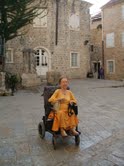
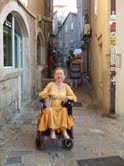
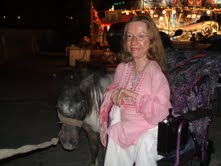
She is a tiny human being, but a huge personality. She sits on her wheelchair as a beautiful porcelain doll on her throne. She is so fragile that if you grasp her hand it will break. Although she is not able to move her body without the help of others, her thoughts are independent, and her ideas are the ideas of a leader who is reshaping the way disability is experienced and viewed in Serbia.
Until the age of six Julijana Catalinac was quite an ordinary child. Then disaster struck. She was diagnosed with a severe form of muscular dystrophy. As the second child in a family with three girls, the other two sisters healthy, she was in a unique position regarding her parents and the rest of the outer world. For more then five years she was in bed. Her mother Piroska was her support, the one whose dedication taught Julijana never to surrender. Her father, although a kind and loving man, never adapted to having a psychically disabled child. After his death Julijana’s connection with her mother grew even stronger. After her sisters left home, the two of them lived together, with mother tending to Julijana’s many physical needs. Then disaster struck once again. The only one human being Julijana depended upon was diagnosed with an advanced stage of cancer. Not thinking of herself, Piroska’s greatest fear was that she would leave her daughter alone, helpless and without protection.
“Mother supported me during the worst period of my life,” Julijana says today, “so, of course, I was determined to make her last days easier.” Her sisters were absent most of the time, but Julijana was a constant presence at her mother’s bedside. Nobody called her to ask how she was doing; it was a lonely vigil. When her mother passed away, Julijana fell into a deep depression. She saw only two possibilities: to kill herself or to fight for herself. After months of loneliness, Julijana somehow pulled herself together and decided to fight for life.
Looking back at that dark period, Julijana says “As long as we think about our disability as a tragedy, people will feel pity for us. As long as we are ashamed of who we are, our lives will be considered useless. As long as we are invisible, other people will tell us what to do.” Julijana forced herself to go out into the world, where found strength for life by connecting with other people and making friendships.
In the late 1980s all of Julijana’s efforts to reach out to other disabled individuals culminated in the establishment of the Muscular Dystrophy Association of Sombor, of which she has been a founding member. She has been active in this Association ever since. The MDA has neither premises of its own, nor a steady source of financing. It receives government financial support through its sponsorship of successful “projects.” Julijana initiated the association’s first project, the one that was important to her as someone confined to a wheelchair: the adaptation of pedestrian crossings for wheelchair access. While progress has been made, even today there is no access for the disabled at many post offices, banks, ambulances or the local government offices. Public transportation is still inaccessible for those using a wheelchair.
For its next project, the MDA initiated the idea of educating and hiring personal assistants. For people with muscular dystrophy a skilled caregiver can mean the difference between isolation and a full, participatory life. The funding for this project paid the salaries of the personal assistants over a three year period. Since 2010, however, budget cutbacks have reduced funding to cover just seven months of salary per year. In 2012 the funding will probably be cut completely, putting the disabled people’s journey towards independence on an uncertain path.
Juliana, as a founding member of the local MDA, often participates in interviews and panels on TV programs and radio broadcasts. She writes about muscular dystrophy and related issues for the local newspapers and helps with the educational campaigns about the disease, for the other members of the public.
Julijana’s example gives hope to those whose needs have been neglected that changes are possible. She is working hard to educate the new generations of the disabled, as well as the people around them who care. She is self-confident and not afraid to confront politicians, who can be arrogant about their power and dismissive of her political views.
As a public persona Julijana is beloved by the media. She’ll on her smartest dress, a brightly colored designer hat, and her jewelry, to talk to journalists and TV reporters about the rights of the people she represents. Her courage and strength are epic, and her feisty attitude breaks barriers and boundaries. She has also appealed to the international community to recognize the struggles of the disabled in Serbia. The good news is that although Serbia is a transitional country with a lot of problems to overcome, there are some positive trends that have directly impacted the way the country’s disabled citizens are being integrated into the Serbian society. This is due, in no small part, to the tireless efforts of Julijana and other volunteers at the MDA.
At the end of our interview I found myself looking at this porcelain doll and trying to imagine the difficulties that she has had to overcome, often with no one to turn to for help or solace. In the Serbian language there is a proverb: “Wit rules, strength rolls the logs”. Julijana’s self-confidence and her passion for improving conditions for the disabled have moved the conscience of many people in Serbia. She is an example of what a woman is capable of doing with the power of her mind.
After meeting her, I decided to join the cause she promotes, one of which I, like many Serbs, was not aware of. Julijana’s fight for the disabled has brought a new dimension to my struggle for the rights of women in Serbia.
This article is part of a writing assignment for Voices of Our Future a program of World Pulse that provides rigorous new media and citizen journalism training for grassroots women leaders. World Pulse lifts and unites the voices of women from some of the most unheard regions of the world.
- Europe