
Your Voice Matters on Food and Food Systems Transformation
Aug 24, 2021
story

Ever since I made a radical shift from being a marketer many years ago into community work and human rights and social justice , I feel more at home when I engage in debates on issues that matter to humanity , when I share my knowledge and skills with a diverse audience , when I get to speak about food justice, climate justice , rural women, shrinking civic spaces and matters youth.
Food , a basic need is changing today, from the way it is produced , to the way it is stored and transported. Laboratories are churning new seed varieties day in day out and this is coupled with a push by agro-chemicals to continue selling chemical and industrial seeds as they are assured of a ready market.
We hear of cases where supermarkets are lacing food with formalin to make it stay fresh for longer and to look appealing to customers, we hear of chicken being injected with hormones to mature faster , we hear of cattle being injected to produce more milk , and bananas laced with carbide – a chemical to make them ripen[1] , ready for customers. Do you know the uses of carbide, also known as calcium acetylide? It is used for drilling and mining tools, an industrial alloy, in surgical devices, recycling of scrape materials among others[2]
And as you eat your mandazi [3]accompanied by a cup of tea in the morning , do you care to find out how the mandazi was prepared ? , do you know where the oil that made your mandazi comes from ? yes , you got me right, some unscrupulous business people are using transformed oil to fry chips , mandazi and cassava[4] .Transformer oil is said to make chips look ever fresh . what of the wheat flour that was used to make the mandazi which boasts of bio-fortification ?, what happened to natural nutrients found in food , that warrants replacement with bio fortification? In the midst of this plant varieties are disappearing and biodiversity is weakened leading to new pathogens and outbreaks of pandemics on a global scale. According to Food and Agriculture Organisation-FAO , since 1900s 75 percent of plant genetic diversity has been lost as farmers worldwide have left their multiple local varieties and landraces for genetically uniform , high yielding varieties, furthermore, 30% of livestock breeds are at risk of extinction with six breeds being lost each month .Today , 75 percent of the world’s food is generated from only 12 plants and five animal species[5] .And yet , despite this grave situation, industrial food system is working day and night to replace nature with synthetic matter .
Scientists working for industrial food systems are coming up with all manners of “food “sometimes maize is touted as being water efficient and meant for the African continent , fast growing , resistant to pests and diseases and marketing has gone a notch higher where pesticides packages are put in bold colours with the aim of attracting farmers to buy these and put on their crops and this comes to your table in the form of the food that you eat.This is not being against science , but a science that works for the people and not for corporations to mint profits in the context of food.
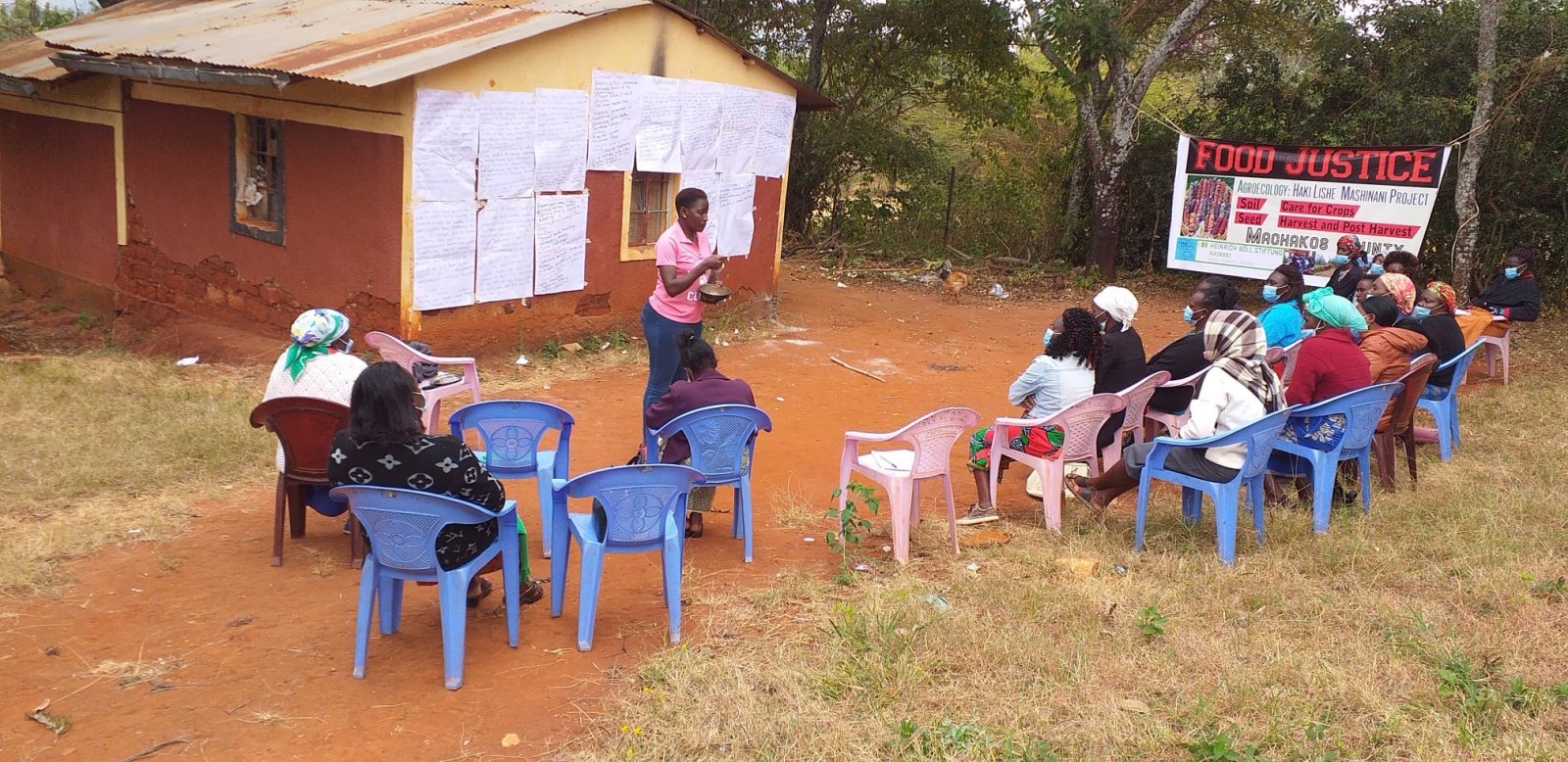
In Africa , many farmers do not use protective devices when spraying chemicals , some do not have boots , others do not have masks and many are illiterate and cannot fathom what the instructions on the pesticide packages say. As one case was shared during a Food Justice and Agroecology Forum held in Muvuti –Machakos County in Eastern Kenya:
“a young man in our village in Muvuti spayed pesticides at 11 am , he did not have a mask and did not take milk after spraying. He started feeling dizzy and went to rest , he never woke up again, he died. This happened 4 years ago”. Such one of the realities of many farming communities who get enticed to use pesticides but lack protective gear. Isn’t it about time the world transformed to a healthier and more sustainable food systems?
Industrial food systems continue to push for GM seeds , but the world hunger continues to rise , why this contradiction? According to the State of World Food Report (SOFI2021), the prevalence of undernourishment (PoU) increased from 8.4 to around 9.9 percent in just one year[6], It is projected that between 720 and 811 million people in the world faced hunger in 2020. Considering the middle of the projected range (768 million), around 118 million more people were facing hunger in 2020 than in 2019 – or as many as 161 million more.[7]The hunger and incidences of global malnutrition is glaring, whereas one part of the world is wasting food, other parts are going hungry. SOFI2021 continues to note that Hunger affects 21.0 percent of the population in Africa, compared with 9.0 percent in Asia and 9.1 percent in Latin America and the Caribbean. In terms of numbers, more than half of the world’s undernourished are found in Asia (418 million) and more than one-third in Africa (282 million). Compared with 2019, about 46 million more people in Africa, 57 million more in Asia, and about 14 million more in Latin America and the Caribbean were affected by hunger in 2020.Isn’t this real enough to make us change how we produce and consumer our food? The industrial food system often focuses on profit maximisation, they always push for Distinctiveness Uniformity and Standardisation, this excludes biodiversity and this monoculture approach is responsible for loss of nutrients for example in the soil, making farmers permanent customers to agrovets in search of additives to put on their dead soil.
It is very important to speak out against the dangers in our food systems , to provide workable alternatives and give voice to smallholder farmers from whom 80% of the food we eat comes from .It is critical that we use every opportunity to correct the wrongs in our food system , it can be as simple as bringing a group of women together to reflect on where their seeds comes from , to a conversation with students on what determines what they eat , to a practical session with farmers on how to make a compost in order to reduce their footprints to the agrovet , is it about writing articles about the experiences of farmers in your village or neighbourhood and how different in taste meat you buy in the village is different from what you buy in the city.It is also about being conscious on where your food comes from.
References
[1] https://qz.com/africa/590973/on-the-menu-in-kenya-kale-laced-with-lead-a...
[2] https://www.epubzone.org/what-is-carbide-used-for/
[3] https://en.wikipedia.org/wiki/Mandazi#:~:text=Mandazi%20(Swahili%3A%20Mandazi
[4] https://www.reuters.com/article/kenya-electricity-idUSL6N0U81JB20141227
[5] http://www.fao.org/3/y5609e/y5609e02.htm
[6] http://www.fao.org/3/cb4474en/online/cb4474en.html#chapter-2_1
[7] ibid
Video Credit@ Route to Food Initiative https://www.youtube.com/watch?v=4YO_OsJKFKg
https://www.youtube.com/watch?v=4YO_OsJKFKg
- Leadership
- Environment
- Health
- Human Rights
- Africa